



Wake-up call for automakers as cumulative EV sales top $1-trillion

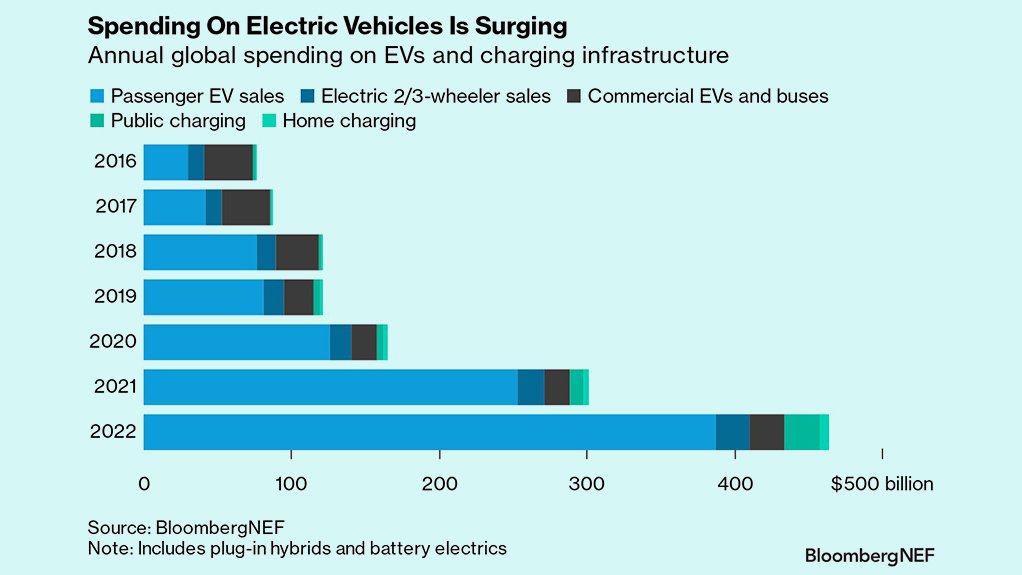


Global spending on electric vehicles (EVs) is surging. According to a new report published by BloombergNEF on investment in the energy transition, annual spending on passenger EVs hit $388-billion in 2022, up 53% from the year before.
With the 2022 tally included, the value of electric vehicles sold to date in the passenger vehicle segment has now crossed $1-trillion. At the most basic level, if an automaker didn’t have a decent EV strategy, they missed out on their share of a trillion-dollar revenue opportunity over the last decade.
That sounds like a big number, but global auto sales are worth around $2.5-trillion a year. So, over the last ten years since EVs first showed up in the modern era, the value of total car sales has been roughly $25-trillion. In that context, the cumulative value of EV sales is relatively modest. Total profits from EVs also are much lower.
Still, growth rates matter, and almost 60% of total EV spending occurred in just the last 18 months. This year will break records again, with passenger EV sales likely to comfortably exceed $500-billion. This is now a very material, very fast-moving part of global auto sales.
The auto industry operates on long product cycles. While it feels like there’s a constant stream of new products, many are just cosmetic updates to existing models. To understand product cycles and what happens next, it’s important to look at vehicle platforms.
High-volume automakers develop new platforms that underpin vehicles over what is usually a six- to ten-year period. The platforms take years to develop, cost billions of dollars and ideally are versatile, allowing automakers to use different body structures catering to a wider variety of consumer preferences. These platforms also allow for component sharing across many models, which is a necessary part of the cutthroat economics of building vehicles at scale.
Long development cycles also mean if an automaker has been caught wrongfooted, it can take a while to realise the full impact of mistakes. The trillion-dollar EV sales mark is probably the point where it becomes clear that some automakers made the wrong bets.
Japanese automakers illustrate this well. All of the Japanese brands combined sold less than 5% of the EVs purchased globally last year, and none were among the top ten EV brands by volume. This wasn’t a problem in 2019, when plug-in vehicles were just 2.6% of global auto sales, but it’s worrisome when they’ll likely be closer to 18% of sales in 2023.
It’s even more extreme in China, where EVs will likely be over 30% of sales this year, up from just 5% in 2019. That’s a huge change in a timeframe well within the normal life cycle of a vehicle platform. Japanese automakers’ market share in China is now starting to slip, to 21% of new-vehicle sales last year from 25% in 2020.
Alarm bells are ringing at the Japanese automakers now, with Honda revamping its EV strategy and Toyota installing new management preaching an EV-first strategy.
Changing course will take a while. Toyota has said it won’t have a new dedicated EV platform ready for launch until 2027. While that might get accelerated, it reflects the timescales traditional automakers operate on.
Toyota may well still succeed. The company has shown impressive adaptability over its 85-year history, but the point here is that the next vehicle cycle is absolutely critical to turning the ship around. If it misses the mark, the consequences will be dire.
Many other automakers face a similar situation, with their platforms for models due to arrive from 2026 to 2028 largely set. It will take a few years to find out if they’ve made the right bets.
There are still many challenges ahead as EV sales take off. Only about 3% of the 1.3-billion passenger cars on the road globally will be electric at the end of this year. Soaring demand is also placing real strains on the battery supply chain and public charging infrastructure.
Article Enquiry
Email Article
Save Article
Feedback
To advertise email advertising@creamermedia.co.za or click here
Research Reports

Projects


Latest Multimedia


Latest News
Showroom

Industrial Nozzles & Systems (Pty) Ltd (Est. 2000) exclusive representative in Southern Africa for LECHLER GmbH (Est. 1879) - Europe's leading...
VISIT SHOWROOM
ATI systems comprises five divisions: electrical assemblies, drives and controls, feedback sensors, enclosures, and strip guiding.
VISIT SHOWROOM



Press Office
Announcements
What's On
Subscribe to improve your user experience...
Option 1 (equivalent of R125 a month):
Receive a weekly copy of Creamer Media's Engineering News & Mining Weekly magazine
(print copy for those in South Africa and e-magazine for those outside of South Africa)
Receive daily email newsletters
Access to full search results
Access archive of magazine back copies
Access to Projects in Progress
Access to ONE Research Report of your choice in PDF format
Option 2 (equivalent of R375 a month):
All benefits from Option 1
PLUS
Access to Creamer Media's Research Channel Africa for ALL Research Reports, in PDF format, on various industrial and mining sectors
including Electricity; Water; Energy Transition; Hydrogen; Roads, Rail and Ports; Coal; Gold; Platinum; Battery Metals; etc.
Already a subscriber?
Forgotten your password?
Receive weekly copy of Creamer Media's Engineering News & Mining Weekly magazine (print copy for those in South Africa and e-magazine for those outside of South Africa)
➕
Recieve daily email newsletters
➕
Access to full search results
➕
Access archive of magazine back copies
➕
Access to Projects in Progress
➕
Access to ONE Research Report of your choice in PDF format
RESEARCH CHANNEL AFRICA
R4500 (equivalent of R375 a month)
SUBSCRIBEAll benefits from Option 1
➕
Access to Creamer Media's Research Channel Africa for ALL Research Reports on various industrial and mining sectors, in PDF format, including on:
Electricity
➕
Water
➕
Energy Transition
➕
Hydrogen
➕
Roads, Rail and Ports
➕
Coal
➕
Gold
➕
Platinum
➕
Battery Metals
➕
etc.
Receive all benefits from Option 1 or Option 2 delivered to numerous people at your company
➕
Multiple User names and Passwords for simultaneous log-ins
➕
Intranet integration access to all in your organisation
