



Sasol outlines 600 MW own-gen proposal in response to DMRE RFI

Sasol CEO Fleetwood Grobler on the need for a culture change at the company following major cost overruns at its US project. Camera Work: Kutlwano Matlala. Editing: Nicholas Boyd. Recorded: 24.2.2020
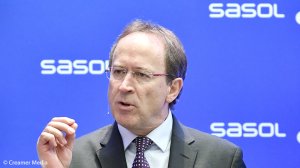


Sasol CEO Fleetwood Grobler confirmed late last month that the energy and chemicals group had made a submission to the Department of Mineral Resources and Energy in line with its request for information (RFI) on possible emergency electricity solutions that could be “grid-connected in the shortest time at the least possible cost”.
The RFI closed at the end of January and Mineral Resources and Energy Minister Gwede Mantashe announced last month that 481 responses had been received, outlining supply and demand solutions to close an immediate supply shortfall of 2 000 MW.
Grobler told Engineering News & Mining Weekly that Sasol’s submission outlined a proposal for increasing self-generation across its South African production locations, which could reduce its demand and free up capacity for Eskom to supply other consumers.
Overall, Sasol’s operations in Secunda, in Mpumalanga, and Sasolburg, in the Free State, required 1 200 MW of electricity. Sasol already generated 600 MW of that internally and Grobler indicated that it had plans that could make it entirely self-sufficient.
These plans included the development of wind and solar photovoltaic (PV) generators either adjacent to its Secunda and Sasolburg complexes or wheeled from areas where the wind and solar resources were more potent. To complement these two variable power generation technologies, Sasol envisaged introducing additional gas-fired power generation capacity.
Grobler said Sasol was considering both direct investments into power generation and entering into multidecade power purchase agreements with independent power producers.
“We would be open to having this capacity installed by others and we are already in the market for two 10 MW solar PV facilities in Sasolburg and Secunda.”
Sasol had capped the developments to 10 MW, owing to the prevailing regulatory uncertainty for projects larger than that.
However, Grobler was heartened by Mantashe’s recent announcement that there would be no limit for self-generation projects above 1 MW. That said, the Minister had not yet outlined specifics regarding the wheeling or trading of power from such plants, which would be key to facilitating investments.
“At the moment, we are looking primarily at sites around our facilities, but there seems to be a greater openness to the wheeling of power and, if there is an option to wheel, of course, we would look at bringing in power from more sun-drenched areas.”
Renewable energy would also feature in Sasol’s evolving ‘Sustainability Roadmap’, details of which would be released at the group’s capital markets day in November.
In 2019, Sasol released a climate report in which it committed to reducing its greenhouse-gas emissions by 10% by 2030 relative to its 2017 emissions baseline.
The plan had been widely criticised as inadequate and Grobler said the roadmap would outline an “ambitious vision for sustainability and a viable pathway to deliver it, given the significant stakeholder ramifications”.
Key areas of focus would be the utility blocks at Sasolburg and Secunda, which, besides generating steam and electricity, were responsible for 50% of emissions. The other focus area would be process emissions, which arise primarily from the gasification of coal, which is then used as a feedstock in the production of fuels and chemicals.
Grobler said Sasol was keeping tabs on developments for producing green hydrogen from renewable electricity and water rather than from gas or coal, which could assist in reducing its emissions. He stressed, however, that these processes remained significantly more expensive than the conventional routes for producing hydrogen.
“All oil and gas companies are in the same boat. There is pressure from society and from investors and we are not excluded from that pressure. In our case, though, coal is an aggravating circumstance . . . as are the socioeconomic implications of moving away from coal. Our approach is to look at what are the practical realities, how we deal, justly, with the socioeconomic impacts of those realities and to assess what the viable options are for sourcing an alternative feedstock to coal, namely gas.”
What he confirmed, however, was that Sasol had decided that its coal mines remained core and would not be sold as part of the ongoing portfolio restructuring, expected to release some $2-billion in sale proceeds.
Article Enquiry
Email Article
Save Article
Feedback
To advertise email advertising@creamermedia.co.za or click here
Research Reports

Projects
Latest Multimedia
Latest News
Showroom
Rentech provides renewable energy products and services to the local and selected African markets. Supplying inverters, lithium and lead-acid...
VISIT SHOWROOM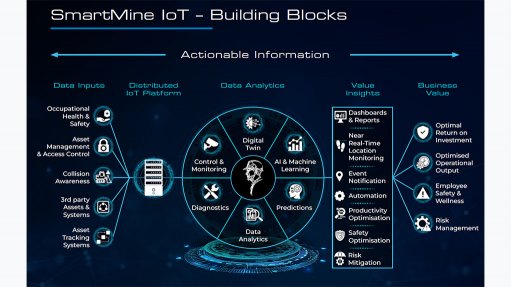
SmartMine IoT has been developed with the mining industry in mind, to provides our customers with powerful business intelligence and data modelling...
VISIT SHOWROOM
Press Office
Announcements
What's On
Subscribe to improve your user experience...
Option 1 (equivalent of R125 a month):
Receive a weekly copy of Creamer Media's Engineering News & Mining Weekly magazine
(print copy for those in South Africa and e-magazine for those outside of South Africa)
Receive daily email newsletters
Access to full search results
Access archive of magazine back copies
Access to Projects in Progress
Access to ONE Research Report of your choice in PDF format
Option 2 (equivalent of R375 a month):
All benefits from Option 1
PLUS
Access to Creamer Media's Research Channel Africa for ALL Research Reports, in PDF format, on various industrial and mining sectors
including Electricity; Water; Energy Transition; Hydrogen; Roads, Rail and Ports; Coal; Gold; Platinum; Battery Metals; etc.
Already a subscriber?
Forgotten your password?
Receive weekly copy of Creamer Media's Engineering News & Mining Weekly magazine (print copy for those in South Africa and e-magazine for those outside of South Africa)
➕
Recieve daily email newsletters
➕
Access to full search results
➕
Access archive of magazine back copies
➕
Access to Projects in Progress
➕
Access to ONE Research Report of your choice in PDF format
RESEARCH CHANNEL AFRICA
R4500 (equivalent of R375 a month)
SUBSCRIBEAll benefits from Option 1
➕
Access to Creamer Media's Research Channel Africa for ALL Research Reports on various industrial and mining sectors, in PDF format, including on:
Electricity
➕
Water
➕
Energy Transition
➕
Hydrogen
➕
Roads, Rail and Ports
➕
Coal
➕
Gold
➕
Platinum
➕
Battery Metals
➕
etc.
Receive all benefits from Option 1 or Option 2 delivered to numerous people at your company
➕
Multiple User names and Passwords for simultaneous log-ins
➕
Intranet integration access to all in your organisation
