NMU centre acquires new microscopes to boost condition monitoring services to industry

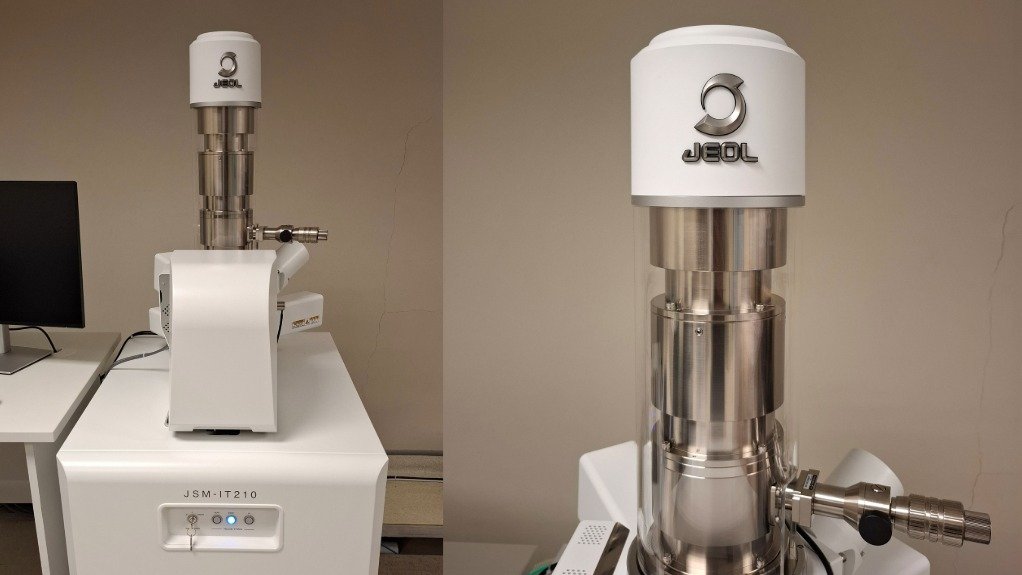


The Nelson Mandela University (NMU) Faculty of Science's Centre for High Resolution Transmission Electron Microscopy (CHRTEM) has received the first of two new scanning electron microscopes (SEMs) from manufacturer Japan Electron Optical Laboratories (JEOL).
A second, larger SEM is scheduled for delivery in May.
“We have worked with JEOL since the start of CHRTEM 15 years ago,” says Professor Jaco Olivier, director of the CHRTEM – a national infrastructure platform supported by the Department of Science, Technology and Innovation (DSTI) and the National Research Foundation (NRF), providing national and international support to industry, academia and research centres.
“We are an imaging facility that studies materials at a microscopic scale down to the atomic level. We are the eyes to the unseeable – the tiniest components in a variety of material types, including catalysts, nanomedicines and minerals, and structural materials such as titanium, aluminium, steel and nickel alloys. We analyse and research the microscopic structures of materials and how they relate to material properties and performance," he points out.
In December 2025, Olivier and CHRTEM facility manager Dr Arno Jansen van Vuuren accompanied JEOL’s agent in South Africa, Angstrom Scientific, on a visit to Japan to JEOL’s manufacturing site where they had demonstrations on the two SEMs and other instruments the centre was considering replacing over the next few years.
“Monitoring the state of materials with electron microscopes equipped with unique detector technology is essential to see if they are maintaining their material properties under a range of conditions,” Olivier explains.
Modern scientific and industrial applications use a range of materials, engineered at the microscopic scale to yield specific properties suitable for their application in harsh operational environments. Any changes in the microstructure, and by extension the properties, can lead to a catastrophic failure of the materials, impacting safety, commercial output, business performance and the huge associated infrastructure costs, such as in power plants.
SEMs are extensively used at the CHRTEM to investigate structural materials, particularly steels and aluminium alloys. In the case of aluminium, the facility works closely with local industry partners such as Hulamin, providing critical insights into the condition of materials at various stages of production. By enabling detailed evaluation of microstructural features, SEM analysis helps ensure that end products meet required specifications while also supporting the optimisation of manufacturing processes.
“Another partnership within the university and nationally is on green hydrogen. We use imaging to assist research groups in designing new materials and catalysts. One example relates to hydrogen safety as it will have to be stored in vessels under immense pressure and cryogenic temperatures. We look at the interaction of hydrogen in steels (proposed as the vessel material) at these pressures and temperatures to evaluate the integrity and possible degradation mechanisms of the steel, as it could be catastrophic if a vessel fails.”
The facility is in constant use by a range of disciplines, including physics, engineering, zoology, biochemistry, physiology, medicine and more. One of the centre's strategic partnerships is with the DSTI nanomedicine platform in the Medical School at NMU to investigate and produce a range of experimental nanomedicines for the treatment of diseases like cancer and tuberculosis, as well as diabetic wounds.
In addition, the centre’s SEM capabilities support a range of marine research initiatives in collaboration with the Mandela University Institute for Coastal and Marine Research. These include projects focused on the identification and description of new oceanic invertebrate species, as well as studies on marine diatom ecology and taxonomy, the development of diatom-based indices for assessing environmental health and disturbance, and bioprospecting for valuable diatom-derived products.
A notable recent outcome is the development of an otolith atlas of marine fishes, produced through a collaboration between the Port Elizabeth Museum at Bayworld, in Gqeberha, and the Department of Zoology and Institute for Coastal and Marine Research, at NMU. An otolith is a hard, calcium carbonate structure found in the inner ear of vertebrates, primarily known for its role in fish balance, orientation, and hearing. In fish, they grow daily, acting like tree rings to determine age.
The atlas incorporates high-resolution images generated using SEMs at the CHRTEM to achieve detailed micrographs of fish otoliths, significantly enhancing the quality and scope of the atlas following the publication of its first edition.
Over the past 15 years, the CHRTEM has logged more than 30 000 instrument hours for research and supported almost 1 000 postgraduate students with their research or training, produced close to 300 peer-reviewed articles and engaged in over 600 conference proceedings – including national and international presentations and lectures.
“We are now in a phase of renewal as the instruments in the lab are getting beyond their factory support period and need replacing. These new SEMs are the first step in this process,” says Olivier, adding that NMU funded most of the cost of these with support from the DSTI and NRF.
To inspect the SEMs, Olivier and Jansen van Vuuren travelled to Tokyo and then to a city on its western outskirts called Tachikawa where JEOL is situated. “The company is very impressive and incredibly well run, and the people, as is the case throughout Japan, are incredibly helpful and friendly in a polite way," comments Olivier.
He adds that few places in the world can live up to the standard of Japanese engineering. “We have had great success working with JEOL all these years. They do not bring anything to market unless it is the best and we witnessed the professionalism and skill with which they design and operate the instruments.”
Once the two new SEMs are set up at the CHRTEM, a Japanese engineer from JEOL will visit the centre to do the final setup. Together with Angstrom Scientific in South Africa, JEOL offers comprehensive service support, including remote diagnostics where applicable.
Down the line, the CHRTEM is also planning to replace its aberration-corrected transmission electron microscope (TEM) at an investment of more than R100-million. “Our current model is still incredibly good but the new generation is much more stable, the speed of acquisition and amount of signal acquired is substantially better, and the images are sharper,” Olivier explains.
“The CHRTEM is the only facility in Africa that has an aberration-corrected TEM, whereas Europe and China have hundreds of them, and they replace them every seven or eight years because it is such a rapidly developing technology. It is incredibly important that South Africa continue to invest in this technology as it is a critical national capability needed to remain globally competitive,” he asserts.
Article Enquiry
Email Article
Save Article
Feedback
To advertise email advertising@creamermedia.co.za or click here
Research Reports
Projects


Latest Multimedia
Latest News
Showroom
North Ridge Pumps is an independent manufacturer of pumps. We have a proven track record for product support and customer service throughout the...
VISIT SHOWROOM
Occupational health services, mobile clinics, wellness campaigns, aviation.
VISIT SHOWROOM


Announcements
What's On
Subscribe to improve your user experience...
Option 1 (equivalent of R125 a month):
Receive a weekly copy of Creamer Media's Engineering News & Mining Weekly magazine
(print copy for those in South Africa and e-magazine for those outside of South Africa)
Receive daily email newsletters
Access to full search results
Access archive of magazine back copies
Access to Projects in Progress
Access to ONE Research Report of your choice in PDF format
Option 2 (equivalent of R375 a month):
All benefits from Option 1
PLUS
Access to Creamer Media's Research Channel Africa for ALL Research Reports, in PDF format, on various industrial and mining sectors
including Electricity; Water; Energy Transition; Hydrogen; Roads, Rail and Ports; Coal; Gold; Platinum; Battery Metals; etc.
Already a subscriber?
Forgotten your password?
Receive weekly copy of Creamer Media's Engineering News & Mining Weekly magazine (print copy for those in South Africa and e-magazine for those outside of South Africa)
➕
Recieve daily email newsletters
➕
Access to full search results
➕
Access archive of magazine back copies
➕
Access to Projects in Progress
➕
Access to ONE Research Report of your choice in PDF format
RESEARCH CHANNEL AFRICA
R4500 (equivalent of R375 a month)
SUBSCRIBEAll benefits from Option 1
➕
Access to Creamer Media's Research Channel Africa for ALL Research Reports on various industrial and mining sectors, in PDF format, including on:
Electricity
➕
Water
➕
Energy Transition
➕
Hydrogen
➕
Roads, Rail and Ports
➕
Coal
➕
Gold
➕
Platinum
➕
Battery Metals
➕
etc.
Receive all benefits from Option 1 or Option 2 delivered to numerous people at your company
➕
Multiple User names and Passwords for simultaneous log-ins
➕
Intranet integration access to all in your organisation