



CSIR has developed add-on protection for armoured vehicles

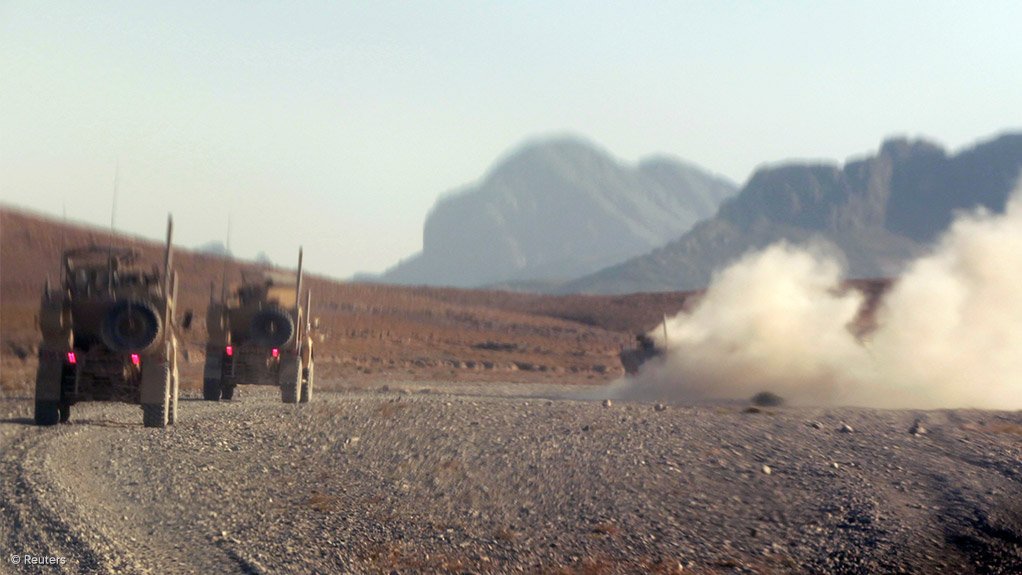



The Council for Scientific and Industrial Research (CSIR) has successfully developed a counter-improvised explosive device (IED) shaped charge protection system for vehicles. This was reported on Thursday at the CSIR Conference in Pretoria by Rayeesa Ahmed, research group leader for protection and survivability systems.
The project was to develop a system that would provide protection against a medium-sized explosively-formed projectile (EFP) IED threat. EFPs, also called explosively-formed penetrators, are the IED equivalent of shaped charges in regular munitions. Both operate on the same principle of focusing the power of an explosion. A metal liner, usually cone- or dish-shaped, is placed in front of the explosive charge and when the explosive is detonated this liner focuses the explosion and becomes a metal "slug" that is shot at the target at a very high velocity. Because the energy of the explosion is focused, an IED that produces an EFP can do much greater damage to an armoured vehicle than one that just produces blast effects.
"IEDs have become the number one choice of attack by insurgents," she pointed out. This applied to Africa as well. "We're looking at an average of 38 [IED] detonations a month, in Africa."
For the CSIR team, a medium-sized EFP is one produced by an IED with a diameter of 120 mm. "To define the protection solution, you need to characterise the threat," she pointed out. "No two IEDs are the same." So the team had to design and develop surrogate EFPs, so that they could reliably repeat the threat, for test and development purposes.
The key characteristics of EFPs are their mass, speed and shape. "A good solution needs to be able to break up or change the shape of the projectile, or slow it down," she explained. Achieving any of these would prevent the projectile from piercing the vehicle's armour. Just increasing the thickness of the conventional armour would increase the vehicle's weight and reduce its mobility and thus usefulness.
Building on years of research already done by the CSIR, the team have developed and tested a panel that stops EFPs and prevents them penetrating the target vehicle. However, Ahmed will not reveal how it is produced and what material or materials it employs. Nor will she reveal whether it slows or deforms or breaks up the EFP.
"It is a successfully developed panel; the development is complete," she noted. "It is an add-on protective package." That is, the panels are added to the outside of the vehicle's existing armour.
Article Enquiry
Email Article
Save Article
Feedback
To advertise email advertising@creamermedia.co.za or click here
Research Reports

Projects


Latest Multimedia


Latest News

Showroom

Sulzer South Africa, established in 1922, partners with critical industries like power, oil & gas, water, mining, and chemicals to boost...
VISIT SHOWROOM
The Steel Tube Export Association of South Africa was established to develop sustainable, internationally competitive carbon steel tube and pipe...
VISIT SHOWROOM



Press Office
Announcements
What's On
Subscribe to improve your user experience...
Option 1 (equivalent of R125 a month):
Receive a weekly copy of Creamer Media's Engineering News & Mining Weekly magazine
(print copy for those in South Africa and e-magazine for those outside of South Africa)
Receive daily email newsletters
Access to full search results
Access archive of magazine back copies
Access to Projects in Progress
Access to ONE Research Report of your choice in PDF format
Option 2 (equivalent of R375 a month):
All benefits from Option 1
PLUS
Access to Creamer Media's Research Channel Africa for ALL Research Reports, in PDF format, on various industrial and mining sectors
including Electricity; Water; Energy Transition; Hydrogen; Roads, Rail and Ports; Coal; Gold; Platinum; Battery Metals; etc.
Already a subscriber?
Forgotten your password?
Receive weekly copy of Creamer Media's Engineering News & Mining Weekly magazine (print copy for those in South Africa and e-magazine for those outside of South Africa)
➕
Recieve daily email newsletters
➕
Access to full search results
➕
Access archive of magazine back copies
➕
Access to Projects in Progress
➕
Access to ONE Research Report of your choice in PDF format
RESEARCH CHANNEL AFRICA
R4500 (equivalent of R375 a month)
SUBSCRIBEAll benefits from Option 1
➕
Access to Creamer Media's Research Channel Africa for ALL Research Reports on various industrial and mining sectors, in PDF format, including on:
Electricity
➕
Water
➕
Energy Transition
➕
Hydrogen
➕
Roads, Rail and Ports
➕
Coal
➕
Gold
➕
Platinum
➕
Battery Metals
➕
etc.
Receive all benefits from Option 1 or Option 2 delivered to numerous people at your company
➕
Multiple User names and Passwords for simultaneous log-ins
➕
Intranet integration access to all in your organisation
