



Copper prices continue to decline amid global economic caution – report


JOHANNESBURG (miningweekly.com) – The price of copper slumped by almost 10% during 2012, and has effectively been in a sideways trading range since the fourth quarter of 2011, the Thomson Reuters GFMS Copper Survey 2013 has revealed.
By the end of the first quarter of 2013, the copper price had declined a further 5% from the start of the year, said the survey, which was released on Tuesday in Chile.
Thomson Reuters GFMS Base Metals Research and Forecasts head Sanjay Saraf said that continued uncertainty surrounding the eurozone had recently been exacerbated by the eruption of the Cypriot debt and banking crisis, which had, together with ongoing caution regarding the economic outlook for both the US and China, kept sentiment in the copper, and the broader commodities market, on the back foot.
“Adding to this, on the fundamentals front, has been a rise in global exchange stocks and in our estimate of copper inventories in Chinese-bonded warehouses in 2012,” he said.
Saraf believed that prices could spend much of this year within their recent broad trading range; however, growing negative market sentiment weights risk to the downside, with around $6 500 as a potential level of support if selling intensified.
Production Upswing
Global mine production grew by 4% to 16.7-million tonnes last year after posting two consecutive years of barely positive growth.
“This was the highest yearly increase since 2004,” noted Saraf.
In 2012, shortfalls in targeted production were characterised by a net
fall in grades and recoveries rather than unexpected disruptions and the survey argued that this was more representative of a longer term structural trend in
the industry.
Meanwhile, world refined copper supply increased by 2% to 20.06-million tonnes and, in contrast to mine supply, represented a decline in the rate of growth when compared to the previous two years.
This also corresponded with a moderation in the rate of supply from secondary sources, although total production from scrap of 3.6-million tonnes was still 3% higher than 2011.
Production from solvent extraction and electrowinning plants increased at a similar rate to mine output, at 4%.
Global copper consumption totalled 19.8-million tonnes in 2012, up less than 1% year-on-year.
Restrained Demand
The sharp slowdown in the rate of expansion in Chinese demand was a primary factor behind this, with growth halving to 4% last year, as the wider slowdown in economic growth and a high level of downstream product inventories, most notably in the appliances market, weighed on performance.
“The EU was the major area of weakness, with all end-use sectors recording declines, as sovereign debt concerns and stagnation in economic activity
weighed on demand,” Saraf commented.
Overall, the survey revealed that world copper consumption within the building construction sector fell 1% last year, while the electrical and electronic products sector – the largest end-use segment – saw a 2% increase, driven by growth in demand from the power utilities sector in the emerging economies, and China in particular.
The consumer and general products sector was the worst-performing end-use segment in 2012, with consumption sliding 3% on weak demand and high inventories in the appliance market, although robust performance in the tablet and
smartphone sectors helped to restrict further weakness.
Thomson Reuters GFMS estimated that the copper market registered a surplus of 214 000 t in 2012.
Risk Aversity
There was an implied increase in off-exchange stocks, with the bulk of this increase occurring in China, with this inventory having contributed to the capping of the upside for prices through 2013 so far.
Indeed, the report identified that a notable feature of the market last year, which had continued into 2013, was a lower-volatility environment, both for realised and implied volatility.
While primarily driven by the flatter copper price trend, the copper survey also highlighted a more risk-averse stance being adopted by many commodity and macro funds that traded copper, as well as the culling of proprietary trading at major investment banks, as extenuating factors.
“Investment activity is likely to remain an important driver of short-term movements in the copper market, especially as macroeconomic forces and market speculation over further monetary and fiscal loosening globally should promote
continued uncertainty over the course of the year,” Saraf explained.
Such conditions last year saw investors, in aggregate, alternating between periods of net long and short positions.
Current sentiment had shifted to a negative tone, helped by a stronger US dollar, with the trade-weighted index gaining around 4% since the start of the year.
Recent positioning in copper by speculators, as determined by the Commodity Futures Trading Commission, shows a net short that exceeds that built at the height of the post-Lehman financial crisis, in early 2009, when the copper price was trading around $3 000/t.
Higher Costs
The global average cash operating cost continued to trend higher in 2012, according to Thomson Reuters GFMS, rising 14% to $3 527/t.
Marginal cost was measured at $5 512/t and, although this implied an operating margin of 31% from the 2012 copper price of $7 950/t, the report noted that this gap appeared to be closing.
“In last year’s copper survey, we mentioned that the likely near-term trend would be for unit costs to continue to rise above inflation, and this scenario seems to be playing out,” Saraf said.
“Together with the related increase in capital costs, such movement has shifted higher the barriers to entry. Consequently, the economics of the industry do not look quite as attractive as they did perhaps only two years ago. This is already apparent from the decisions taken by some major producers this year in revising plans for new development projects.”
According to Thomson Reuters GFMS, the upward shift in the cost curve in 2012 was more a function of steady increases across all drivers of cost, rather than a seismic shift in any given variable.
Article Enquiry
Email Article
Save Article
Feedback
To advertise email advertising@creamermedia.co.za or click here
Research Reports

Projects


Latest Multimedia


Latest News

Showroom

Design, Construction and Maintenance of Site Erected, Welded Bulk Storage Tanks for the Petrochemical, LNG, Ammonia and Sustainable fuel Sectors.
VISIT SHOWROOM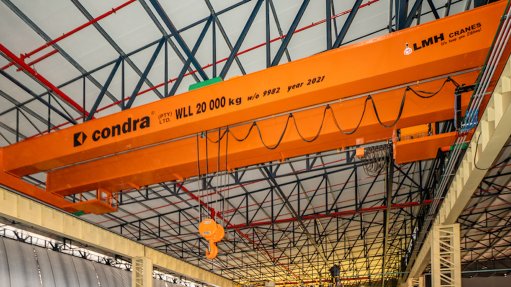
ISO-certified Condra manufactures overhead cranes, portal cranes, cantilever cranes and crane components: hoists, drives, end-carriages, brakes and...
VISIT SHOWROOM



Press Office
Announcements
What's On
Subscribe to improve your user experience...
Option 1 (equivalent of R125 a month):
Receive a weekly copy of Creamer Media's Engineering News & Mining Weekly magazine
(print copy for those in South Africa and e-magazine for those outside of South Africa)
Receive daily email newsletters
Access to full search results
Access archive of magazine back copies
Access to Projects in Progress
Access to ONE Research Report of your choice in PDF format
Option 2 (equivalent of R375 a month):
All benefits from Option 1
PLUS
Access to Creamer Media's Research Channel Africa for ALL Research Reports, in PDF format, on various industrial and mining sectors
including Electricity; Water; Energy Transition; Hydrogen; Roads, Rail and Ports; Coal; Gold; Platinum; Battery Metals; etc.
Already a subscriber?
Forgotten your password?
Receive weekly copy of Creamer Media's Engineering News & Mining Weekly magazine (print copy for those in South Africa and e-magazine for those outside of South Africa)
➕
Recieve daily email newsletters
➕
Access to full search results
➕
Access archive of magazine back copies
➕
Access to Projects in Progress
➕
Access to ONE Research Report of your choice in PDF format
RESEARCH CHANNEL AFRICA
R4500 (equivalent of R375 a month)
SUBSCRIBEAll benefits from Option 1
➕
Access to Creamer Media's Research Channel Africa for ALL Research Reports on various industrial and mining sectors, in PDF format, including on:
Electricity
➕
Water
➕
Energy Transition
➕
Hydrogen
➕
Roads, Rail and Ports
➕
Coal
➕
Gold
➕
Platinum
➕
Battery Metals
➕
etc.
Receive all benefits from Option 1 or Option 2 delivered to numerous people at your company
➕
Multiple User names and Passwords for simultaneous log-ins
➕
Intranet integration access to all in your organisation
