Zuma says Arms Deal commission found no evidence of bribery, corruption and fraud

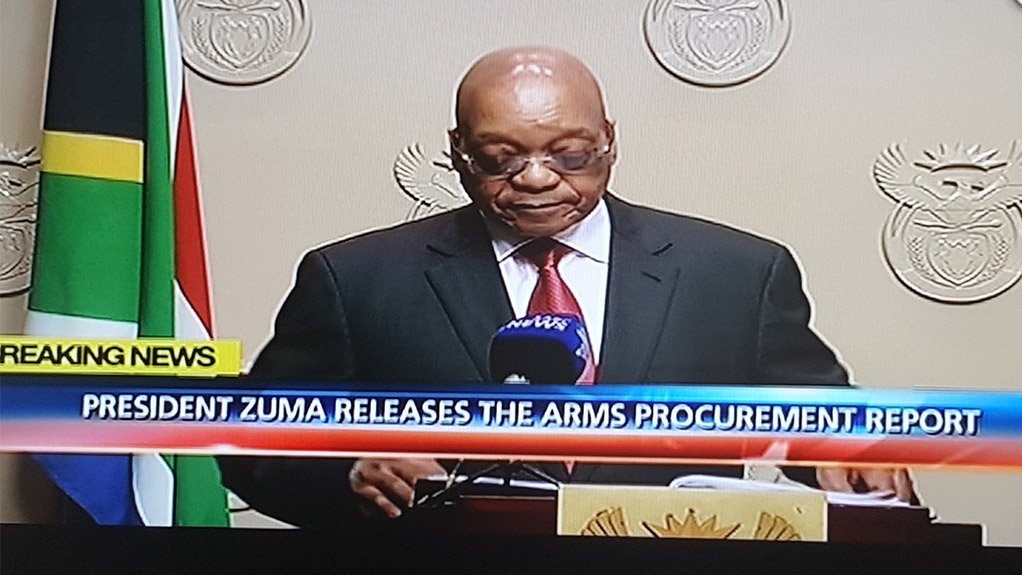


President Jacob Zuma announced on Thursday that the Commission of Inquiry appointed in 2011 to test persistent allegations of corruption in South Africa’s controversial multibillion-rand ‘Arms Deal’, of 1998, found no evidence of impropriety by those involved in the selection of the preferred bidders.
Even more startlingly the commission, headed by Judge Willie Seriti, dismissed suggestions that the equipment was not being fully utilised by the South African National Defence Force (SANDF), and indicated that both the employment and offset commitments associated with the procurement packages had also been substantially met.
The commission, which submitted its final three-volume report to Zuma on December 30, 2015, therefore made no recommendations regarding further prosecution.
Through the deal, which was estimated to cost around R30-billion, in 1999 rand terms, South Africa purchased four Valour-class frigates, three Type-209 submarines, 26 Saab Gripen fighter aircraft, 24 BAe Hawk lead-in fighter-trainers, 30 Agusta A109 light utility helicopters, and four Super Lynx maritime helicopters.
Speaking in a televised address, Zuma said the commission found no evidence that undue or improper influence played a role in the selection of the preferred bidders. In addition, no evidence was presented to show that the procurement process was tainted by any fraud or corruption.
“The commission states that the widespread allegations of bribery, corruption and fraud in the arms procurement process, especially in relation to the selection of the preferred bidders and costs, have found no support or corroboration in the evidence, oral or documentary.”
On the large payments made to consultants and whether those were, in reality, destined for decision-makers in the arms procurement process, the commission indicated that “not a single iota of evidence was placed before it, showing that any of the money received by any of the consultants was paid to any officials involved in the Strategic Defence Procurement Package, let alone any of the members of the Inter-Ministerial Committee that oversaw the process, or any member of the Cabinet that took the final decisions, nor is there any circumstantial evidence pointing to this”.
The commission found that the anticipated offsets had “substantially materialised” and that adequate arrangements were in place to ensure that those which had failed to meet their obligations would do so in future.
“The evidence tendered before the commission indicated that the projected number of jobs to be created through the arms procurement process was achieved,” Zuma added, noting that the number of jobs created or retained were higher than 11 916.
The commission also found that the equipment was necessary for the SANDF to carry out its “Constitutional mandate and international obligations of peace support and peace-keeping”.
“On the question of whether the arms and equipment acquired are under-utilised or not utilised at all, the commission found that all the arms and equipment acquired are well-utilised,” Zuma said – this notwithstanding ongoing reports that the aircraft and submarines in particular, were not being deployed as envisaged.
The outcome of the inquiry – which included public hearings between August 2013 and June 2015 at which 54 witnesses, including former President Thabo Mbeki, appeared – was likely to be treated with a great deal of scepticism, with a number of commentators having warned that it could be a “whitewash”.
MASSIVE DISAPPOINTMENT
The opposition Democratic Alliance (DA) had been particularly critical of the inquiry, while the resignations of a senior investigator in 2013, as well as a researcher and two evidence leaders prior to that, raised questions about the way the inquiry was being managed.
DA shadow finance minister David Maynier described the report is a “massive disappointment”, adding that those implicated in arms-deal corruption, had effectively been let off the hook by the Arms Procurement Commission.
“Today, the expectation that those who were implicated in arms deal corruption, including President Jacob Zuma himself, had nothing to fear from the Arms Procurement Commission, has been proven correct.”
Maynier was particularly unhappy with the commission’s refusal to admit “crucial” documents, such as the final report by Debevoise & Plimpton, which arose from a compliance investigation into Ferrostaal, which was part of the German Submarine Consortium. The report, he said, revealed that Ferrostaal was itself concerned about “questionable and improper payments” to its own consultants.
“The Arms Procurement Commission rejected the allegations in the final report of Debevoise & Plimpton. However, there appears to be no explanation as to why employees of Ferrostaal, alleged to be involved in questionable and improper payments, were not interviewed, and the allegations not properly investigated, by the Arms Procurement Commission.
"And so, despite the Arms Procurement Commission sitting for four years, and consuming more than R113-million, the question still remains, whether any forward payments were made by these consultants, and if forward payments were made by these consultants, who received those forward payments,” Maynier said in a statement.
United Democratic Movement president Bantu Holomisa said the long-awaited report had not surprised anyone. “It only adds to the shelves of South Africa, another whitewashed report whose objective is nothing less than clearing comrades from Luthuli House.”
Holomisa noted that the commission had been marred by resignations, including the resignation of evidence leaders who challenged the credibility of the inquiry.
Zuma, nevertheless, expressed gratitude to Judge Seriti as well as Judge Hendrik Thekiso Musi for “the professional, efficient and effective manner in which they conducted the commission”.
Article Enquiry
Email Article
Save Article
Feedback
To advertise email advertising@creamermedia.co.za or click here
Research Reports

Projects
Latest News
Showroom
Mitsubishi Chemical Advanced Materials South Africa (Pty) Ltd is a leading manufacturer of high-performance engineering plastics for the mining...
VISIT SHOWROOM
Press Office
Announcements
What's On
Subscribe to improve your user experience...
Option 1 (equivalent of R125 a month):
Receive a weekly copy of Creamer Media's Engineering News & Mining Weekly magazine
(print copy for those in South Africa and e-magazine for those outside of South Africa)
Receive daily email newsletters
Access to full search results
Access archive of magazine back copies
Access to Projects in Progress
Access to ONE Research Report of your choice in PDF format
Option 2 (equivalent of R375 a month):
All benefits from Option 1
PLUS
Access to Creamer Media's Research Channel Africa for ALL Research Reports, in PDF format, on various industrial and mining sectors
including Electricity; Water; Energy Transition; Hydrogen; Roads, Rail and Ports; Coal; Gold; Platinum; Battery Metals; etc.
Already a subscriber?
Forgotten your password?
Receive weekly copy of Creamer Media's Engineering News & Mining Weekly magazine (print copy for those in South Africa and e-magazine for those outside of South Africa)
➕
Recieve daily email newsletters
➕
Access to full search results
➕
Access archive of magazine back copies
➕
Access to Projects in Progress
➕
Access to ONE Research Report of your choice in PDF format
RESEARCH CHANNEL AFRICA
R4500 (equivalent of R375 a month)
SUBSCRIBEAll benefits from Option 1
➕
Access to Creamer Media's Research Channel Africa for ALL Research Reports on various industrial and mining sectors, in PDF format, including on:
Electricity
➕
Water
➕
Energy Transition
➕
Hydrogen
➕
Roads, Rail and Ports
➕
Coal
➕
Gold
➕
Platinum
➕
Battery Metals
➕
etc.
Receive all benefits from Option 1 or Option 2 delivered to numerous people at your company
➕
Multiple User names and Passwords for simultaneous log-ins
➕
Intranet integration access to all in your organisation