Modernisation of South African mining is an ‘urgent strategic priority’

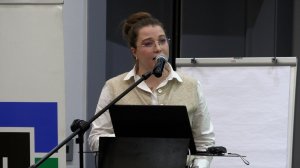
South African mining modernisation presentation covered by Mining Weekly's Martin Creamer. Video: Creamer Media's Shadwyn Dickinson. Video editing: Creamer Media's Nicholas Boyd.
Mine modernisation infographic.
Mine modernisation infographic.
Smelt Direct innovation.


JOHANNESBURG (miningweekly.com) – Mining modernisation, with private and public sectors as drivers, is an urgent strategic priority for the South African economy, a study undertaken by industry leaders, researchers, government partners, and innovators from across the South African spectrum reported very forcefully this week.
“We see that our competitors are investing heavily in digitisation and automation, as well as critical minerals and beneficiation.
“They're moving really quickly, and because they're moving really quickly, they're able to attract a lot of investment,” Research Institute for Innovation and Sustainability (RIIS) consultant Ashleigh Muller reported during the Modernisation Showcase that displayed a strong partnership between Minerals Council South Africa, the Centre for Science, Technology and Innovation Indicators’ specialised research unit within South Africa's Human Sciences Research Council, PwC Smart Mining, the Department of Science, Technology and Innovation, and the National Advisory Council on Innovation. (Also watch attached Creamer Media video.)
“We know that mining is a significant contributor to our national GDP. We also have a really strong mineral wealth endowment. We have established historical markets that we can make use of, and most importantly, we have a legacy of mining experience that we can draw from.
“But the problem is that the benefits that come from these advantages are increasingly being offset by … aging infrastructure, lack of skills, and slow adoption of technology really hinders our ability to be globally competitive.
“I think everyone in this room understands that South Africa … has an adoption and implementation problem. South Africa has the raw materials to lead but the regulatory, skills and technology gaps must be closed with urgency and coordination,” Muller pointed out.
The purpose of the global benchmarking of South African mining was to understand the best practices being undertaken by other mining jurisdictions across the globe and to see what lessons South Africa could learn and implement from them.
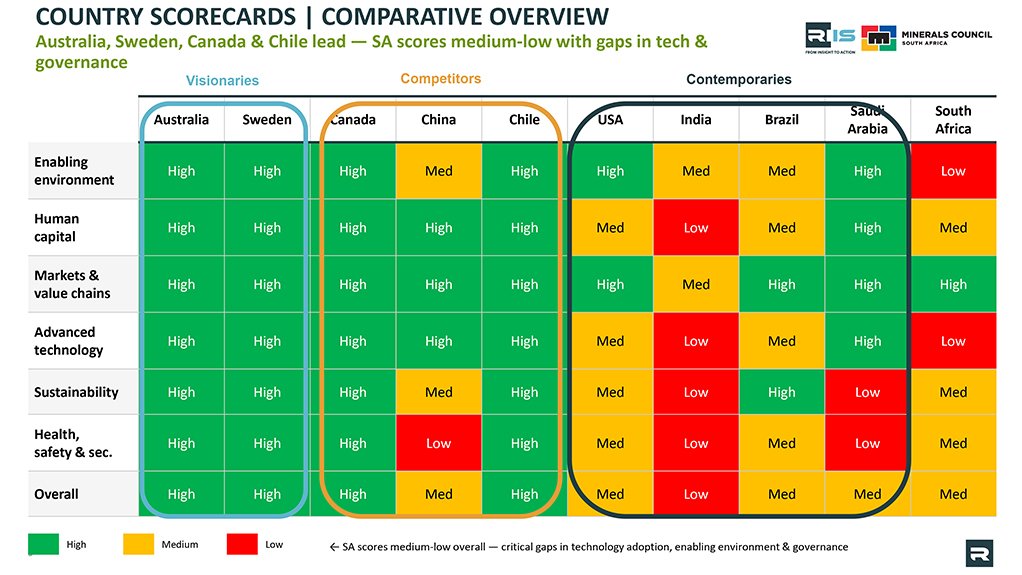
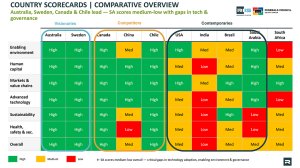
“Not necessarily because we're looking for a copy-paste solution. We understand that each mining jurisdiction is unique, but there are lessons to be learned from each of the nine”, which were classified under the categories of ‘visionaries’ – Australia and Sweden – ‘competitors’ – Canada, China and Chile – and ‘contemporaries’ – US, India, Brazil and Saudi Arabia.
The only ‘green’ achieved by South Africa was in markets and value chains. South Africa’s ‘reds’ were under the headings of ‘enabling environment’ and ‘advanced technology’ and ‘yellows’ in the categories of human capital, sustainability, health, safety and security and exposed were the critical gaps of technology adoption, enabling environment and governance.
INNOVATION PRIORITIES
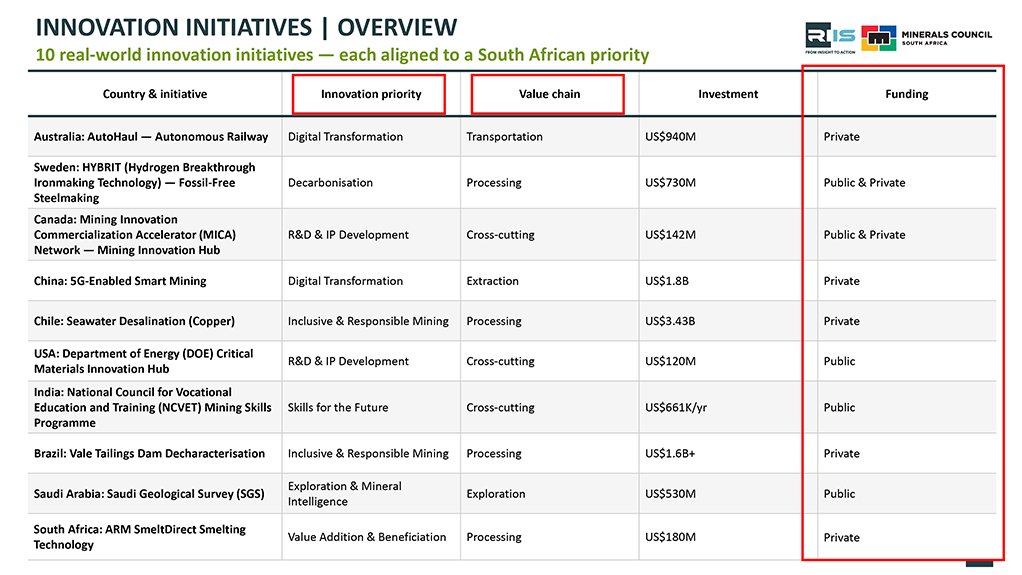
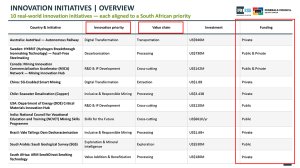
Drawing on work published by South Africa's State-owned Council for Scientific and Industrial Research and public research initiative Mandela Mining Precinct, seven innovation priorities for the uplifting of South Africa's mining sector were identified, namely:
- digital transformation and automation;
- exploration and mineral intelligence;
- research and development intellectual property;
- decarbonisation and energy modernisation;
- inclusive and responsible innovation; and
- value addition and beneficiation.
These priorities align closely with South Africa’s Cabinet-approved Critical Minerals & Metals Strategy, which is designed to create 2.3-million jobs and boost mining's contribution to GDP to 12% by 2030 through local beneficiation, but with success dependent on the resolution of energy, logistics, skills and regulatory issues.
South Africa’s innovation priorities were described as being well-defined but in need of implementation speed, funding, and cross-sector coordination to eradicate:
- Regulatory: more than 5 000 unresolved mining rights and featuring eighty-third out of 180 on the Corruption Index.
- Technology: 10% of deep mines use autonomous vehicles, 25% use AI and digital twins.
- Skills: 18% of engineers are trained in AI and 62% of firms cite a digital skills shortage.
- Beneficiation: only 25% of South Africa’s minerals are processed domestically.
- Infrastructure: Transnet transports 149-million tonnes versus a targeted 185-million tonnes, and 6.8% of output is lost to loadshedding.
Strengths to build on were listed as South Africa's:
- world-leading position in platinum group metals, manganese and chrome reserves.
- robust Johannesburg Stock Exchange (JSE) capital market where more than 40 mining companies are listed.
- widespread environmental, social and governance reporting by 90% of the firms listed on the JSE.
- strong R1.3-trillion private sector investment (2013–2022).
- improving safety record with fatalities down from 104 in 2016 to 41 in 2025.
“South Africa has the raw materials to lead but the regulatory, skills, and technology gaps must be closed with urgency and coordination,” the study found.
“Overall, I think the lesson for South Africa is quite simple – if we want to make progress, we need to move,” Muller emphasised during the presentation covered by Mining Weekly.
SMELT DIRECT INNOVATION
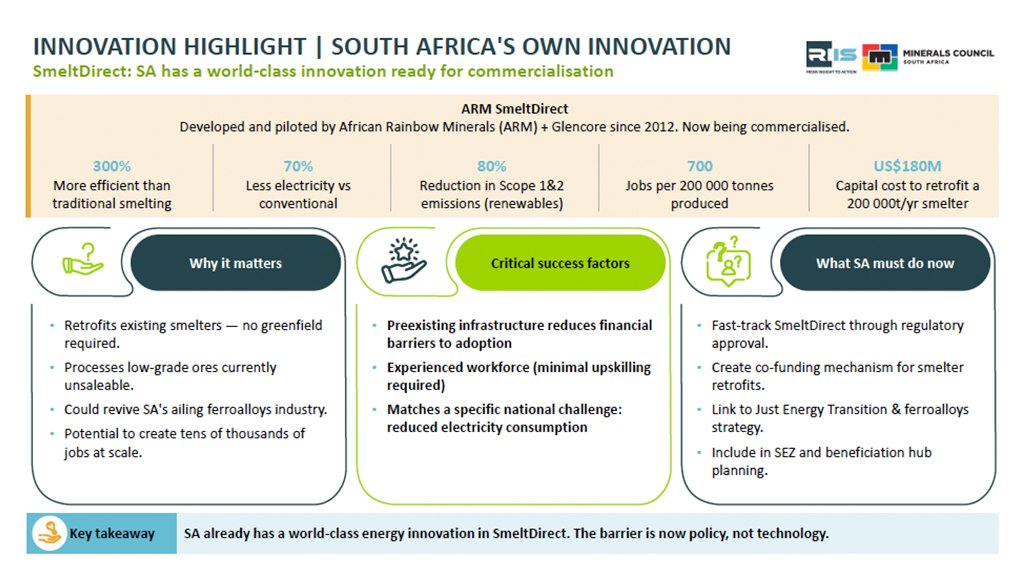
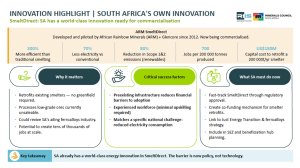
Very interestingly, a remarkable Proudly South African innovation that RIIS spotlighted was the home-grown Smelt Direct technology that has been advanced to commercial phase by African Rainbow Minerals.
What Smelt Direct allows is for ore to be pre-smelted using chemical energy lost in conventional smelting. It is 300% more efficient, 70% less electricity intensive, 80% cleaner and greener, a provider of 700 jobs for every 200 000 t of production, and a solution that can be retrofitted to an existing 200 000 t/y smelter for $180-million, which drastically reduces the cost of implementation.
It also allows for continuation of the existing skill set and matches South Africa’s decarbonisation challenge, an important national priority.
“But even though this is definitely a successful technology, it still needs support. So, what kinds of things can South Africa look to do? Because it's in the commercialisation phase, if there are any regulatory hurdles that exist there, we can look to see what we can do to fast-track those.
“We also need to address the funding gaps. So, what can we do to make co-funding mechanisms that are made more attractive for smelters to want to implement and retrofit their existing operations?
“It's also really interesting to highlight the fact that we can link it to existing supported policy that South Africa has. Sometimes I think we get quite fixated on the fact that South Africa does not have supportive regulation; you'll hear this often. But that's not necessarily the full picture of our regulatory environment at all.
“We can make use of supporting policies such as Just Energy Transition Investment Plan because this has a significant impact on our greenhouse gas emission reduction, and we also can look to leverage the existing economic and industrial infrastructure that we have, such as implementing within special economic zones.
“What I'd like you to take away from this is that South Africa really does have innovative technologies. We do have people who are making strides towards that, but each of these technologies requires support.
“It's really important that we look to understand what the support needs to entail, and I think that this defining of the support comes from the lessons that we learn when we look at all of the initiatives that we case studied.
"When we look at all ten of them, what we're able to see is that successful innovation implementation is not a technology problem at all, it's an ecosystem challenge, and it requires simultaneous and coordinated action in order to build this ecosystem," said Muller.
"Required to build this ecosystem are supportive policy and regulatory environments, strategic investment and access to funding, strong collaborations and partnerships between key stakeholders, available technology as well as the infrastructure to host that technology, skills and organisational capacity, and human capital is essential.
“Then finally – and this is quite a key point – we need to have strategic alignment between our stakeholders and our ESG policies. Without that, we cannot build this ecosystem that needs to drive modernisation forward,” Muller pointed out.
LADDER-CLIMBING ROUTE
Addressing concerns that face South Africa’s mining sector can appear overwhelming, particularly if framed as simultaneous, which prompted the communication of ladder-climbing imagery.
“I'd like to plant in our minds the seed of potential power that coordinated action has through the metaphor about what it takes to climb a ladder. To climb a ladder, we need both hands and both feet to be on individual rungs.
“If we want to leap upwards, that action of climbing has to happen at the same time, coordinating all of our learnings together to move forward.
“If we bring this back to our challenge of building this ecosystem, what we can take away is a really hopeful message, and we have all of the metaphorical rungs that we need to climb this ladder.
“We definitely have the stakeholders and the collaboration partners who are eager to work in this space. We just need to find the right partnerships. We have skilled labour. Yes, there needs to be work done on upscaling and reskilling, but our workforce exists.
“There are supportive regulatory incentives we can make use of, and so this just hammers home the importance of being able to forge an ecosystem that works together to address this challenge."
The upbeat Modernisation Showcase event on July 23 emphasised that modernisation of the vital South African mining industry could only be achieved if uplifted collectively and a space for dialogue, action and positive transformation was created.
Article Enquiry
Email Article
Save Article
Feedback
To advertise email advertising@creamermedia.co.za or click here
Research Reports

Projects
Latest News
Showroom
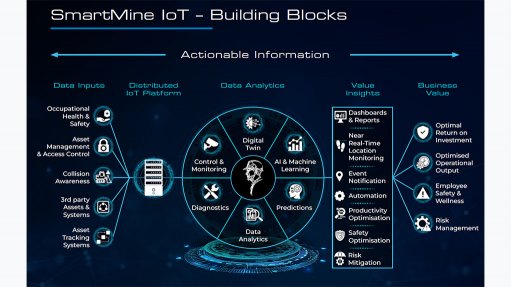
SmartMine IoT has been developed with the mining industry in mind, to provides our customers with powerful business intelligence and data modelling...
VISIT SHOWROOM
Your global lifecycle technology & service partner for materials & minerals processing equipment for coal, iron ore, copper, manganese & other...
VISIT SHOWROOM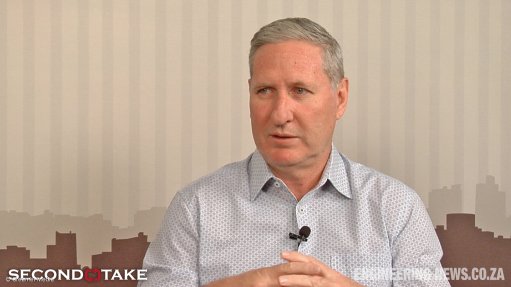

Press Office
Announcements
What's On
Subscribe to improve your user experience...
Option 1 (equivalent of R125 a month):
Receive a weekly copy of Creamer Media's Engineering News & Mining Weekly magazine
(print copy for those in South Africa and e-magazine for those outside of South Africa)
Receive daily email newsletters
Access to full search results
Access archive of magazine back copies
Access to Projects in Progress
Access to ONE Research Report of your choice in PDF format
Option 2 (equivalent of R375 a month):
All benefits from Option 1
PLUS
Access to Creamer Media's Research Channel Africa for ALL Research Reports, in PDF format, on various industrial and mining sectors
including Electricity; Water; Energy Transition; Hydrogen; Roads, Rail and Ports; Coal; Gold; Platinum; Battery Metals; etc.
Already a subscriber?
Forgotten your password?
Receive weekly copy of Creamer Media's Engineering News & Mining Weekly magazine (print copy for those in South Africa and e-magazine for those outside of South Africa)
➕
Recieve daily email newsletters
➕
Access to full search results
➕
Access archive of magazine back copies
➕
Access to Projects in Progress
➕
Access to ONE Research Report of your choice in PDF format
RESEARCH CHANNEL AFRICA
R4500 (equivalent of R375 a month)
SUBSCRIBEAll benefits from Option 1
➕
Access to Creamer Media's Research Channel Africa for ALL Research Reports on various industrial and mining sectors, in PDF format, including on:
Electricity
➕
Water
➕
Energy Transition
➕
Hydrogen
➕
Roads, Rail and Ports
➕
Coal
➕
Gold
➕
Platinum
➕
Battery Metals
➕
etc.
Receive all benefits from Option 1 or Option 2 delivered to numerous people at your company
➕
Multiple User names and Passwords for simultaneous log-ins
➕
Intranet integration access to all in your organisation