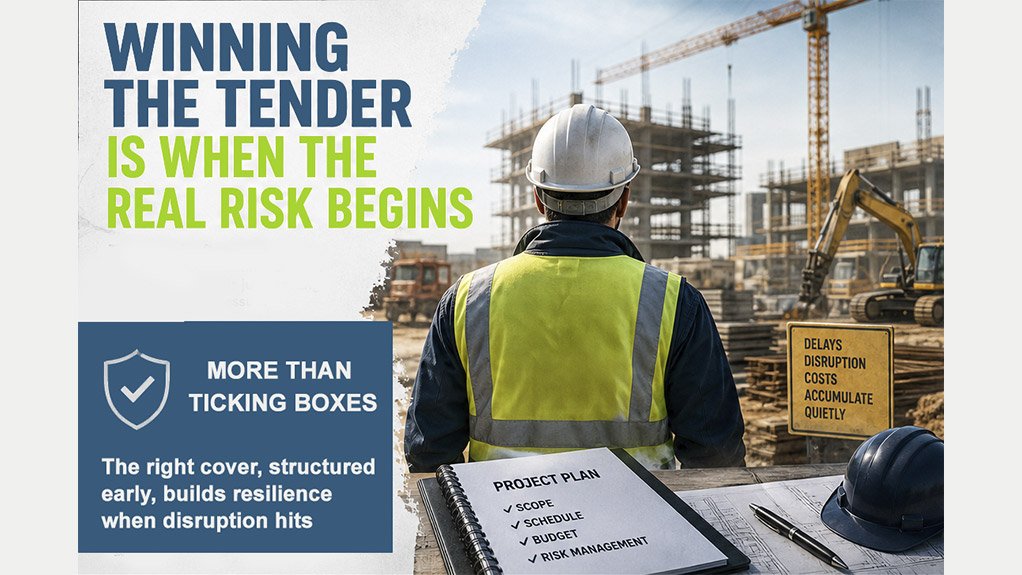
Winning the tender is when the real risk begins




This article has been supplied.
By: Morag Evans - CEO of Databuild
Winning a tender tends to create a sense that things are under control. The project is secured, teams are briefed, and attention shifts quickly to getting work underway. What is less visible at that point is how quickly the risk profile changes.
Recent building failures have brought these risks into sharper focus, but the underlying issue is not what happens when things go wrong. It is what is already in motion long before that point.
In the South African context, the award is often a signal that risk exposure is starting to build. For example, financial commitments must be locked in, operational demands start increasing on the business, and more of the project begins to sit outside the company’s direct control. On paper, the job is just starting. In practice, the pressure has already begun.
An interconnected environment
This impacts the entire delivery chain. Equipment moves between sites. Materials travel long distances before they reach their destination. Subcontractors come and go. Labour is managed under pressure. Each of these introduces its own set of risks, and they do not operate in isolation. It is here where the gap often appears. Insurance is treated as a requirement to be satisfied before work begins, rather than a reflection of whether the project has been fully understood.
Spend time near active sites, and the patterns are clear. Materials do not arrive when expected. Equipment is either delayed or stolen. Invariably, deliveries get disrupted. Sites are forced to pause, not because the work cannot continue, but because something in the chain has broken. The costs do not always show immediately, but they accumulate quietly in the background.
Transport risk alone has become more complex. The movement of goods, particularly over long distances, exposes contractors and manufacturers to increasing levels of disruption. Truck hijackings remain a persistent concern across key routes, affecting not only delivery timelines but also the availability of critical materials. When a delivery does not arrive, it is not just a logistics issue. It affects scheduling, labour allocation, and ultimately project viability.
At the site level, security risks are equally present. Equipment and materials are valuable, often unsecured, and frequently targeted. In some cases, projects are disrupted by organised groups seeking access, influence, or payment. These realities are part of the operating environment in the South African construction sector.
Layer onto that the administrative risks. Contract disputes, delays, and compliance requirements all sit alongside the physical build. When timelines change or costs increase, those pressures come to the fore very quickly. For contractors operating on tight margins, there is very little room to absorb unexpected events.
More than ticking boxes
This is why insurance cannot be approached as a checklist exercise. It is not simply about having a cover in place. It is about whether the right risks have been identified early enough, and whether the project has been structured to absorb disruption.
Cover for plant and machinery, goods in transit, liability, and business interruption should not be afterthoughts. They are indicators of how well the project has been scoped and understood. If those conversations only begin after the tender has been awarded, the process is already reactive.
What is changing in the market is not just the level of risk, but who is carrying it. The construction sector is seeing increased participation from newer contractors entering the tender environment. This is a positive shift in terms of competition and opportunity. Still, it also means that more projects are being delivered by teams that may not yet have experienced the full spectrum of operational risk.
Managing pressure
At the same time, pricing pressure continues. Margins are tighter. Timelines are more demanding. The tolerance for disruption is lower, even as the likelihood of disruption increases. That combination creates a fragile operating environment where small issues can escalate quickly.
From a broader industry perspective, risk is becoming more fragmented. It no longer sits in one obvious place. It moves between logistics, site operations, compliance, and external factors such as security and infrastructure reliability. Managing that requires a more integrated approach, not just to insurance, but to how projects are planned from the outset.
The contractors who navigate this successfully tend to have one thing in common. They do not separate delivery from risk. They treat insurance, logistics, and operational planning as part of the same conversation, not as separate steps in a process.
In construction, outcomes are rarely decided on site alone. They are shaped long before work begins, in the decisions made around planning, coverage, and preparedness. Winning the tender may feel like the milestone that matters. In practice, it is the moment when the risk exposure is revealed.
Article Enquiry
Email Article
Save Article
Feedback
To advertise email advertising@creamermedia.co.za or click here
Research Reports

Projects
Latest Multimedia

Latest News

Showroom
ATI systems comprises five divisions: electrical assemblies, drives and controls, feedback sensors, enclosures, and strip guiding.
VISIT SHOWROOM
Rentech provides renewable energy products and services to the local and selected African markets. Supplying inverters, lithium and lead-acid...
VISIT SHOWROOM

Press Office
Announcements
What's On
Subscribe to improve your user experience...
Option 1 (equivalent of R125 a month):
Receive a weekly copy of Creamer Media's Engineering News & Mining Weekly magazine
(print copy for those in South Africa and e-magazine for those outside of South Africa)
Receive daily email newsletters
Access to full search results
Access archive of magazine back copies
Access to Projects in Progress
Access to ONE Research Report of your choice in PDF format
Option 2 (equivalent of R375 a month):
All benefits from Option 1
PLUS
Access to Creamer Media's Research Channel Africa for ALL Research Reports, in PDF format, on various industrial and mining sectors
including Electricity; Water; Energy Transition; Hydrogen; Roads, Rail and Ports; Coal; Gold; Platinum; Battery Metals; etc.
Already a subscriber?
Forgotten your password?
Receive weekly copy of Creamer Media's Engineering News & Mining Weekly magazine (print copy for those in South Africa and e-magazine for those outside of South Africa)
➕
Recieve daily email newsletters
➕
Access to full search results
➕
Access archive of magazine back copies
➕
Access to Projects in Progress
➕
Access to ONE Research Report of your choice in PDF format
RESEARCH CHANNEL AFRICA
R4500 (equivalent of R375 a month)
SUBSCRIBEAll benefits from Option 1
➕
Access to Creamer Media's Research Channel Africa for ALL Research Reports on various industrial and mining sectors, in PDF format, including on:
Electricity
➕
Water
➕
Energy Transition
➕
Hydrogen
➕
Roads, Rail and Ports
➕
Coal
➕
Gold
➕
Platinum
➕
Battery Metals
➕
etc.
Receive all benefits from Option 1 or Option 2 delivered to numerous people at your company
➕
Multiple User names and Passwords for simultaneous log-ins
➕
Intranet integration access to all in your organisation