Wetility's free municipal grid reliability tool points to stark differences


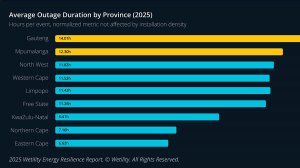


Solar energy company Wetility has released a free-to-use interactive lookup tool that allows anyone to search their municipality and view a detailed electricity outage profile, including average duration, monthly trends and how their area compares with the national average.
South African households experienced an average of six to nine grid outages a month in 2025 and more than 91 000 unique outages were recorded during the year, the company says.
Real-time telemetry data from Wetility’s national network of solar and battery installations show stark disparities in grid reliability across South Africa’s municipalities, with the average power outage lasting less than two hours in some areas and more than 24 hours in others, the company says.
The dataset, published in the Wetility ‘2025 Energy Resilience’ report, covers 57 municipalities across all nine provinces, and measures grid outages at the point of delivery, as well as captures failures across the full chain of generation, transmission and distribution.
The national average outage duration was 12.1 hours, but the range around this average is enormous, it notes.
The findings suggest that, even as national generation performance improved, many households continued to experience localised reliability challenges.
The pattern is consistent with known distribution-side pressures, including ageing infrastructure, maintenance backlogs, theft, vandalism and equipment failure, Wetility adds.
“This data makes clear that the conversation about grid reliability cannot be a national one alone. Many municipalities are operating under significant pressure, with ageing infrastructure, cable theft and revenue-collection constraints and this reality is reflected in the variability we see,” says Wetility chief commercial officer Franta Pour.
“This dataset provides visibility and serves as a way for municipalities, businesses and households to better understand local conditions and make more informed decisions,” he says.
Further, the gap between best- and worst-performing municipalities is significant, he notes.
“We are not looking at marginal differences. In some areas, outages are resolved relatively quickly, while in others they can persist for extended periods. Where you live has a material impact on reliability,” he says.
In the City of Tshwane, in Gauteng, the average outage duration was 15.6 hours, and 69.5% of all outages lasted longer than eight hours.
The City of Johannesburg, also in Gauteng, recorded more than 10 800 outage events in 2025, which is the highest of any municipality in the dataset, Wetility says.
In the Waterberg district, in Limpopo, almost 80% of outages exceeded eight hours, and the area recorded an average duration of 16.4 hours, which is among the longest in the country.
Additionally, the iLembe district, in KwaZulu-Natal, resolved 82.9% of outages within 2 hours, with the average duration of outages being only 2 hours.
By comparison, the Amajuba district, also in KwaZulu-Natal, recorded average outage durations of 18.6 hours, with 82.7% of the outages exceeding eight hours, says Wetility.
Further, the data also explains the continuing strong demand for solar and battery systems, despite Eskom not having had to implement loadshedding for many months.
With six to nine unplanned outages a month, and many lasting half a day or more, the driver is not scheduled cuts, but unpredictability. Electricity tariffs also continue to rise, says Pour.
“The combination of rising costs and unreliable supply means the question for many households is not whether to explore alternatives, but what capacity they need based on the outage profile in their area.
“The municipality lookup tool is designed to support that decision. It is free, requires no registration and is publicly accessible on our website,” he says.
Article Enquiry
Email Article
Save Article
Feedback
To advertise email advertising@creamermedia.co.za or click here
Research Reports

Projects


Latest Multimedia

Latest News

Showroom
From batteries for boats and jet skis, to batteries for cars and quad bikes, SABAT Batteries has positioned itself as the lifestyle battery of...
VISIT SHOWROOM
Established on 1 March, 2000, by Barries Barnard, Advanced Fire Suppression Technologies (AFST) and the Advanced Group stands as Sub-Saharan...
VISIT SHOWROOM


Press Office
Announcements
What's On
Subscribe to improve your user experience...
Option 1 (equivalent of R125 a month):
Receive a weekly copy of Creamer Media's Engineering News & Mining Weekly magazine
(print copy for those in South Africa and e-magazine for those outside of South Africa)
Receive daily email newsletters
Access to full search results
Access archive of magazine back copies
Access to Projects in Progress
Access to ONE Research Report of your choice in PDF format
Option 2 (equivalent of R375 a month):
All benefits from Option 1
PLUS
Access to Creamer Media's Research Channel Africa for ALL Research Reports, in PDF format, on various industrial and mining sectors
including Electricity; Water; Energy Transition; Hydrogen; Roads, Rail and Ports; Coal; Gold; Platinum; Battery Metals; etc.
Already a subscriber?
Forgotten your password?
Receive weekly copy of Creamer Media's Engineering News & Mining Weekly magazine (print copy for those in South Africa and e-magazine for those outside of South Africa)
➕
Recieve daily email newsletters
➕
Access to full search results
➕
Access archive of magazine back copies
➕
Access to Projects in Progress
➕
Access to ONE Research Report of your choice in PDF format
RESEARCH CHANNEL AFRICA
R4500 (equivalent of R375 a month)
SUBSCRIBEAll benefits from Option 1
➕
Access to Creamer Media's Research Channel Africa for ALL Research Reports on various industrial and mining sectors, in PDF format, including on:
Electricity
➕
Water
➕
Energy Transition
➕
Hydrogen
➕
Roads, Rail and Ports
➕
Coal
➕
Gold
➕
Platinum
➕
Battery Metals
➕
etc.
Receive all benefits from Option 1 or Option 2 delivered to numerous people at your company
➕
Multiple User names and Passwords for simultaneous log-ins
➕
Intranet integration access to all in your organisation