Uncertainty persists as NWU’s Policy Uncertainty Index marks ten-year anniversary

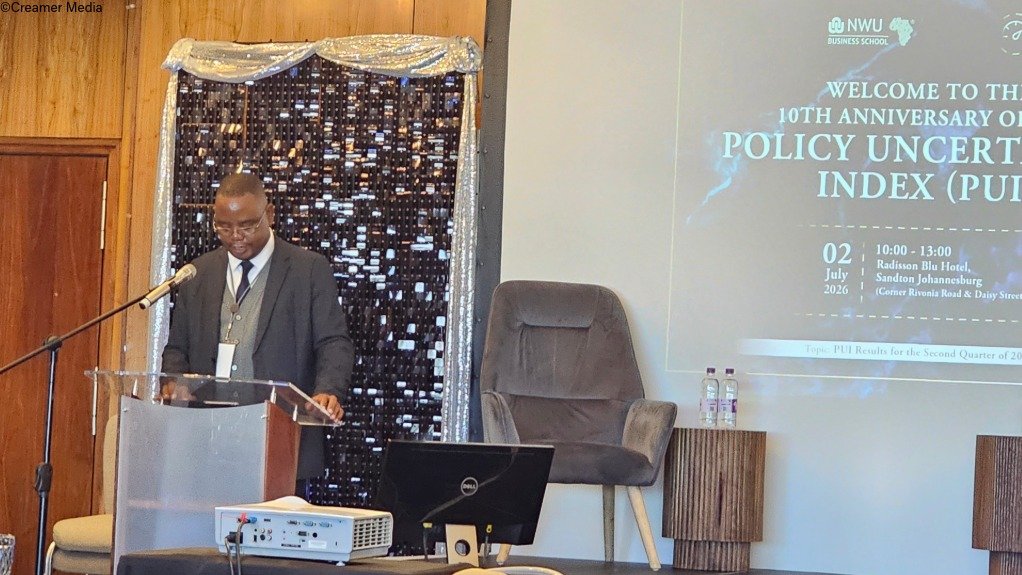
NWU Business School Professor Raymond Parsons expresses his hope for the future of the Policy Uncertainty Index
NWU Professor Mabutho Sibanda
Photo by Creamer Media's Tasneem Bulbulia



As the North West University (NWU) marks the tenth anniversary of its Policy Uncertainty Index (PUI), the data shows that a decade on, uncertainty is increasing and much of the frustrations of the past decade are the result of South Africa not capitalising on its true potential.
This was highlighted by speakers at the commemoration of the PUI anniversary, in Sandton, on July 2, where the PUI for the second quarter of this year was also released.
Delivering the opening remarks, NWU Faculty of Economic and Management Sciences executive dean Professor Mabutho Sibanda pointed out that the country does not lack potential; rather, it not capitalising on converting that potential into tangible outcomes.
He pointed out that the PUI has shown that the country has lacked sustained policy certainty that converts this potential into investment.
Sibanda paid tribute to the PUI over the years, highlighting that it has served as an accurate representation of the economic climate of the country over the years, with uncertainty worsening over this time.
He averred that the purpose of the PUI remains the same as it did in 2016, that is, “to illuminate rather than alarm” policymakers, businesses and citizens, providing them with a clearer view of the environment in which decisions must be taken.
NWU School of Economics Professor Waldo Krugell described the PUI as a hybrid tool with a numerical index and narrative commentary.
He lauded its trajectory over the years, with the publication growing and the term policy uncertainty being widely referenced, from news reporting to the country’s Monetary Policy Review.
Krugell echoed Sibanda’s sentiments, warning that studies have shown that economic policy uncertainty lowers investment, employment and growth.
NWU Business School Professor Raymond Parsons stressed the need for infrastructure spending to drive GDP growth, with this having declined over the years.
Outlining the findings for the second quarter of this year, he informed that owing to recent negative geopolitical developments in the Middle East, the PUI rose to 81.9, from 77.8 in the first quarter, thus moving further into negative territory.
While Iran and the US have signed a memorandum of understanding and this is expected to be a positive factor for the world economy, it came too late in the quarter to have a real impact.
In the meantime, the outlook for the global economy has weakened considerably with lower global oil prices expected to take time to materialise.
The continued uncertainty surrounding the global energy crisis and its consequences for growth, inflation, interest rates and business confidence had an impact on South Africa’s domestic economic activity, with the country bearing a detrimental cost of higher fuel prices and emerging inflation in the second quarter.
Interest rates were raised, factory gate inflation rose and the South African Reserve Bank’s (SARB’s) Monetary Policy Committee lowered its growth forecasts for the next two years. The SARB’s leading business cycle indicator also declined by 1.8% in April.
Positively, however, two major ratings agencies recently issued favourable reports on South Africa’s investment rating and economic outlook, indicating that it the country has the potential to lift its growth rate higher and reduce public debt faster if the correct economic policies are pursued.
The PUI highlights that total fixed investment needs to be a much higher percentage of GDP than it presently is; and for investor confidence to be nurtured through accelerating the pace of growth-friendly policies and projects.
Parsons expressed his hope that the future of the PUI would see it move into positive territory, with this in the hands of policymakers.
While South Africa operates as part of the global economy and is impacted by factors outside of it control, it must focus on domestic issues that it can, he pointed out.
Article Enquiry
Email Article
Save Article
Feedback
To advertise email advertising@creamermedia.co.za or click here
Research Reports

Projects


Latest News

Showroom

For over 30 years, Werner South Africa Pumps & Equipment (PTY) LTD has been designing, manufacturing, supplying and maintaining specialist...
VISIT SHOWROOM
Mitsubishi Chemical Advanced Materials South Africa (Pty) Ltd is a leading manufacturer of high-performance engineering plastics for the mining...
VISIT SHOWROOM
Press Office
Announcements
What's On
Subscribe to improve your user experience...
Option 1 (equivalent of R125 a month):
Receive a weekly copy of Creamer Media's Engineering News & Mining Weekly magazine
(print copy for those in South Africa and e-magazine for those outside of South Africa)
Receive daily email newsletters
Access to full search results
Access archive of magazine back copies
Access to Projects in Progress
Access to ONE Research Report of your choice in PDF format
Option 2 (equivalent of R375 a month):
All benefits from Option 1
PLUS
Access to Creamer Media's Research Channel Africa for ALL Research Reports, in PDF format, on various industrial and mining sectors
including Electricity; Water; Energy Transition; Hydrogen; Roads, Rail and Ports; Coal; Gold; Platinum; Battery Metals; etc.
Already a subscriber?
Forgotten your password?
Receive weekly copy of Creamer Media's Engineering News & Mining Weekly magazine (print copy for those in South Africa and e-magazine for those outside of South Africa)
➕
Recieve daily email newsletters
➕
Access to full search results
➕
Access archive of magazine back copies
➕
Access to Projects in Progress
➕
Access to ONE Research Report of your choice in PDF format
RESEARCH CHANNEL AFRICA
R4500 (equivalent of R375 a month)
SUBSCRIBEAll benefits from Option 1
➕
Access to Creamer Media's Research Channel Africa for ALL Research Reports on various industrial and mining sectors, in PDF format, including on:
Electricity
➕
Water
➕
Energy Transition
➕
Hydrogen
➕
Roads, Rail and Ports
➕
Coal
➕
Gold
➕
Platinum
➕
Battery Metals
➕
etc.
Receive all benefits from Option 1 or Option 2 delivered to numerous people at your company
➕
Multiple User names and Passwords for simultaneous log-ins
➕
Intranet integration access to all in your organisation