



Task team slates ‘blockages’ in skills development pipeline

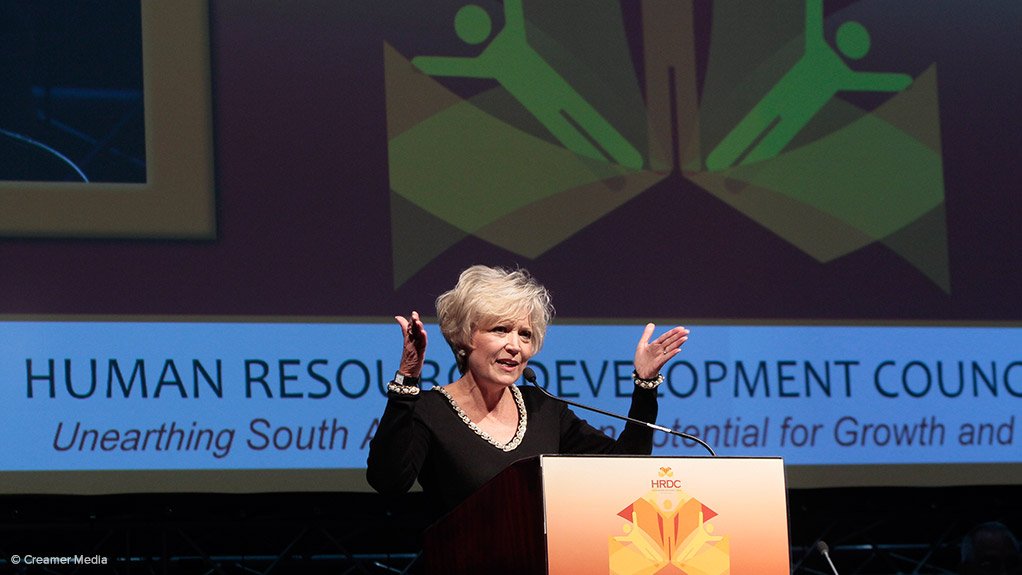


A technical task team deployed by the Human Resources Development Council (HRDC) to investigate blockages in the country’s professional skills development pipeline has identified several impediments to growth, calling specifically on industry representative organisations to play a more meaningful role in the development of sector-specific professionals.
“Among the core recommendations made to the council was that industry organisations should play a more active role in enabling individuals to enter the profession; they are absolutely critical in this sense. These councils shouldn’t just be registration bodies,” HRDC technical task team chairperson Chantyl Mulder said on Monday.
Speaking at the HRDC Summit in Johannesburg, she said the results of a three-year investigation had further revealed the need for alignment between the work of industry bodies with that of government departments, adding that certain organisations should be allocated additional funding to further skills development priorities.
“Skills development is not [only] government’s job, especially if we want to develop [high-end professional] skills,” Mulder, who is also a senior executive for professional development, transformation and growth at the South African Institute of Chartered Accountants, commented.
She added that inadequate basic education – particularly in maths and science – hindered local skills development.
There was also an absence of adequate career guidance and a limited number of learners that could be admitted to specialised educational institutions, such as the Onderstepoort Veterinary Institute and Academic Hospital, in Pretoria, which, according to Mulder, only admitted around 140 students a year.
“Further, as a country, we haven’t been able to increase the number of medical doctors that qualify [yearly] in the last 20 years, owing to a lack of training institutions,” she said.
Mulder noted that there was also inadequate learner preparation for tertiary education, inconsistency in terms of the quality of tertiary education provided, inadequate funding and unqualified lecturing staff.
“We also need to ensure that curriculums are fit-for-purpose and teach real workplace requirements. For example, the current 30% [pass rate] for maths or science [at a Grade 12 level] is not high enough.
“In fact, the university entry requirement [for maths] should be higher than 60%,” she noted.
Once qualified, graduates from tertiary institutions also struggled with insufficient access to practical training opportunities as well as with the absence of a clear programme assisting them with entering the workplace and gaining experience.
Insufficient funding to support the transition from university to the workplace also presented an impediment, said Mulder.
HUMAN RESOURCES STRATEGY
Minister of Higher Education and Training Blade Nzimande, who also spoke at the summit, added that the recommendations made by each of the HRDC’s various technical task teams, including the one chaired by Mulder, would be used to implement the council’s overarching five-point plan.
This plan focused on strengthening support to further education and training colleges, increasing the production of intermediate skills and professionals, improving the production of academics, enhancing worker education and providing enhanced foundational learning.
“We won’t be able to achieve the goals of the National Development Plan without the HRDC.
“Formed in 2010, the council draws on input from Cabinet Ministers, academia, labour and others and provides a platform through which social partners can deliberate on the country’s social issues, including skills development,” Nzimande said.
The council further served to advise Deputy President and HRDC chairperson Kgalema Motlanthe on the need for and implementation of human resource development policies and strategies, as well as to encourage organised business, civil society, government and organised labour to invest in education and training and take responsibility for human resource development in their areas of competency.
“This council is of particular significance as it seeks to contribute to solving stubborn socioeconomic problems, such as poverty and unemployment,” Nzimande noted.
Motlanthe was expected on Tuesday to launch the Human Resources Development Strategy of South Africa, which was based on the findings of the HRDC’s task teams, and aimed to “stimulate a culture of training and lifelong learning at individual, organisational and national levels of employability.”
“Our goals also include increasing productivity and [facilitating] the human resource development needed to successfully transform our country into a knowledge [-based] economy,” the council stated.
Article Enquiry
Email Article
Save Article
Feedback
To advertise email advertising@creamermedia.co.za or click here
Research Reports

Projects


Latest Multimedia


Latest News

Showroom

As one of South Africa's leading manufacturers, Bell Equipment distributes and exports its wide range of heavy equipment globally to mining,...
VISIT SHOWROOM
From batteries for boats and jet skis, to batteries for cars and quad bikes, SABAT Batteries has positioned itself as the lifestyle battery of...
VISIT SHOWROOM


Announcements
What's On
Subscribe to improve your user experience...
Option 1 (equivalent of R125 a month):
Receive a weekly copy of Creamer Media's Engineering News & Mining Weekly magazine
(print copy for those in South Africa and e-magazine for those outside of South Africa)
Receive daily email newsletters
Access to full search results
Access archive of magazine back copies
Access to Projects in Progress
Access to ONE Research Report of your choice in PDF format
Option 2 (equivalent of R375 a month):
All benefits from Option 1
PLUS
Access to Creamer Media's Research Channel Africa for ALL Research Reports, in PDF format, on various industrial and mining sectors
including Electricity; Water; Energy Transition; Hydrogen; Roads, Rail and Ports; Coal; Gold; Platinum; Battery Metals; etc.
Already a subscriber?
Forgotten your password?
Receive weekly copy of Creamer Media's Engineering News & Mining Weekly magazine (print copy for those in South Africa and e-magazine for those outside of South Africa)
➕
Recieve daily email newsletters
➕
Access to full search results
➕
Access archive of magazine back copies
➕
Access to Projects in Progress
➕
Access to ONE Research Report of your choice in PDF format
RESEARCH CHANNEL AFRICA
R4500 (equivalent of R375 a month)
SUBSCRIBEAll benefits from Option 1
➕
Access to Creamer Media's Research Channel Africa for ALL Research Reports on various industrial and mining sectors, in PDF format, including on:
Electricity
➕
Water
➕
Energy Transition
➕
Hydrogen
➕
Roads, Rail and Ports
➕
Coal
➕
Gold
➕
Platinum
➕
Battery Metals
➕
etc.
Receive all benefits from Option 1 or Option 2 delivered to numerous people at your company
➕
Multiple User names and Passwords for simultaneous log-ins
➕
Intranet integration access to all in your organisation
