Strategic procurement and clean energy seen as key to manufacturing revival





Decarbonisation and switching to renewable energy can be key drivers of competitiveness as local manufacturers seek to increase capacity to achieve better economies of scale and remain relevant in a changing global supply chain landscape.
South African manufacturing has been in a sustained, structural decline over the past three decades, with the sector’s share of GDP decreasing from 23% to 13% currently.
The decline is attributable to a combination of international and local factors, including negligible economic growth, weak local demand, insufficient trade protection in some cases, inadequate municipal service delivery, high electricity prices and poor policy alignment.
A panel of experts hosted by Creamer Media recently identified several factors dragging down South Africa’s manufacturing performance, with Manufacturing Circle executive director Philippa Rodseth highlighting the fact that many local manufacturers operate well below their installed production capacity – at levels of between 50% and 70%.
She said this undermines economies of scale and competitiveness, and argued in favour of increasing demand through coordinated State procurement in infrastructure projects such as transmission lines, renewable energy and rail.
Rodseth advocated for a programmatic and strategic approach to procurement that enables proactive participation by local manufacturers – particularly through improved visibility of demand.
With the right frameworks in place and better alignment of existing policies, she believes the country has the capabilities and expertise to supply into these large-scale infrastructure build programmes, including those related to energy.
Commenting on the energy aspect for manufacturers, Rodseth noted how global stakeholders are increasingly focusing on sustainable inputs and sourcing. She said manufacturers need to become increasingly mindful of the environmental, social and governance credentials of their processes, with energy use and decarbonisation key considerations.
Trade and Industry Policy Strategies executive director Dr Saul Levin weighed in by stating that renewable energy can help manufacturers become more competitive by lowering electricity costs, controlling input costs, and strengthening companies’ credentials when supplying to new markets.
Levin pointed out that manufacturers also have opportunities to supply within the renewable energy sector itself, given the magnitude of products being imported for these plants.
Cost Driver
Discovery Green executive director and actuarial research and development head Dan Ginsberg explained that manufacturers’ transition to renewable energy has become primarily driven by cost savings rather than just environmental concerns. He detailed how renewable energy can offer immediate and long-term financial benefits, including predictable electricity costs through long-term contracts.
“Going for renewable energy is simply much cheaper, with the ability to recognise savings and control input costs for electricity. Renewable-energy costs, through contracts and trading, can be hedged for decades, and prices will only go up in line with inflation,” he said.
Ginsberg cautioned, however, that the timing and mix of renewables are crucial, as energy demand and supply fluctuate throughout the day. He recommended that manufacturers maximise renewable-energy coverage, especially during high-cost periods, and partner with reputable suppliers who can guarantee stable supply.
Ginsberg also warned of the growing impact of local and international carbon taxes on manufacturers, noting that the EU’s Carbon Border Adjustment Mechanism poses a significant threat to export competitiveness. For him, incoming punitive measures such as carbon taxes and other green supply chain requirements reinforce the financial imperative for decarbonisation and renewable-energy adoption.
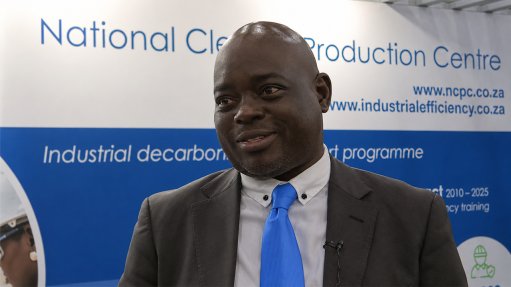
National Cleaner Production Centre of South Africa (NCPC-SA) technical, quality and standards manager Kevin Cilliers added that notable productivity and financial gains can be made through optimal resource management – particularly energy efficiency – by combining digitisation and decarbonisation.
He also emphasised the importance of data-driven decision-making, urging companies to systematically collect and analyse operational data to identify efficiency opportunities and respond effectively to policy and market changes.
“Too often, data that could have informed industry or government is scattered all over the place, leading to delayed or uninformed decision-making.”
Cilliers suggested that manufacturers can start with basic data collection and process optimisation before investing in advanced systems. “Proactive adaptation to changing market and regulatory conditions is no longer optional but necessary for survival and growth in the manufacturing sector,” he said.
Through NCPC-SA’s Industry Efficiency Project, just under 6 500 GWh of electricity worth R3.5-billion has been saved for industrial companies in South Africa over the past ten years. The project has included capacity development, skills development and knowledge-sharing on energy management systems, efficiency and optimisation.
Wider Approach
As an example of how a manufacturer has been able to adapt to low domestic demand, Multotec group CEO Thomas Holtz explained that when local market demand is static, and manufacturers start competing for a “piece of the same pie but the pie is not growing”, industrialists are forced to find new markets elsewhere.
“Any manufacturer makes more money when it comes to scale. Policy should help us become more attractive as an investment destination to export, particularly into the African region,” he said.
In this context, Rodseth noted the negative impacts of dumped imports and companies becoming uncompetitive amid current global trade dynamics. This underscores the importance of a supportive tariff regime, alongside efforts to address the local supply-side challenges of expensive electricity, unreliable water supply and inefficient logistics, thereby enabling competitive exports when local market demand is weak.
Rodseth argued that the country needs more agile and well-monitored protection mechanisms to shield local industry from global oversupply and unfair competition. He also highlighted the importance of identifying and supporting sectors where South Africa has a clear competitive advantage.
She emphasised the need to better monitor the use of certain trade allowances, noting that loopholes are often exploited to the detriment of local manufacturers. One example is the South African Revenue Service’s policy instrument that allows for many items to be imported in a “staged consignment” for a project build, which often unintentionally disadvantages local manufacturers of the same products that would not otherwise have to compete with these imports.
Further, Holtz emphasised that manufacturers have to adapt to operational challenges such as energy shortages or high prices to remain competitive. “Industrialisation is premised on affordable electricity,” he said.
Multotec, for example, invested in solar power generation 15 years ago, delivering a decent return on investment for the company.
This energy system has evolved from being a grid-tied set-up used to supplement the company’s power demand to a more arbitraged and sophisticated system with inverters and battery technology – ultimately using technology in a smarter way for more efficiency and cost-saving gains while ensuring reliable energy supply.
For Holtz, a major incentive for more manufacturing investment would be permitting the wheeling of energy between facilities across all municipalities in the country, as well as for feed-in tariffs to be set in stone for manufacturers to supply and sell excess energy into the national grid.
Manufacturers can also make the most of their resources and maximise productivity by diversifying operations and unlocking value from what companies would often consider to be waste or non-focus products, Cilliers argued.
He emphasised that it will become increasingly critical for companies to consider the waste management and value-add opportunities in their chain of operations.
“It is no longer a luxury to think about decarbonisation and circular economy principles. Industries will have to look at investments into these aspects for long-term sustainability, not necessarily quick gains.
“If manufacturers do not adjust and adapt now, they will be pushed out of the marketplace,” Cilliers said.
Article Enquiry
Email Article
Save Article
Feedback
To advertise email advertising@creamermedia.co.za or click here
Research Reports

Projects

Latest Multimedia

Latest News


Showroom
Axiom Hydraulics is a trusted leader in South Africa’s hydraulic industry, delivering world-class components, systems, and engineering expertise...
VISIT SHOWROOM
ECG provides specialised electrical engineering services to the Mining, Utilities, Materials Handling and Industrial industries, with extensive and...
VISIT SHOWROOM

Press Office
Announcements
What's On
Subscribe to improve your user experience...
Option 1 (equivalent of R125 a month):
Receive a weekly copy of Creamer Media's Engineering News & Mining Weekly magazine
(print copy for those in South Africa and e-magazine for those outside of South Africa)
Receive daily email newsletters
Access to full search results
Access archive of magazine back copies
Access to Projects in Progress
Access to ONE Research Report of your choice in PDF format
Option 2 (equivalent of R375 a month):
All benefits from Option 1
PLUS
Access to Creamer Media's Research Channel Africa for ALL Research Reports, in PDF format, on various industrial and mining sectors
including Electricity; Water; Energy Transition; Hydrogen; Roads, Rail and Ports; Coal; Gold; Platinum; Battery Metals; etc.
Already a subscriber?
Forgotten your password?
Receive weekly copy of Creamer Media's Engineering News & Mining Weekly magazine (print copy for those in South Africa and e-magazine for those outside of South Africa)
➕
Recieve daily email newsletters
➕
Access to full search results
➕
Access archive of magazine back copies
➕
Access to Projects in Progress
➕
Access to ONE Research Report of your choice in PDF format
RESEARCH CHANNEL AFRICA
R4500 (equivalent of R375 a month)
SUBSCRIBEAll benefits from Option 1
➕
Access to Creamer Media's Research Channel Africa for ALL Research Reports on various industrial and mining sectors, in PDF format, including on:
Electricity
➕
Water
➕
Energy Transition
➕
Hydrogen
➕
Roads, Rail and Ports
➕
Coal
➕
Gold
➕
Platinum
➕
Battery Metals
➕
etc.
Receive all benefits from Option 1 or Option 2 delivered to numerous people at your company
➕
Multiple User names and Passwords for simultaneous log-ins
➕
Intranet integration access to all in your organisation