



Square Kilometre Array project, Africa and Australia




Name and Location
Square Kilometre Array (SKA) project, Africa and Australia.
Client
The international SKA project is run by the UK-based SKA Organisation, which currently comprises ten countries – Australia, Canada, China, Germany, Italy, the Netherlands, New Zealand, South Africa, Sweden and the UK. India is an associate member and is expected to become a full member shortly.
The SKA Organisation formalises relationships between the international partners and centralises the leadership project.
The project in South Africa is the responsibility of a separate, local organisation, SKA SA.
Project Description
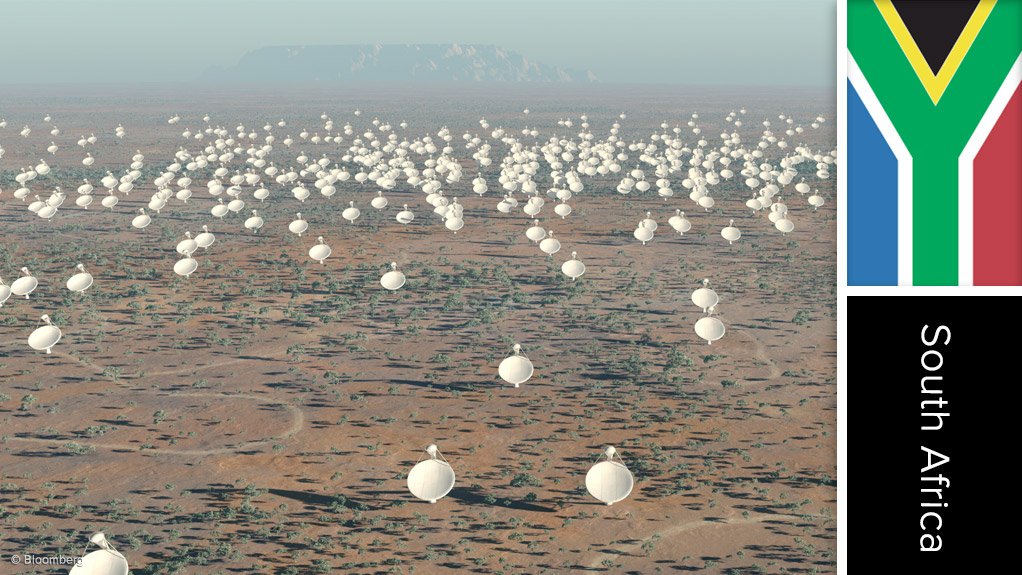
The SKA will provide one-million square metres of collecting area, which demands a revolutionary break from traditional radio-telescope design.
The SKA will use three types of antennas (radio-wave receptors) – dishes, midfrequency aperture arrays and low-frequency aperture arrays – to provide continuous frequency coverage from 70 MHz to 10 GHz. Combining the signals from the antennas will create a telescope with a collecting area equivalent to a dish with an area of about one square kilometre.
Built over two sites, in Australia and Africa, the SKA will achieve high-sensitivity and high-resolution images by having antennas densely distributed in the central region of the arrays and then positioned in clusters along five spiral arms – the clusters will become more widely spaced further away from the centre.
The central regions, in Australia and in South Africa, will contain cores, each 5 km in diameter – one for each antenna type. Fifty per cent of the collecting area will be within the central cores. The aperture array antennas will extend to about 200 km from the core regions. In Africa, the dishes will be positioned at distant stations that are 3 000 km from the core regions.
The construction of the SKA will be phased.
Phase 1 (SKA1) will comprise about 10% of the array and will include dishes and low-frequency aperture arrays.
The Australian Square Kilometre Array Pathfinder and South Africa’s Meerkat precursor dishes will be incorporated in the SKA1. The Murchison Widefield Array, located at the Australia site, is another precursor telescope to the SKA.
Phase 2 (SKA2) will extend the array with midfrequency aperture arrays and further dishes.
All the dishes for SKA2 will be located in Africa.
All the low-frequency aperture arrays will be located in Australia.
All the midfrequency aperture arrays will be built in Southern Africa.
The phased construction of the telescope will mean that the SKA can start operating before construction is completed.
Value
SKA1 is expected to cost €650-million (about R8.9-billion).
Duration
The first elements of SKA1 should be deployed in 2016 and construction of SKA1 should start in 2018 and be completed in 2023.
Latest Developments
The UK has given a major boost to the SKA radio telescope programme by announcing funding of £100-million (€120-million or almost R1.8-billion) for SKA1 of the instrument. As the construction cost of SKA1 has been capped at €650-million, the British grant amounts to almost 18.5% of the total required to build the first phase of the SKA.
UK Science and Technology Facilities Council (STFC) CEO Professor John Womersley says: “This represents a significant investment on behalf of the UK and, along with our other contributions, aims to confirm the UK’s leading role in key aspects of the project.”
In addition, the STFC has confirmed that it is contributing £19-million to the SKA over the next four years, comprising £11-million for big data research and development and £8-million (£2-million a year) on the continuing core programme. The funds from the STFC will go to the universities of Cambridge, Manchester, Oxford and Southampton and the University College London. Thus, the total funding for the SKA announced by the UK totals £119-million (more than R2.1-billion).
Full funding for the construction of SKA1 is scheduled to be confirmed by 2016, with construction starting in 2018. The SKA will be cohosted by South Africa and Australia.
South Africa has welcomed Britain’s decision to provide the £100-million for the construction of Phase 1 of the international SKA radio telescope.
South Africa has contributed nearly R4-billion to the project through funding for its 64-dish MeerKAT radio telescope array, which will be a precursor to the SKA will later be incorporated into the international instrument and into programmes to develop the necessary human capital for the project. In SKA1, another 190 dishes will be added to those of MeerKAT, creating the midfrequency element of the SKA.
In its press release, the South African Department of Science and Technology has noted that the “UK is a major player in the global SKA project”. “South Africa and the UK are collaborating extensively in the field of radio astronomy, with 25 research organisations and more than 80 individual scientists from the UK directly involved in the large survey teams that will use the MeerKAT telescope for research during its first five years of operation.
The two countries are also working together on big data and high-performance computing for the SKA.
The first MeerKAT antenna is scheduled to be inaugurated on March 27 and the entire 64-dish array should be finished in 2016/17.
Key Contracts and Suppliers
South Africa: Neotel/Broadband Infraco joint venture, or JV (bandwidth network); Eskom (electricity); Telkom (telecommunications); and Nokia Siemens Networks, Intel, Seacom, Dimension Data, Microsoft and IBM (connectivity support).
On Budget and on Time?
The project is reportedly on course.
Contact Details for Project Information
Council for Scientific and Industrial Research general and technical enquiries, Tendani Tsedu, tel +27 12 841 3417.
SKA South Africa, tel +27 11 442 2434, fax +27 11 442 2454 or email tcheetham@ska.ac.za.
SKA Organisation chief communication officer William Garnier, tel +44 161 306 9613 or email w.garnier@skatelescope.org.
Article Enquiry
Email Article
Save Article
To advertise email advertising@creamermedia.co.za or click here
Research Reports

Projects


Latest Multimedia


Latest News

Showroom

Sulzer South Africa, established in 1922, partners with critical industries like power, oil & gas, water, mining, and chemicals to boost...
VISIT SHOWROOM
Leading condition monitoring specialists, WearCheck, help boost machinery lifespan and reduce catastrophic component failure through the scientific...
VISIT SHOWROOM



Press Office
Announcements
What's On
Subscribe to improve your user experience...
Option 1 (equivalent of R125 a month):
Receive a weekly copy of Creamer Media's Engineering News & Mining Weekly magazine
(print copy for those in South Africa and e-magazine for those outside of South Africa)
Receive daily email newsletters
Access to full search results
Access archive of magazine back copies
Access to Projects in Progress
Access to ONE Research Report of your choice in PDF format
Option 2 (equivalent of R375 a month):
All benefits from Option 1
PLUS
Access to Creamer Media's Research Channel Africa for ALL Research Reports, in PDF format, on various industrial and mining sectors
including Electricity; Water; Energy Transition; Hydrogen; Roads, Rail and Ports; Coal; Gold; Platinum; Battery Metals; etc.
Already a subscriber?
Forgotten your password?
Receive weekly copy of Creamer Media's Engineering News & Mining Weekly magazine (print copy for those in South Africa and e-magazine for those outside of South Africa)
➕
Recieve daily email newsletters
➕
Access to full search results
➕
Access archive of magazine back copies
➕
Access to Projects in Progress
➕
Access to ONE Research Report of your choice in PDF format
RESEARCH CHANNEL AFRICA
R4500 (equivalent of R375 a month)
SUBSCRIBEAll benefits from Option 1
➕
Access to Creamer Media's Research Channel Africa for ALL Research Reports on various industrial and mining sectors, in PDF format, including on:
Electricity
➕
Water
➕
Energy Transition
➕
Hydrogen
➕
Roads, Rail and Ports
➕
Coal
➕
Gold
➕
Platinum
➕
Battery Metals
➕
etc.
Receive all benefits from Option 1 or Option 2 delivered to numerous people at your company
➕
Multiple User names and Passwords for simultaneous log-ins
➕
Intranet integration access to all in your organisation
