



Newly discovered fossil sheds light on dinosaur flight

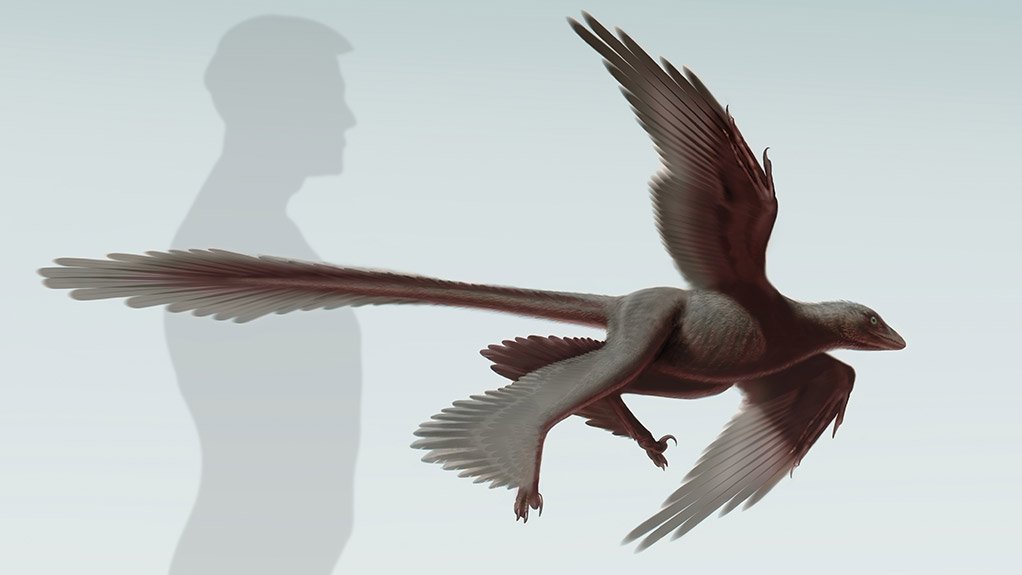

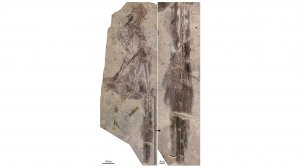


An international team of experts, including University of Cape Town Department of Biological Sciences head and palaeobiologist Professor Anusuya Chinsamy-Turan, has discovered a previously unknown predatory dinosaur, dubbed the changyuraptor, in the Liaoning Province of north-east China – an area that has produced several discoveries in feathered dinosaur fossils in the last decade.
The dinosaur had a full set of feathers cloaking its entire body, including unusually long tail feathers believed to have been used by the raptor to decrease descent speed and assure safe landings.
With a weight of 4 kg, the 122-cm-long changyuraptor was the biggest of all four-winged dinosaurs, with the specimen uncovered believed to be fully grown and around five years old.
The research team said the discovery of the changyuraptor consolidated the notion that flight preceded the origin of birds, being inherited by the latter from their dinosaurian predecessors.
“The new fossil documents that dinosaur flight was not limited to very small animals but to dinosaurs of more substantial size. Clearly, far more evidence is needed to understand the nuances of dinosaur flight, but the changyuraptor is a major leap in the right direction,” commented research team leader and Natural History Museum of Los Angeles palaeontologist Dr Luis Chiappe.
According to Chinsamy-Turan, these microraptorine dinosaurs were known as the “four-winged” dinosaurs, as the long feathers attached to the legs had the appearance of a second set of wings.
“As we know, birds have wings on their forelimbs. However, about ten years ago, predatory dinosaurs were discovered with wings on both their forelimbs and hindlimbs.
“These recent discoveries pose an enigma as to how these microraptorine dinosaurs used their four wings to fly. Our new microraptor, changyuraptor, is quite large, and we propose that its unusually long tail – some 30 cm in length – helped to keep it airborne and could have assisted with landing,” she explained
While it remained uncertain as to how well these dinosaurs were able to fly, the team believed the discovery did explain the role that the tail feathers played during flight control.
For larger flyers, safe landings were of particular importance.
“It makes sense that the largest microraptorines had especially large tail feathers as they would have needed the additional control,” added research paper co-author and University of Southern California researcher Dr Michael Habib.
Article Enquiry
Email Article
Save Article
Feedback
To advertise email advertising@creamermedia.co.za or click here
Research Reports

Projects


Latest Multimedia


Latest News


Showroom

The SAIMM started as a learned society in 1894 after the invention of the cyanide process that saved the South African gold mining industry of the...
VISIT SHOWROOM
Industrial Nozzles & Systems (Pty) Ltd (Est. 2000) exclusive representative in Southern Africa for LECHLER GmbH (Est. 1879) - Europe's leading...
VISIT SHOWROOM



Announcements
What's On
Subscribe to improve your user experience...
Option 1 (equivalent of R125 a month):
Receive a weekly copy of Creamer Media's Engineering News & Mining Weekly magazine
(print copy for those in South Africa and e-magazine for those outside of South Africa)
Receive daily email newsletters
Access to full search results
Access archive of magazine back copies
Access to Projects in Progress
Access to ONE Research Report of your choice in PDF format
Option 2 (equivalent of R375 a month):
All benefits from Option 1
PLUS
Access to Creamer Media's Research Channel Africa for ALL Research Reports, in PDF format, on various industrial and mining sectors
including Electricity; Water; Energy Transition; Hydrogen; Roads, Rail and Ports; Coal; Gold; Platinum; Battery Metals; etc.
Already a subscriber?
Forgotten your password?
Receive weekly copy of Creamer Media's Engineering News & Mining Weekly magazine (print copy for those in South Africa and e-magazine for those outside of South Africa)
➕
Recieve daily email newsletters
➕
Access to full search results
➕
Access archive of magazine back copies
➕
Access to Projects in Progress
➕
Access to ONE Research Report of your choice in PDF format
RESEARCH CHANNEL AFRICA
R4500 (equivalent of R375 a month)
SUBSCRIBEAll benefits from Option 1
➕
Access to Creamer Media's Research Channel Africa for ALL Research Reports on various industrial and mining sectors, in PDF format, including on:
Electricity
➕
Water
➕
Energy Transition
➕
Hydrogen
➕
Roads, Rail and Ports
➕
Coal
➕
Gold
➕
Platinum
➕
Battery Metals
➕
etc.
Receive all benefits from Option 1 or Option 2 delivered to numerous people at your company
➕
Multiple User names and Passwords for simultaneous log-ins
➕
Intranet integration access to all in your organisation
