



SA digital radio gets leg up as trial kicks off




The transition from analogue to digital radio in South Africa could become a reality as Radio Pulpit kick-starts the migration with a pioneering one-year Digital Radio Mondiale (DRM) trial.
Radio Pulpit, which secured a special broadcasting licence from the Independent Communications Authority of South Africa (Icasa) to undertake the project, would, from July 1, officially start broadcasting on the DRM standard across greater Pretoria and parts of Johannesburg until May next year.
DRM, the only universal, openly standardised digital broadcasting system for all frequencies, was a high-quality, digital replacement for current analogue radio broadcasting in the AM and FM/VHF bands used by national networks and regional stations, as well as the smaller commercial and community stations.
The trial, which would use a DRM30 configuration designed to operate alongside AM broadcast frequency bands, would make use of a recently acquired 25 kW DRM-ready transmitter, based in Kameeldrift, Pretoria, to broadcast on signals of 10 kHz bandwidth on a medium wave AM 1 440 kHz frequency.
Radio Pulpit had another 50 kW unit based in Meyerton, while the neighbouring Veritas Radio had a similar unit, both on standby for the imminent commercialisation of digital radio.
Radio Pulpit MD and chairperson of the Southern African branch of the global DRM Consortium Dr Roelf Petersen said at the launch of DRM, in Centurion, on Wednesday, that the DRM technical trial would start on July 1, followed by the start of a DRM programme in September.
In November, the DRM Consortium planned to host a think tank aimed at formulating the strategy moving forward as the trial advanced.
By February 2015, Radio Pulpit would start examining a Sentech-supplied alternative low-profile antenna.
Should the trial be successful, Radio Pulpit would apply for a new licence from Icasa to broadcast permanently on DRM, marking the start of the station’s official migration, which could take up to another year.
The purpose of the trial and subsequent transition was to accelerate digital radio in South Africa, and spur supportive policies of digital radio – both in South Africa and its neighbouring countries.
“My role will be to coordinate the strength of all the African parties involved to ensure that the great potential of the DRM technology becomes a practical reality for serving the people of Southern Africa,” Petersen explained.
The DRM aimed to stimulate the introduction and roll-out of DRM broadcasts and to demonstrate a business case for locally producing and selling DRM radio sets or auxiliary devices.
The DRM platform in Southern Africa followed the launch of national platforms in India, Brazil and Germany.
India was already ahead of the game, having delved into digital opportunities a number of years ago and expected to cover 70%, or 800-million, of its population with the DRM transmission by the end of this year.
The limited dependability of existing AM services was causing listeners to search for other alternatives, while FM sound broadcasting had become saturated, and the advantages of a complementary digital broadcast system below 30 MHz were emerging.
DRM, which would enable the broadcast of three to four channels on one frequency and could be operated with the same channelling and spectrum allocations as currently employed, could be used for a range of audio content and boasted the capacity to integrate text and data, while enabling the broadcast of emergency warnings and electronic programme guides.
The DRM30, which was intended for broadcasts on short, medium and long wave up to 30 MHz, provided large coverage areas and low power consumption.
“The improvement brought by DRM30 over AM is immediately noticeable and [the second DRM configuration] DRM+ removes the fading that mars FM reception,” the DRM Consortium said on Wednesday, demonstrating for the first time in South Africa broadcasting using DRM.
The International Telecommunications Union-endorsed DRM delivered FM-like, or CD-like, sound quality and enabled the automatic tune-in by station name, with uninterrupted, auto-adjusting high-quality reception, regardless of regional or national boundary crossings.
As well as offering advanced audio quality for listeners, the adoption of DRM could be beneficial to broadcasters.
The standard’s mutual analogue/digital compatibility could significantly reduce the initial investment cost for a broadcaster, allowing a phased-in approach to the changeover from analogue to digital broadcasting and spreading the required investment over a period of time.
“The scope of the capital investment required is also manageable because just a few transmitters can achieve excellent coverage over very extensive territories. Unlike other systems of digital audio broadcasting, DRM does not require a large network of transmitters or a complicated lattice of repeaters to do the job,” the Consortium noted.
A VAST NEW MARKET
As with the digital terrestrial television (DTT) transition, the roll-out of digital radio could open up South Africa’s local manufacturing potential, particularly owing to the DRM’s open, nonproprietary standard
A technical economic feasibility study showed that it was “relatively straightforward” and cost effective to integrate DRM capabilities into a variety of devices – from hybrid radio sets with multiband functionality to handhelds and mobile phones.
The DRM Consortium indicated that there were an estimated 2.5-billion analogue AM receivers currently in the world and, as radio moved into the digital era, these devices would be replaced, enabling market expansion.
South Africa boasted at least six large-scale manufacturers and several small operators with the capability and capacity to locally produce or assemble the required digital receivers for digital radio, independent consultant Kobus Boshoff said.
Ninety-three per cent of South Africa’s 14.5-million households, representing about 37-million people listened to the radio, meaning, radio far outstripped the reach of television, which only covered about 20-million people.
Further, with 200 community radio stations and 38 commercial broadcasters possibly shifting to digital radio, the potential for local manufacture, such as that developed for the set-top boxes required for DTT, was vast.
Article Enquiry
Email Article
Save Article
Feedback
To advertise email advertising@creamermedia.co.za or click here
Research Reports

Projects


Latest Multimedia


Latest News

Showroom
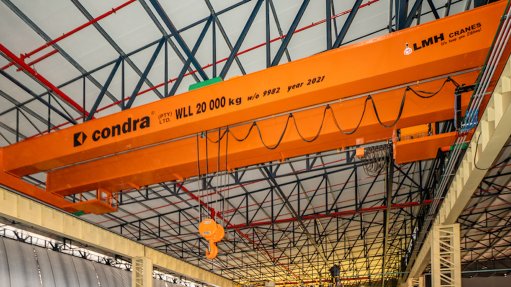
ISO-certified Condra manufactures overhead cranes, portal cranes, cantilever cranes and crane components: hoists, drives, end-carriages, brakes and...
VISIT SHOWROOM
Columbus Stainless, based in Middelburg, Mpumalanga, is Africa’s only producer of stainless steel flat products. In addition, Columbus is the only...
VISIT SHOWROOM



Press Office
Announcements
What's On
Subscribe to improve your user experience...
Option 1 (equivalent of R125 a month):
Receive a weekly copy of Creamer Media's Engineering News & Mining Weekly magazine
(print copy for those in South Africa and e-magazine for those outside of South Africa)
Receive daily email newsletters
Access to full search results
Access archive of magazine back copies
Access to Projects in Progress
Access to ONE Research Report of your choice in PDF format
Option 2 (equivalent of R375 a month):
All benefits from Option 1
PLUS
Access to Creamer Media's Research Channel Africa for ALL Research Reports, in PDF format, on various industrial and mining sectors
including Electricity; Water; Energy Transition; Hydrogen; Roads, Rail and Ports; Coal; Gold; Platinum; Battery Metals; etc.
Already a subscriber?
Forgotten your password?
Receive weekly copy of Creamer Media's Engineering News & Mining Weekly magazine (print copy for those in South Africa and e-magazine for those outside of South Africa)
➕
Recieve daily email newsletters
➕
Access to full search results
➕
Access archive of magazine back copies
➕
Access to Projects in Progress
➕
Access to ONE Research Report of your choice in PDF format
RESEARCH CHANNEL AFRICA
R4500 (equivalent of R375 a month)
SUBSCRIBEAll benefits from Option 1
➕
Access to Creamer Media's Research Channel Africa for ALL Research Reports on various industrial and mining sectors, in PDF format, including on:
Electricity
➕
Water
➕
Energy Transition
➕
Hydrogen
➕
Roads, Rail and Ports
➕
Coal
➕
Gold
➕
Platinum
➕
Battery Metals
➕
etc.
Receive all benefits from Option 1 or Option 2 delivered to numerous people at your company
➕
Multiple User names and Passwords for simultaneous log-ins
➕
Intranet integration access to all in your organisation
