



Public–private liquefied natural gas terminal model punted

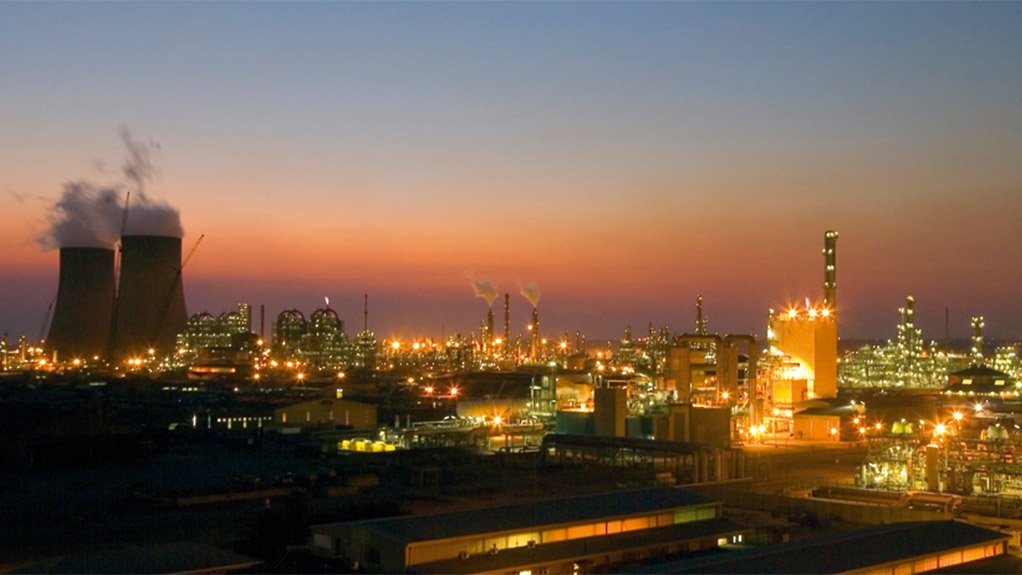
Secunda (pictured) and Sasolburg have about 400 MW of additional near-term power capacity



Energy and chemicals group Sasol is working with the Eskom War Room on a possible public–private partnership (PPP) to build a floating liquefied natural gas (LNG) facility along the South African coast, which will facilitate the importation of gas to be used by both Eskom and independent power producers (IPPs).
CEO David Constable reports that Sasol stands willing to support efforts, which are being overseen by Deputy President Cyril Ramaphosa, to initially build a floating LNG terminal, which would facilitate the conversion of the expensive diesel open-cycle gas turbines, in the Western Cape, to gas.
Sasol is punting a PPP model similar to the one deployed in Mozambique in 2004, which led to the creation of 865 km of gas pipeline from a central processing facility in Temane, Mozambique, to Secunda, South Africa. The binational project has been developed by the Republic of Mozambique Pipeline Investments Company, or Rompco, which is a joint venture between Sasol, Companhia Mocambiçana de Gasoduto and the State-owned South African Gas Development Company.
Constable envisages Sasol and others working with domestic State-owned companies on the LNG terminal project, which he admits to being at an early stage of development.
The possible partners have not been identified, but PetroSA has been working on various LNG import options for a number of years, having recently pulled back from a proposed LNG terminal project near Mossel Bay, owing to the fact that the sea conditions have been deemed too rough for a floating terminal.
It is understood that a terminal is now being proposed for the West Coast, possibly at Saldanha Bay, in order to facilitate the introduction of gas-to-power projects, including the conversion of Eskom’s Ankerlig and Gourikwa plants from diesel to gas.
Sasol may be willing to take an equity position in the LNG terminal, but Constable stresses that its initial involvement through the war room is as a thought leader and adviser.
“The roles have not been sorted out, or the funding . . . [but] Sasol wants to play a leadership role – not necessarily from an investment perspective – in making it happen technically and from a project management perspective and a deal-making perspective,” he explains.
The gas itself is unlikely to come from Mozambique, with sources of supply expected to be the US or the Middle East.
The initiative is aligned to a Cabinet-endorsed plan to facilitate an injection of gas into South Africa’s coal-dominated electricity mix, as well as to a plan by government’s IPP Office to launch a procurement programme for gas-based IPPs during 2015.
IPP Office head Karen Breytenbach has indicated that a request for information will be issued this month as a possible precursor to a 3 000 MW tender for gas-to-power projects.
Sasol is also in talks with Eskom on possible new power purchase agreements (PPAs) that could unlock a further 400 MW of much-needed electricity capacity from both Secunda and Sasolburg.
The group generates about 1 100 MW currently from steam boilers and gas turbines and consumes around 1 500 MW. However, it has capacity to produce more, which could allow it to either reduce its Eskom demand or inject excess capacity into the grid.
“There is an opportunity for us to work with Eskom on PPAs for excess capacity that we have and this discussion is ongoing . . . and we are looking at between 375 MW and 400 MW that we could bring on to the grid.”
Sasol already has PPAs in place with Eskom, but these are being renewed yearly, with the current deals set to expire at the end of this month.
Harnessing short-term IPP and cogeneration opportunities have also been included in the Cabinet-backed five-point plan designed to address the current strain on the electricity system, which has become increasingly prone to incidents of load-shedding.
Article Enquiry
Email Article
Save Article
Feedback
To advertise email advertising@creamermedia.co.za or click here
Research Reports

Projects


Latest Multimedia



Showroom
EIMS is an independent specialised environmental consulting firm offering the full spectrum of environmental management services across all sectors...
VISIT SHOWROOM
CMTS is a leading, well-established EC&I contractor with 37+ years of mining and industrial experience. We execute full-scope EC&I projects with...
VISIT SHOWROOM


Press Office
Announcements
What's On
Subscribe to improve your user experience...
Option 1 (equivalent of R125 a month):
Receive a weekly copy of Creamer Media's Engineering News & Mining Weekly magazine
(print copy for those in South Africa and e-magazine for those outside of South Africa)
Receive daily email newsletters
Access to full search results
Access archive of magazine back copies
Access to Projects in Progress
Access to ONE Research Report of your choice in PDF format
Option 2 (equivalent of R375 a month):
All benefits from Option 1
PLUS
Access to Creamer Media's Research Channel Africa for ALL Research Reports, in PDF format, on various industrial and mining sectors
including Electricity; Water; Energy Transition; Hydrogen; Roads, Rail and Ports; Coal; Gold; Platinum; Battery Metals; etc.
Already a subscriber?
Forgotten your password?
Receive weekly copy of Creamer Media's Engineering News & Mining Weekly magazine (print copy for those in South Africa and e-magazine for those outside of South Africa)
➕
Recieve daily email newsletters
➕
Access to full search results
➕
Access archive of magazine back copies
➕
Access to Projects in Progress
➕
Access to ONE Research Report of your choice in PDF format
RESEARCH CHANNEL AFRICA
R4500 (equivalent of R375 a month)
SUBSCRIBEAll benefits from Option 1
➕
Access to Creamer Media's Research Channel Africa for ALL Research Reports on various industrial and mining sectors, in PDF format, including on:
Electricity
➕
Water
➕
Energy Transition
➕
Hydrogen
➕
Roads, Rail and Ports
➕
Coal
➕
Gold
➕
Platinum
➕
Battery Metals
➕
etc.
Receive all benefits from Option 1 or Option 2 delivered to numerous people at your company
➕
Multiple User names and Passwords for simultaneous log-ins
➕
Intranet integration access to all in your organisation
