



Public debt ‘explosion’ now constraining South Africa’s growth prospects

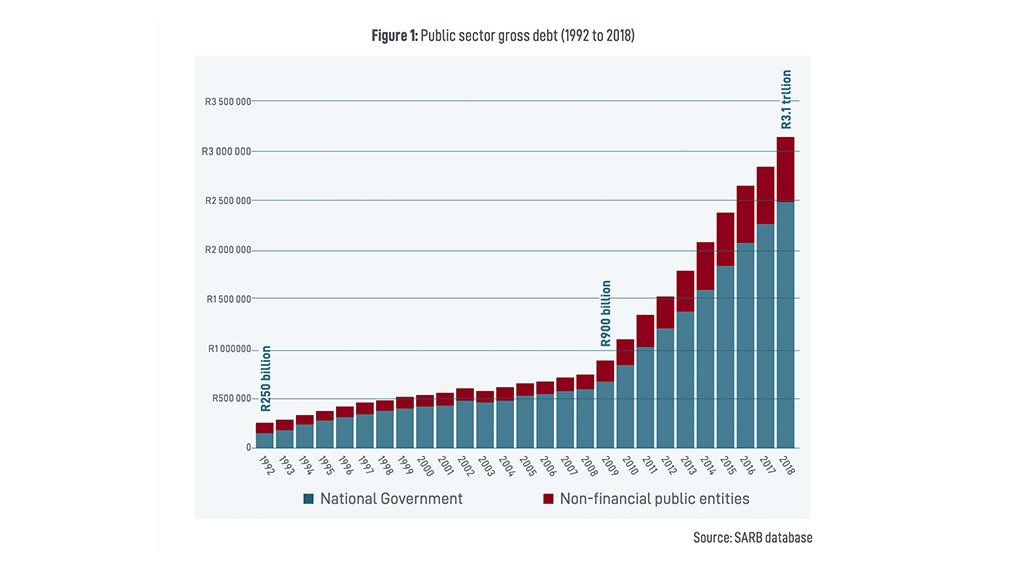


A new report on South Africa’s public finances draws a direct link between the “explosion” in the country’s public debt over the past ten years, from R990-billion in 2009 to R3-trillion currently, and the economy’s poor growth performance and outlook.
Titled ‘Running out of Road: South Africa’s public finances and what is to be done’, the report said that the country’s public debt stock, which includes debt accumulated by State-owned companies (SOCs), exceeds 60% of gross domestic product, which represents a return to the highest levels recorded towards the end apartheid.
“The build-up of public debt has slowed growth by directly raising the cost of capital and by increasing the risk of very bad outcomes. In slowing growth, public finances have increased the degree to which their trajectory is unsustainable, and unless determined efforts at fiscal consolidation are implemented now, the likelihood of an acceleration in growth is greatly diminished,” the report warns.
Published by Centre for Development and Enterprise (CDE) and written with support from several leading economists, the document urges government to take urgent steps to cut expenditure and introduce growth-supporting reforms.
These reforms should stimulate higher levels of private investment and improve the performance of the country’s debt-laden SOCs, but where the performance of an SOC is irretrievable the entity should be “allowed to fail”.
The report follows hot on the heels of the release of a potentially far-reaching National Treasury consultation paper titled ‘Economic transformation, inclusive growth, and competitiveness: Towards an Economic Strategy for South Africa’.
The National Treasury document warns that the combination of low growth and rising unemployment has placed South Africa on an “unsustainable” economic trajectory. It adds, however, that the economy’s potential growth could be increased by between two and three percentage points should a series of reforms be adopted.
In a departure from previous State-led government policies, the paper proposes a greater role for the private sector in network industries currently dominated by SOCs, such as electricity and water.
Titled ‘Economic transformation, inclusive growth, and competitiveness:
Towards an Economic Strategy for South Africa’, the paper even suggests that government could take a decision that Eskom should sell coal-fired power stations, possibly through a series of auctions.
The CDE report, meanwhile, highlights that low growth and public finances are interrelated and have to be address simultaneously. It, therefore, calls for “fiscal consolidation” through the cutting of expenditure rather than through raising taxes.
CDE executive director Ann Bernstein acknowledges that budget cuts could slow growth in the near term, but argues that build-up of debt to unsustainable levels is currently a larger drag on growth. “Therefore, fiscal consolidation has become necessary for long-term growth.”
Economist Lumkile Mondi adds that priority should be given to the “excessively rapid increase in public servants’ average remuneration, which has increased at around 11% a year for the last decade, a rate far in excess of inflation and economic growth.
That said, cutting Cabinet-level salaries and perks would also send a powerful signal of government’s seriousness about cutting expenditure and placing the country’s finances on a more sustainable footing.
Both Mondi and Bernstein stress, however, that placing South Africa’s public finances on a more sustainable footing is not possible without faster growth.
To accelerate the pace of growth, the report includes the following recommendations:
- That government adopts a different attitude towards business and the role of competitive markets.
- That the skills constraint be tackled through improvements to educational outcomes and through immigration reform.
- That energy supply be made reliable and affordable.
- That labour market and regulatory reform be instituted.
- And that urbanisation be accelerated, and city management be improved.
“Faster economic growth should be government’s top priority,” Bernstein says.
To illustrate the power of growth in containing debt, the CDE published a model showing that, had South Africa grown by 1% more a year for the past decade, government debt would be only 44% of gross domestic product, and falling, rather than the 63%, and rising, level at which it stands currently.
“One percent more growth is doable, and this means we can get off this debt path – but only if we do the things we have to do to get this economy growing.”
She, thus, urges government to adopt a stance in line with a sentiment expressed in a recent social-media post which read: “The question should be growth, the recipe should be growth, the solution should be growth – solve only for what can generate broad-based economic growth.”
Article Enquiry
Email Article
Save Article
Feedback
To advertise email advertising@creamermedia.co.za or click here
Research Reports

Projects

Latest Multimedia

Latest News

Showroom

The SAIMM started as a learned society in 1894 after the invention of the cyanide process that saved the South African gold mining industry of the...
VISIT SHOWROOM
ECG provides specialised electrical engineering services to the Mining, Utilities, Materials Handling and Industrial industries, with extensive and...
VISIT SHOWROOM

Press Office
Announcements
What's On
Subscribe to improve your user experience...
Option 1 (equivalent of R125 a month):
Receive a weekly copy of Creamer Media's Engineering News & Mining Weekly magazine
(print copy for those in South Africa and e-magazine for those outside of South Africa)
Receive daily email newsletters
Access to full search results
Access archive of magazine back copies
Access to Projects in Progress
Access to ONE Research Report of your choice in PDF format
Option 2 (equivalent of R375 a month):
All benefits from Option 1
PLUS
Access to Creamer Media's Research Channel Africa for ALL Research Reports, in PDF format, on various industrial and mining sectors
including Electricity; Water; Energy Transition; Hydrogen; Roads, Rail and Ports; Coal; Gold; Platinum; Battery Metals; etc.
Already a subscriber?
Forgotten your password?
Receive weekly copy of Creamer Media's Engineering News & Mining Weekly magazine (print copy for those in South Africa and e-magazine for those outside of South Africa)
➕
Recieve daily email newsletters
➕
Access to full search results
➕
Access archive of magazine back copies
➕
Access to Projects in Progress
➕
Access to ONE Research Report of your choice in PDF format
RESEARCH CHANNEL AFRICA
R4500 (equivalent of R375 a month)
SUBSCRIBEAll benefits from Option 1
➕
Access to Creamer Media's Research Channel Africa for ALL Research Reports on various industrial and mining sectors, in PDF format, including on:
Electricity
➕
Water
➕
Energy Transition
➕
Hydrogen
➕
Roads, Rail and Ports
➕
Coal
➕
Gold
➕
Platinum
➕
Battery Metals
➕
etc.
Receive all benefits from Option 1 or Option 2 delivered to numerous people at your company
➕
Multiple User names and Passwords for simultaneous log-ins
➕
Intranet integration access to all in your organisation
