Participants in Cape Town’s Blue Dot pilot project for minibus taxi industry exceed adherence expectations

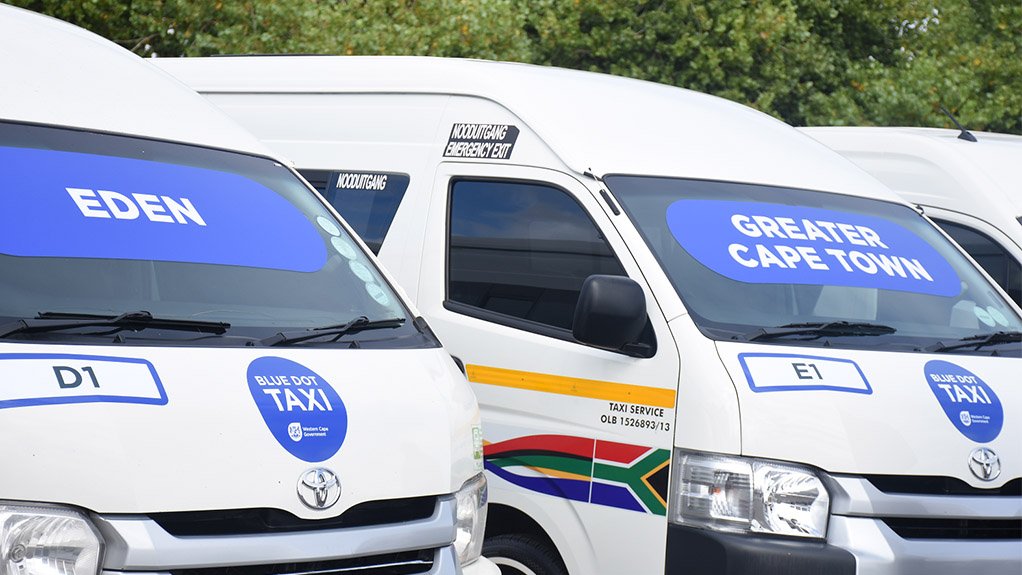


Cape Town has piloted and enjoyed successes from its Blue Dot programme, which was the city’s approach to improving minibus taxi transport – a necessary intervention given that minibus taxi services are the most widely used mode of public transport, but experience service quality challenges and receive sparse financial support from government.
This was noted by speakers during the South African Transport Conference, held in Pretoria earlier this month.
The Blue Dot programme was approved by the Western Cape provincial Cabinet in September 2020 and went live on May 15, 2021. The pilot phase ended on November 30, 2022.
It included 500 operators, 1 100 drivers and 800 taxis from across the province.
The programme was introduced with the aim of improving service quality and safety, leveraging technology to drive change, addressing taxi violence and illegal operations, and supporting industry formalisation and empowerment.
Participation ranged across the different levels of the industry, with Santaco Western Cape represented by UTS; regional taxi councils represented by new regional companies; and operators and drivers.
To be eligible to join and earn the stipend provided under the programme, all Blue Dot participants had to achieve and maintain a green status. Operators with this status received a monthly payment based on how well they performed against performance standards that measured driver behaviour and service quality.
Performance was scored using a star rating. The more stars received, the higher the incentive.
Performance standards were monitored using a bespoke technology system.
Importantly, participants did not receive any payment for achieving a green status (that is, compliance), but only if they operated well, drove well, and delivered a good quality of service to passengers.
To participate, operators and drivers had to meet certain requirements – most importantly, having a valid registration, having roadworthy vehicles and being tax compliant. To earn a Blue Dot, participants needed to drive well and deliver a good quality service, based on performance standards.
These standards were based on elements like speeding, harsh braking, cornering or acceleration and user feedback ratings. The best drivers were also recognised at an awards ceremony.
It was highlighted that there was a 40% reduction in harsh driving events and a 10% increase in kilometres driven by green status drivers. To meet the performance standards, vehicles had to provide a minimum level of service daily on legal routes to be eligible to earn and had to be driven by a registered driver with the technology system in place.
It was highlighted that Blue Dot went beyond compliance, with many of the outcomes going above this. This included, for examples, minibus taxis servicing a route for a minimum duration and frequency daily, to ensure a more reliable and user-friendly service for passengers; preventing hard-barking, acceleration, or cornering; and drivers being polite and helpful to their passengers – with none of these being a legal requirement.
Core outcomes of the programme included improved driver behaviour and service quality that went beyond compliance, and access to valuable data to reshape services.
Moreover, additional benefits were highlighted as a necessary first step towards transformation, and a building block for further interventions.
Further, there was the formalisation and empowerment of the industry, a crucial adjunct to regulation and enforcement; critical support for a vital service; and a new approach to minibus taxi service improvement and integration.
It was mentioned that there were pockets of resistance, with some drivers “thriving in chaos”. Therefore, there was no 100% driver uptake; however, it was widely noted to be well received, with the majority of drivers participating. Also, it had full participation of provincial and regional leadership.
Despite the successes this programme has enjoyed, it did not continue owing to a lack of further financial buy-in. Further, while it worked in the Western Cape, it might not be sustainable in other provinces, it was mentioned.
However, it was noted that owing to its successes, similar, but applicable programmes could be pursued elsewhere.
The impact of Blue Dot also entailed bespoke apps and intelligence platforms being developed, which enabled government to manage minibus taxi performance, and empowered companies and operators to manage daily operations.
Therefore, what is now being explored includes initiatives like a voucher system for taxis. While a version of this has been trialled and tested before, the Blue Dot programme has the benefit of systems already having been developed, which can be leveraged for data, rather than starting from scratch.
It was highlighted that the Blue Dot pilot was a success and has proven that the concept works.
While it has ended, it is hoped that it will restart soon, building on the lessons learnt. It was noted to be only the start of a continuous, longer-term upgrade of minibus taxi services.
The next steps would entail reviewing the lessons learned, adjusting the programme to enhance its impact and value for money, and securing the funding needed to expand it.
Article Enquiry
Email Article
Save Article
Feedback
To advertise email advertising@creamermedia.co.za or click here
Research Reports

Projects


Latest Multimedia
Latest News


Showroom

FLANDERS Southern Africa provides integrated solutions for mining and industrial operations, covering field services, automation, electrification,...
VISIT SHOWROOM
Sulzer South Africa, established in 1922, partners with critical industries like power, oil & gas, water, mining, and chemicals to boost...
VISIT SHOWROOM



Press Office
Announcements
What's On
Subscribe to improve your user experience...
Option 1 (equivalent of R125 a month):
Receive a weekly copy of Creamer Media's Engineering News & Mining Weekly magazine
(print copy for those in South Africa and e-magazine for those outside of South Africa)
Receive daily email newsletters
Access to full search results
Access archive of magazine back copies
Access to Projects in Progress
Access to ONE Research Report of your choice in PDF format
Option 2 (equivalent of R375 a month):
All benefits from Option 1
PLUS
Access to Creamer Media's Research Channel Africa for ALL Research Reports, in PDF format, on various industrial and mining sectors
including Electricity; Water; Energy Transition; Hydrogen; Roads, Rail and Ports; Coal; Gold; Platinum; Battery Metals; etc.
Already a subscriber?
Forgotten your password?
Receive weekly copy of Creamer Media's Engineering News & Mining Weekly magazine (print copy for those in South Africa and e-magazine for those outside of South Africa)
➕
Recieve daily email newsletters
➕
Access to full search results
➕
Access archive of magazine back copies
➕
Access to Projects in Progress
➕
Access to ONE Research Report of your choice in PDF format
RESEARCH CHANNEL AFRICA
R4500 (equivalent of R375 a month)
SUBSCRIBEAll benefits from Option 1
➕
Access to Creamer Media's Research Channel Africa for ALL Research Reports on various industrial and mining sectors, in PDF format, including on:
Electricity
➕
Water
➕
Energy Transition
➕
Hydrogen
➕
Roads, Rail and Ports
➕
Coal
➕
Gold
➕
Platinum
➕
Battery Metals
➕
etc.
Receive all benefits from Option 1 or Option 2 delivered to numerous people at your company
➕
Multiple User names and Passwords for simultaneous log-ins
➕
Intranet integration access to all in your organisation