Organisations ask South Africans to help it collect data for national crane census



The Endangered Wildlife Trust (EWT) is, in partnership with the International Crane Foundation (ICF), urging South Africans to participate in a national Crane Census over four days in July.
The National Crane Census used to take place on the last weekend of July from 1998 until 2006. Using modern technology, the EWT is reviving the census.
This citizen science project aims to provide vital information to estimate population size and to update distribution across the different species ranges.
In a media release, the EWT explains that the information collected will provide valuable data to guide future conservation actions and management decisions for the benefit of cranes.
“It is crucial that we verify whether observed increases and declines in crane populations are accurate. Through collaboration, we can better understand these trends and contribute to meaningful conservation action,” it states.
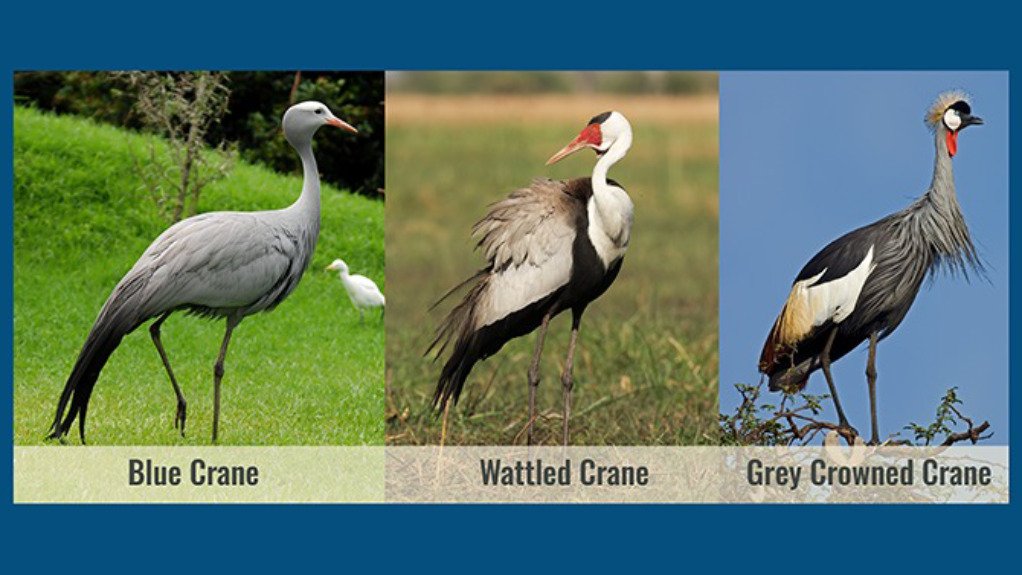
South Africa is home to three crane species – the Blue Crane, Wattled Crane and Grey Crowned Crane – with the Drakensberg range being a global hotspot for all three species.
Since the last National Crane Census 20 years ago, the EWT/ICF partnership has been conducting localised aerial surveys that indicate that the populations of the three species are increasing in KwaZulu-Natal, but that all three species are declining in other areas.
The EWT notes that the Blue Crane, South Africa’s National Bird, was uplisted from near threatened to vulnerable in the 2025 Red Data Book of Birds of South Africa, Lesotho and Eswatini, reflecting growing concern about the species’ future.
Moreover, concerted and targeted conservation efforts in the Drakensberg have seen the Wattled Crane downlisted from critically endangered to endangered, while the Grey Crowned Crane is listed as vulnerable in the South African Red Data Book.
The EWT says Wattled Cranes are good indicators of the health of the environment, particularly wetlands and grasslands, noting that cranes are among the world's most culturally significant birds, including in South Africa.
“They are widely associated with longevity, wisdom, fidelity, peace, vigilance and hope, making them powerful ambassadors for both natural and cultural heritage,” the EWT says.
Considered a flagship species for conservation, the EWT says the habitat for these majestic birds is being destroyed by mining, development and overuse. This includes collisions with power lines and other infrastructure.
In identifying the three crane species found in South Africa, it should be noted that each has very distinct features.
The Blue Crane is just over a metre tall, has a pale blue-grey body, a white crown and long, trailing black wing feathers.
The Grey Crowned Crane is easily recognisable by its striking crown of golden feathers on its head and the bright red gular sac under its chin, boasting grey, brown and black plumage with white wings.
The Wattled Crane is the tallest of these majestic birds and is easily recognisable by its long white neck, ash grey body and two wattles dangling under its chin.
The EWT says crane conservation in South Africa relies on the information submitted by landowners and the public in order to monitor numbers and localities of all three species.
Because information about the distribution of South Africa’s crane species is limited, the EWT is calling on all South Africans to assist in this important citizen science initiative on the weekend of July 24 to 27.
This time, the information can be shared using WhatsApp on 060 086 9053. People are encouraged to share the number of cranes they spot, the species of crane, as well as their location.
The information gathered during the survey will be kept confidential, including the contact details of participants. The results of the survey will be communicated once the information has been analysed.
Article Enquiry
Email Article
Save Article
Feedback
To advertise email advertising@creamermedia.co.za or click here
Research Reports

Projects



Latest News


Showroom

ZF Aftermarket is the after-sales division of the world-renowned German ZF group, a global leader in mobility technology.
VISIT SHOWROOM
Virtual Gas Network supplies compressed natural gas via a virtual gas distribution network.
VISIT SHOWROOM


Press Office
Announcements
What's On
Subscribe to improve your user experience...
Option 1 (equivalent of R125 a month):
Receive a weekly copy of Creamer Media's Engineering News & Mining Weekly magazine
(print copy for those in South Africa and e-magazine for those outside of South Africa)
Receive daily email newsletters
Access to full search results
Access archive of magazine back copies
Access to Projects in Progress
Access to ONE Research Report of your choice in PDF format
Option 2 (equivalent of R375 a month):
All benefits from Option 1
PLUS
Access to Creamer Media's Research Channel Africa for ALL Research Reports, in PDF format, on various industrial and mining sectors
including Electricity; Water; Energy Transition; Hydrogen; Roads, Rail and Ports; Coal; Gold; Platinum; Battery Metals; etc.
Already a subscriber?
Forgotten your password?
Receive weekly copy of Creamer Media's Engineering News & Mining Weekly magazine (print copy for those in South Africa and e-magazine for those outside of South Africa)
➕
Recieve daily email newsletters
➕
Access to full search results
➕
Access archive of magazine back copies
➕
Access to Projects in Progress
➕
Access to ONE Research Report of your choice in PDF format
RESEARCH CHANNEL AFRICA
R4500 (equivalent of R375 a month)
SUBSCRIBEAll benefits from Option 1
➕
Access to Creamer Media's Research Channel Africa for ALL Research Reports on various industrial and mining sectors, in PDF format, including on:
Electricity
➕
Water
➕
Energy Transition
➕
Hydrogen
➕
Roads, Rail and Ports
➕
Coal
➕
Gold
➕
Platinum
➕
Battery Metals
➕
etc.
Receive all benefits from Option 1 or Option 2 delivered to numerous people at your company
➕
Multiple User names and Passwords for simultaneous log-ins
➕
Intranet integration access to all in your organisation