NRWDI outlines steps being taken to prepare for safe interim storage of nuclear waste

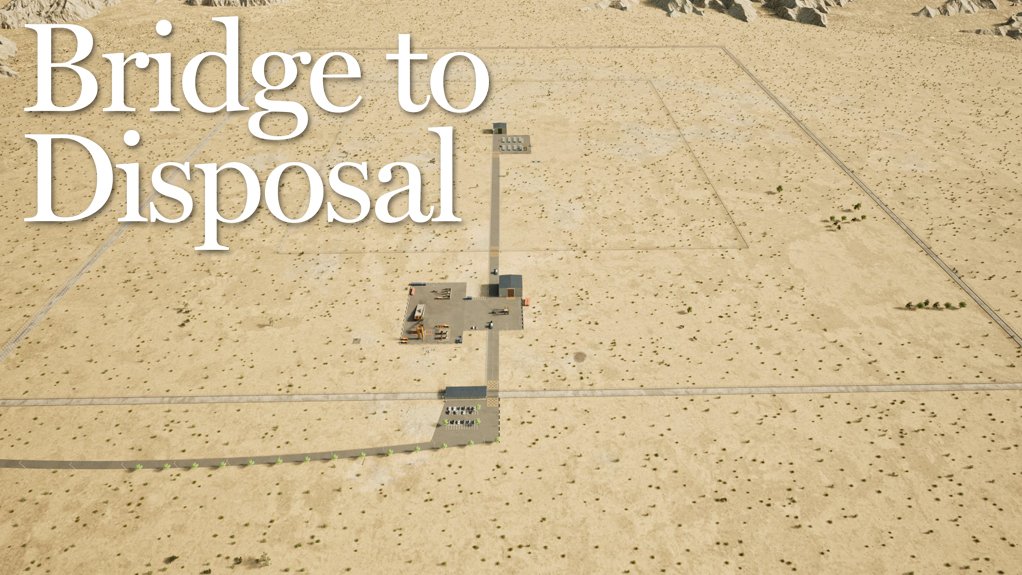


Buoyed by several significant milestones that the National Radioactive Waste Disposal Institute (NRWDI) has achieved over the past year, CEO Riedewaan Bakardien is upbeat about its prospects for shaping the future of South Africa’s nuclear waste management landscape and the back-end management of the nuclear fuel cycle.
In a wide-ranging interview with Engineering News & Mining Weekly, he delved into the NRWDI’s developing plans to strengthen the country’s long-term radioactive waste management capability through critical research and development, skills developing, technology localisation and the creation of high-quality employment opportunities.
Reflecting on his first year in office, Bakardien, who took the helm on April 1, 2025, says that all the metrics are trending in the right direction, with key strategic projects also progressing well.
The NRWDI, whose mandate to ensure that all radioactive waste generated in South Africa is safely managed and disposed of, achieved 100% of the implementation targets outlined in its latest Annual Performance Plan – for 2026/27 – for the first time in its history. It also successfully secured the licence for the full operation of the Vaalputs radioactive waste disposal facility, in the Northern Cape, from the South African Nuclear Energy Corporation (Necsa).
South Africa’s National Nuclear Regulator (NNR) approved the Vaalputs Nuclear Installation Licence (NIL-43) in July 2025, enabling the NRWDI to assume full operational control of Vaalputs in a carefully planned, months-long process that was completed on April 1.
The NRWDI is now fully responsible for the execution of all radioactive waste disposal activities, ensuring compliance, operational excellence and environmental stewardship, in line with national legislation and international best practice, including standards set by the International Atomic Energy Agency (IAEA), while reinforcing public trust in South Africa’s nuclear governance framework.
As the licensing process progressed, the NRDWI continued its transition from recovery and stabilisation to growth and delivery.
Centralised Interim Storage
The board formally approved a repositioning strategy aimed at enabling the NRWDI to deliver on long-term, complex national infrastructure programmes, including the Centralised Interim Storage Facility (CISF) and, ultimately, the Deep Geological Repository (DGR).
Over the medium term, the organisation is preparing for the establishment of its flagship R2-billion off-site above-ground CISF by 2030.
While the Vaalputs facility is specifically licensed and engineered to accommodate low-level radioactive waste, the CISF will be purpose-designed to manage spent nuclear fuel, providing dedicated capacity for higher- level radioactive materials and addressing a critical gap in South Africa’s radioactive waste management value chain.
The facility will provide a safe, centralised solution for the storage of spent fuel arising from Eskom’s Koeberg nuclear power station, located in the Western Cape, or Necsa’s Safari reactor, based in Pelindaba, in the North West. Spent fuel is currently stored on the respective sites.
With Koeberg’s two units having received a licence to operate for a further 20 years, until July 2045, Bakardien says the CISF will provide an interim storage solution for high-level radioactive waste storage in the absence of a DGR, which is currently in the planning phase and targeted for development by 2065.
It is envisaged that the spent fuel will be stored at the CISF, outside, on a specifically designed concrete plinth, with the facility equipped with the required, and all- encompassing, monitoring systems, radiation protection, maintenance, security, buildings and fencing, while meeting all critical safety and safeguard requirements.
At a later stage, an encapsulation facility will be added to enable the safe transfer of the stored spent fuel into the proposed DGR.
The institution plans to develop a detailed plan for the DGR this year, followed by further research and development activities and the identification of a suitable site to undertake initial testing.
The preliminary design work for the CISF, which is the bridge to the final disposal of spent fuel in the DGR, was completed at the end of March. The next phase will involve the procurement process for the detailed design, followed by licensing, construction and, ultimately, commissioning.
In parallel, the institution is continuing with the environmental authorisation process, including the environmental-impact assessment (EIA), which is currently under way.
“We plan to submit the application to the Department of Forestry, Fisheries and the Environment within the next year,” Bakardien says, adding that a two-year construction period is envisaged to start in 2028, subject to the requisite approvals.
Licensing for site establishment, construction and long-term operations will be a key part of the project and will be undertaken in stages.
Based on preliminary site investigations conducted in the early 1990s, the existing Vaalputs site is a candidate site for the establishment of the CISF and the DGR, subject to environmental, technical and regulatory assessments.
However, no site has been selected, and the final location will ultimately be determined through the EIA and design studies, and licensing requirements.
Meanwhile, the NRWDI currently receives 100% of its operational funding from government grant allocations, and following the licence approval, the Vaalputs operational budget has been transferred from Necsa to the NRWDI.
The licence also enables the NRWDI to generate revenue in the form of waste disposal fees from radioactive waste generators, notably Necsa and Eskom, through disposal fees and the Radioactive Waste Management Fund, which is currently being established as an initiative of the Department of Electricity and Energy.
While implementation of all legislative provisions to operationalise the “polluter pays” principle are still in progress, the NRWDI is prioritising the implementation of a sustainable financial model to ensure predictable and stable funding for its operations and capital programmes.
Future Opportunities
Overall, the spent nuclear fuel is managed as a potentially recoverable resource rather than as waste requiring disposal, as it can provide some value in future as the nuclear sector expands.
If the nuclear industry grows, spent fuel could be reprocessed and reused in reactors, providing one more cycle for the fuel before final disposal.
“Our thinking for those facilities is we need to be able to retrieve that spent fuel, and to do so for many years into the future.”
Ultimately, however, the decision is economic or financial, based on what is most cost effective. While some modifications to the reactors will be required, the largest cost lies in reprocessing.
It is not new technology, and reprocessing has worked in a few countries that have large nuclear industries that have explored or implemented fuel reprocessing programmes as part of their broader nuclear fuel cycle strategies.
“The only reason why we are not doing it in South Africa would be the cost. We envisage we would need about a 20 MW nuclear programme to make it a financially viable discussion, but we keep evaluating that as technology evolves,” says Bakardien.
While this is a possible forward-looking view for the industry, the two projects represent a catalyst for industrialisation, innovation and research and development, skills development and economic transformation.
There is a need to consider future approaches to radioactive waste, which requires extensive research.
“One of the mandates we have as an organisation is to do research in this space . . . to understand the geology of the area, seismic geohydrology, weather patterns and social impacts, besides others.”
In line with this, the NRWDI has signed a number of memoranda of understanding with local universities to undertake specific studies related to the CISF.
This includes geological characterisation, seismicity and radioactivity modelling, where opportunities exist to use AI and advanced modelling to develop the capability to “look” tens of thousands of years into the future, which is how long the spent fuel needs to be carefully managed.
“It is hard to predict where the world will be, but we need to build that into our thinking.”
“We have seen it done at MIT, for example, where they have recently undertaken studies on what happens in an area over tens of thousands of years, and now with the advances in computing power, they are able to do much more accurate predictions. This will provide key insights to ensure that facilities such as these will remain safe.”
Further opportunities include new technology development and deployment, with a lot of technology involved, from automation to AI and robotics skills, as well as skills development and job creation.
For the CISF, it is envisaged that, during construction, more than 100 jobs will be created, along with an additional 100 to 150 operational jobs as the facility advances.
In addition, the NRWDI aims to support schools in surrounding communities to develop skills from the early education phase and create opportunities for youth to develop future-facing skills.
“We see it as part of an opportunity, but also our responsibility, to work with neighbouring communities to help provide opportunities for people. We want to see them sending their kids to universities to gain skills in science, technology, engineering and mathematics fields [and] to become part of the future nuclear workforce.”
As the nuclear industry grows and new nuclear power plants are developed, those skills will be required on a larger scale across South Africa.
While the organisation’s work is on a smaller scale, compared with a nuclear power plant, it remains a key part of the ecosystem that creates opportunities for people while also supporting South Africa’s broader nuclear plans, he says.
Environmental Concerns
A key factor for the organisation is ensuring transparency, engagement and public awareness as these projects start taking shape.
When the project’s preliminary plans first emerged last year, some community and agricultural groups, including farming association TLU, expressed concern that the creation of the facility at Vaalputs could undermine community safety and food security, particularly as it is located in a sensitive and strategically important agricultural region. They also argued that there had been insufficient public consultation and transparency.
TLU raised concerns over food security and sustainable production, the environmental impact on ecologically sensitive areas, lack of transparency and public participation, and potential negative impacts on local development and investment. It also noted that the presence of a nuclear waste facility could negatively affect future agricultural development, tourism investment and land values.
“NRWDI is mindful of the importance of public consultation in the site selection process and therefore wants to assure all stakeholders that NWRDI will comply with all the requirements of the National Nuclear Regulatory Act and the National Environmental Management Act in terms of public participation,” the company noted at the time.
Since then, the NRWDI has held subsequent meetings with the various organisations and communities that had raised the concerns, Bakardien assures.
“I think it is right that people do ask those questions. It is nuclear and it is radioactivity, and we are putting it in an area that is close to farms and communities, so we understand the responsibility we have to share what it is that we are doing, and to take their concerns into account.”
He provides assurances that the Vaalputs land footprint will not be expanded and that any projects would be within the boundaries of the current site.
The institution will also consider the outcomes of the independent EIA process, which will assess potential impacts on flora and fauna, the broader environment, potential disturbances and all associated risks, including possible leaks of material or pollution, besides others.
Further, no final decision has been made on any specific site. While Vaalput has been put forward as a possibility, the final site selection will depend on the outcomes of the EIA process.
“There is also the NNR’s process and the licensing for a new facility which is required,” he says, noting that every detail will be taken into account, from radiological impact, dose or contamination, if any.
Nuclear is often viewed negatively; however, this facility has operated for 40 years with no incident, leaks or contamination, he says, noting that every precaution available is taken.
“We design for any possible events and to ensure that, should anything go awry, we can deal with it without it having an impact on the communities around the facility. We will take the same approach with the CISF facility. Our intent [for future projects] is to have only a positive impact on the environment, the public, or even for future generations.”
Awareness and education regarding the facility’s features and actual risk will be key.
Article Enquiry
Email Article
Save Article
Feedback
To advertise email advertising@creamermedia.co.za or click here
Research Reports

Projects

Latest Multimedia
Latest News
Showroom

ATI systems comprises five divisions: electrical assemblies, drives and controls, feedback sensors, enclosures, and strip guiding.
VISIT SHOWROOM
As a reticulator, Egoli Gas provides natural gas to homes and businesses via underground pipes.
VISIT SHOWROOM
Press Office
Announcements
What's On
Subscribe to improve your user experience...
Option 1 (equivalent of R125 a month):
Receive a weekly copy of Creamer Media's Engineering News & Mining Weekly magazine
(print copy for those in South Africa and e-magazine for those outside of South Africa)
Receive daily email newsletters
Access to full search results
Access archive of magazine back copies
Access to Projects in Progress
Access to ONE Research Report of your choice in PDF format
Option 2 (equivalent of R375 a month):
All benefits from Option 1
PLUS
Access to Creamer Media's Research Channel Africa for ALL Research Reports, in PDF format, on various industrial and mining sectors
including Electricity; Water; Energy Transition; Hydrogen; Roads, Rail and Ports; Coal; Gold; Platinum; Battery Metals; etc.
Already a subscriber?
Forgotten your password?
Receive weekly copy of Creamer Media's Engineering News & Mining Weekly magazine (print copy for those in South Africa and e-magazine for those outside of South Africa)
➕
Recieve daily email newsletters
➕
Access to full search results
➕
Access archive of magazine back copies
➕
Access to Projects in Progress
➕
Access to ONE Research Report of your choice in PDF format
RESEARCH CHANNEL AFRICA
R4500 (equivalent of R375 a month)
SUBSCRIBEAll benefits from Option 1
➕
Access to Creamer Media's Research Channel Africa for ALL Research Reports on various industrial and mining sectors, in PDF format, including on:
Electricity
➕
Water
➕
Energy Transition
➕
Hydrogen
➕
Roads, Rail and Ports
➕
Coal
➕
Gold
➕
Platinum
➕
Battery Metals
➕
etc.
Receive all benefits from Option 1 or Option 2 delivered to numerous people at your company
➕
Multiple User names and Passwords for simultaneous log-ins
➕
Intranet integration access to all in your organisation