Masondo reiterates the importance of private capital investment in infrastructure

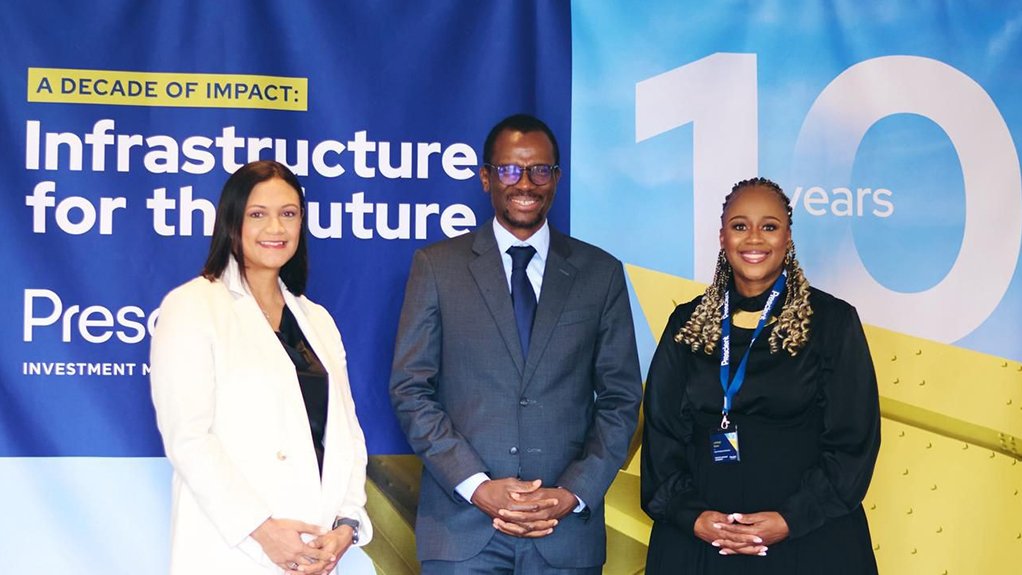
Prescient Investment Management CEO Cheree Dyers, Finance Deputy Minister Dr David Masondo and Prescient institutional investment head Letshego Rankin


Infrastructure as an asset class plays a dual role in building the economy by reducing the costs of doing business and by directly contributing to the economy.
For South African businesses to grow and thereby grow the economy, the country must reduce the cost of doing business, and infrastructure played a role in achieving this, said Finance Deputy Minister Dr David Masondo on March 19, in Westcliff, Johannesburg.
“Electricity and energy are expensive, freight and logistics are expensive and we are becoming less competitive. Development capital is also looking at other jurisdictions and, if the country does not position itself effectively within this competitive environment, less capital will come our way.
“Infrastructure plays a critical role in ensuring that South Africa attracts capital, which it can only do if it reduces the cost of doing business in the country,” he told investment professionals during financial services provider Prescient Investment Management's infrastructure conference.
South Africa and Africa had youthful populations, which were viewed as assets for economic growth and skilled labour, but, unless they could grow their economies, this asset could become a liability, he warned.
“We have to do something about this situation of high unemployment and high youth unemployment, hence the urgency to get economic growth going,” said Masondo.
Prescient Investment Management CEO Cheree Dyers noted that Finance Minister Enoch Godongwana, in an address to Parliament, emphasised that infrastructure was foundational to long-term economic growth, improved service delivery and job creation.
Additionally, the commitments South Africa had made to develop its infrastructure and network industries were significant, with R1-trillion allocated to infrastructure development over the three-year medium term, Dyers pointed out.
However, South Africa has an infrastructure funding gap of about R4-trillion over the next decade, and it is clear that public capital is insufficient to close this gap.
Long-term institutional capital had a role to play in developing infrastructure, she said.
The changes over the past decade, which allowed private generation of electricity, contributed to the diversification of energy resources and greater energy resilience in the country.
Infrastructure had moved from being a niche asset class to a core asset class. Many of the world's largest pension funds invest between 5% and 15% of their funds into infrastructure projects in recognition of the long-term, inflation-linked returns, and to diversify their investment portfolios, she said.
“Infrastructure matters, not as an asset class, but as the foundation of the kind of economy we want to build.
“South Africa is at a pivotal point and has placed infrastructure development at the centre of its economic strategy. We can see the scale in the commitments made in the Budget and the structural reforms driven by Operation Vulindlela, which are aimed at removing the bottlenecks in the network industries,” Dyers said.
However, unlocking private capital requires alignment of policy and capital, in which the role of institutional investors was critical.
The pace at which allocations were made to infrastructure projects was slow, but not without reason. For a long time, these investments fell outside the comfort zone of many portfolio funds because these investments were long-term investments, less liquid and not easy to price and compare.
However, as the pension fund system matured and the legal and regulatory frameworks for private investments in infrastructure improved locally and globally, the conversation within the investment industry needed to shift.
“The question then is not whether the investments are liquid, but whether the investments in infrastructure support growth. This is because, if the economy stagnates, all asset classes are affected,” Dyers said.
Masondo, who spoke after Dyers, echoed some of her sentiments, stating that pension fundswere well positioned to invest in this type of illiquid asset.
However, infrastructure investment and development must be done within the context the country found itself in, while enabling and supporting the macroeconomic environment.
“The National Development Plan aims to support 5% yearly GDP growth rate by 2030 to halve unemployment and poverty, and infrastructure is critical in achieving this goal.”
South Africa's current macroeconomic environment is supportive, with low and stable inflation, sovereign debt is stable and its sovereign rating has been upgraded.
This was important because the macroeconomic conditions affected the price of capital, he emphasised.
Stabilising the sovereign debt had meant the debt servicing costs had significantly declined because the country was managing its fiscus well, which meant its sovereign risk premium had also declined, he said.
Part of the reason South Africa's economy had not grown much since the Global Financial Crisis in 2008 was because of supply-side constraints, including electricity, telecommunications, water, freight, logistics and ports.
“These network industry services are typically dominated by inefficient State-owned enterprises (SoEs), which drags on the fiscus. Through Operation Vulindlela, we are not only solving for inefficient SoEs, but solving for the supply of energy, freight, logistics and telecommunications.
“The consequence of these reforms is more liberalised network industries, and we started with energy,” said Masondo.
South Africa's Credit Guarantee Vehicle, which aimed to help derisk private-sector investments in infrastructure, was being registered with the Prudential Authority at the Reserve Bank and would be operational in July, he noted.
The country would start with attracting capital to develop several thousand kilometres of electricity transmission infrastructure and then scale up. The intentionwas to use this Credit Guarantee Vehicle in other infrastructure projects to derisk capital flowing into sectors such as freight and logistics, Masondo said.
For example, SoE Transnet had been dominant in terms of rail freight and logistics, but South Africa was now allowing third-party access for freight rail service providers.
“Competition reduces the cost of doing business. A monopoly would offer only a single price for its services, and this generated costs for the economy.
“Opening up our freight and logistics through Operation Vulindlela is an opportunity to reduce the costs of doing business in South Africa and attract capital.
“We have done great work in our ports to attract private sector capital and expertise. In terms of rail infrastructure owned by Transnet, we need to enable the private sector to invest in our rail infrastructure.
“Crises present us with opportunities to improve. We must take advantage of the supportive macroeconomic conditions and the improving regulatory framework to seize the opportunities.
“For us as government, we must create the right vehicle and incentives to support the deployment of capital into this space,” said Masondo.
Article Enquiry
Email Article
Save Article
Feedback
To advertise email advertising@creamermedia.co.za or click here
Research Reports

Projects


Latest Multimedia

Latest News
Showroom

Developed to exceed the latest EN 15964 standards for police breathalysers proving that it will remain accurate and reliable for many years to come.
VISIT SHOWROOM


Press Office
Announcements
What's On
Subscribe to improve your user experience...
Option 1 (equivalent of R125 a month):
Receive a weekly copy of Creamer Media's Engineering News & Mining Weekly magazine
(print copy for those in South Africa and e-magazine for those outside of South Africa)
Receive daily email newsletters
Access to full search results
Access archive of magazine back copies
Access to Projects in Progress
Access to ONE Research Report of your choice in PDF format
Option 2 (equivalent of R375 a month):
All benefits from Option 1
PLUS
Access to Creamer Media's Research Channel Africa for ALL Research Reports, in PDF format, on various industrial and mining sectors
including Electricity; Water; Energy Transition; Hydrogen; Roads, Rail and Ports; Coal; Gold; Platinum; Battery Metals; etc.
Already a subscriber?
Forgotten your password?
Receive weekly copy of Creamer Media's Engineering News & Mining Weekly magazine (print copy for those in South Africa and e-magazine for those outside of South Africa)
➕
Recieve daily email newsletters
➕
Access to full search results
➕
Access archive of magazine back copies
➕
Access to Projects in Progress
➕
Access to ONE Research Report of your choice in PDF format
RESEARCH CHANNEL AFRICA
R4500 (equivalent of R375 a month)
SUBSCRIBEAll benefits from Option 1
➕
Access to Creamer Media's Research Channel Africa for ALL Research Reports on various industrial and mining sectors, in PDF format, including on:
Electricity
➕
Water
➕
Energy Transition
➕
Hydrogen
➕
Roads, Rail and Ports
➕
Coal
➕
Gold
➕
Platinum
➕
Battery Metals
➕
etc.
Receive all benefits from Option 1 or Option 2 delivered to numerous people at your company
➕
Multiple User names and Passwords for simultaneous log-ins
➕
Intranet integration access to all in your organisation