



Lots of if’s and but’s about India’s imminent return to iron-ore exporters top league

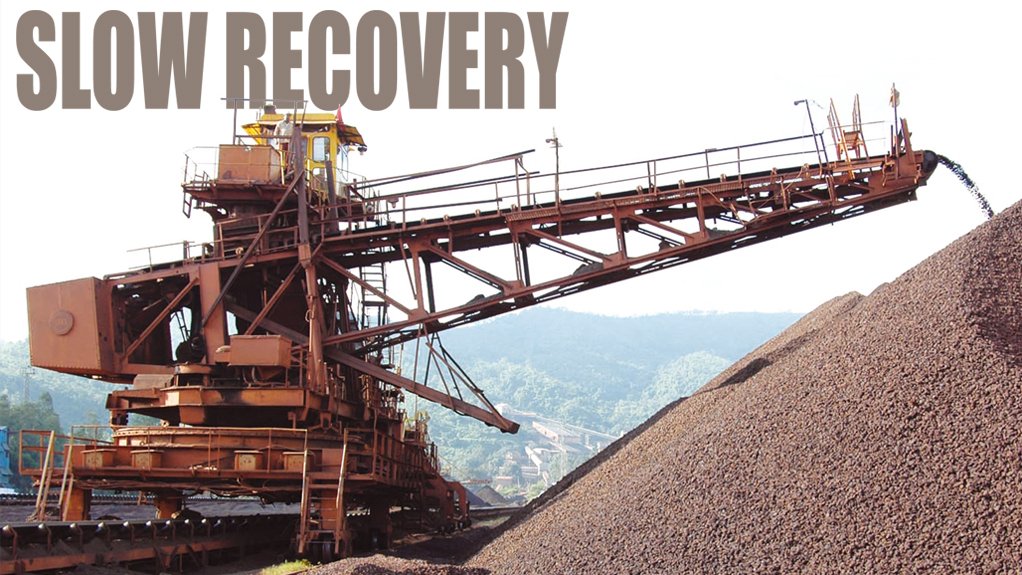


Since its heyday, which ended in 2009, few commentators have hazarded a guess on the revival of the Indian iron-ore mining industry, whose decline has been rapid.
But, after five years in the pits of gloom and doom, there seems to be a slight glimmer of hope. There are lots of if’s and but’s, however.
The cautious optimism is understand- able, considering that, in a very short period, India slipped from being the world’s third-largest exporter of iron-ore, after Australia and Brazil, to being number ten in the pecking order. The Asian country exported 116.3-million tons in 2008/9 of a total production of 215.01-million tons. In 2009/10, iron-ore exports tumbled to 107.21-million tons out of the 210.62-million tons produced that year. The slide continued in 2010/11, when 78.03- million tons of the 208.22-million-ton total output was shipped to international markets.
India lost its ‘third-largest iron-ore exporter’ status in 2011/12, after shipping a paltry 28.18-million tons out of the 152.6-million tons the country’s mines produced that year. The 2011/12 export volume secured the country the number four position on the global iron-ore export log. India declined further in 2013, ending the year as only the tenth-largest iron-ore exporter, far behind South Africa, which exported about 52-million tons, and Canada, which exported 35-million tons. From April to December 2013, Indian iron-ore exports were estimated at a measly 11.17-million tons. Total production during that period totalled 136-million tons.
Few are betting on India regaining its lost status as a Top Five iron-ore exporter any time soon – not with a 30% iron-ore export tax in place. While the Commerce Ministry is gunning for the tax to be scrapped to boost export earnings, the Steel Ministry, backed by steel mills, wants the tax to be retained to ensure greater raw material security of supply for domestic value addition.
Further, the industry has yet to recover from the ravages of illegal mining and a subsequent ban on such operations in the key iron-ore-producing states of Karnataka and Goa. A court-monitored resumption of mining in these states has been agonisingly slow.
Despite the negatives, the fact that iron-ore mines in Karnataka and Goa are limping back to production gives a flicker of hope to the down-in-the-dumps industry.
“I don’t think building a bull case scenario makes sense, given the multiple agencies involved in the Indian mining industry. However, we expect iron-ore supplies in the country to inch up 6% to 7% over the next two to three years, and India will continue to be a net exporter,” says Minerals of Espirito Santo Investment Bank senior analyst Ritesh Shah.
“First, looking at Karnataka, the current run rate is 17-million tons to 18-milion tons on an annualised basis. Going by the current slow pace at which the ban is being lifted, we don’t think we will cross 20-million tons in the next fiscal year but, factoring in few existing mines ramping up output, we can hope for a 25-million-ton to 27-million-ton run rate,” he says.
“In Goa, the provincial government is working at a fast pace and recent trends are encouraging. We expect 13-million tons to 15-million tons of the existing inventory to be auctioned, [after] which supplies will be subject to Supreme Court directives on buffer zones and mining caps . . . Mining should be normalised over the next few months,” Shah adds.
Weighing in, Federation of Indian Mineral Industries (FIMI) president Hukum Chand Daga says: “A 6% to 7% growth in production and higher export volumes in the coming fiscal period are realistic but such growth rates would still be too marginal.
“Even this anticipated growth rate is subject to so many variables – a judicial review and monitoring of the resumption of mining in Karnataka and Goa, administrative issues pertaining to the granting of approvals and executive decisions on the action to be taken against illegal mining in Orissa, established by the investigating commission,” Daga said.
According to Espirito Santo Investment Bank forecasts, iron-ore production will increase to around 142-million tons next year and stabilise at around 170-million tons thereafter.
With new supplies from Orissa and Chattisgarh and inventory liquidations in Goa, Indian iron-ore exports could top the 30-million-ton mark in the coming year, surprising the global seaborne trade watchers, an analyst with the investment bank says.
But this sliver of optimism is yet to gain traction across the iron-ore mining industry, particularly among consuming industries. The multiplicity of issues and agencies involved in getting mining back on the rails and the notoriously slow pace of bureaucratic decision-making are the most cited reasons why this optimism might be misplaced.
Some commentators highlight that, in Karnataka, for example, the number of agencies involved in the iron-ore industry include the state Environment Ministry, federal environmental agencies, local-level monitoring committees, central-level monitoring committees and the state Transport Department. Mining was banned in Karnataka by the Supreme Court in June 2011.
Subsequently, the court imposed a cap of 30-million tons a year on iron-ore mining in the province and later permitted the resumption of operations at only 15 of the 115 mines in the state, subject to their meeting specific court-imposed conditions.
“While the availability of iron-ore in the next fiscal year will be somewhat higher than in the current year, one does not foresee any turnaround, as the resumption of mining operations in Karnataka is extremely slow, owing to delays in processing various statutory applications,” says Alloy Steel Producers Association chairperson Suketu Shah.
“Further, the Supreme Court has yet to decide on the lifting of the mining ban in the state of Goa. There are apprehensions about government action on the Shah Commissions’ investigation report on illegal mining in Orissa,” he adds.
A production volume of 142-million tons to 145-million tons in the next fiscal year could have a marginal salutary impact on the volume of iron-ore shipped overseas, as the conflicts in the industry – pitting miner against consumer, and miner against government – preclude a dramatic increase in exports.
According to the FIMI, the current situation is expected to continue until there are changes in government policy, such as scrapping the 30% tax on fines exports and the 5% on pellet exports.
But iron-ore consumers are not particularly worried about severely limited exports of the steelmaking ingredient. “There could be no objection to exports as long as this takes place after considering the growing requirements for the raw material for [local] steel producers’ expansion projects . . . There should be no special consideration for exports at the expense of domestic demand,” says Suketu Shah.
“Exports of iron-ore may bring in, say, $100/t, but a fall in domestic steel production resulting from a shortage of raw material and the resultant rise in steel imports could see an outgo of foreign exchange of $550 for each ton of steel shipped into the country,” he concludes.
Article Enquiry
Email Article
Save Article
Feedback
To advertise email advertising@creamermedia.co.za or click here
Research Reports

Projects


Latest Multimedia

Latest News
Showroom

Complete range of security sealing solutions including security seals bags and labels.
VISIT SHOWROOM
Sulzer South Africa, established in 1922, partners with critical industries like power, oil & gas, water, mining, and chemicals to boost...
VISIT SHOWROOM



Announcements
What's On
Subscribe to improve your user experience...
Option 1 (equivalent of R125 a month):
Receive a weekly copy of Creamer Media's Engineering News & Mining Weekly magazine
(print copy for those in South Africa and e-magazine for those outside of South Africa)
Receive daily email newsletters
Access to full search results
Access archive of magazine back copies
Access to Projects in Progress
Access to ONE Research Report of your choice in PDF format
Option 2 (equivalent of R375 a month):
All benefits from Option 1
PLUS
Access to Creamer Media's Research Channel Africa for ALL Research Reports, in PDF format, on various industrial and mining sectors
including Electricity; Water; Energy Transition; Hydrogen; Roads, Rail and Ports; Coal; Gold; Platinum; Battery Metals; etc.
Already a subscriber?
Forgotten your password?
Receive weekly copy of Creamer Media's Engineering News & Mining Weekly magazine (print copy for those in South Africa and e-magazine for those outside of South Africa)
➕
Recieve daily email newsletters
➕
Access to full search results
➕
Access archive of magazine back copies
➕
Access to Projects in Progress
➕
Access to ONE Research Report of your choice in PDF format
RESEARCH CHANNEL AFRICA
R4500 (equivalent of R375 a month)
SUBSCRIBEAll benefits from Option 1
➕
Access to Creamer Media's Research Channel Africa for ALL Research Reports on various industrial and mining sectors, in PDF format, including on:
Electricity
➕
Water
➕
Energy Transition
➕
Hydrogen
➕
Roads, Rail and Ports
➕
Coal
➕
Gold
➕
Platinum
➕
Battery Metals
➕
etc.
Receive all benefits from Option 1 or Option 2 delivered to numerous people at your company
➕
Multiple User names and Passwords for simultaneous log-ins
➕
Intranet integration access to all in your organisation
