



Hints of deeper monetary, fiscal coordination as Kganyago is named SARB governor

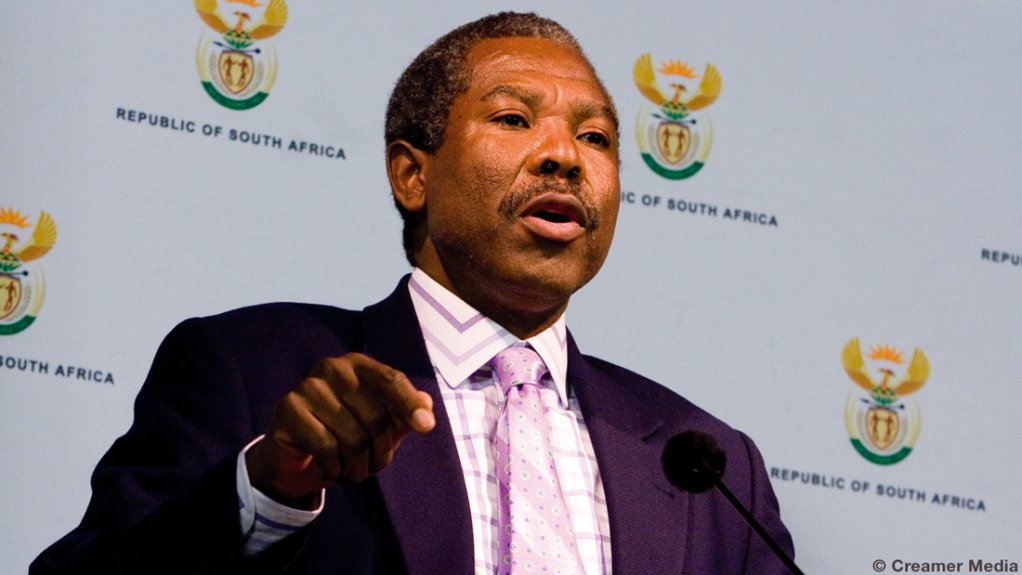


President Jacob Zuma announced on Monday that Lesetja Kganyago would replace Gill Marcus as governor of the South African Reserve Bank (SARB).
Marcus announced in September that she would be stepping down when her contract expired on November 8.
Kganyago has been a deputy governor at the bank since 2011, having previously worked as the director-general in the National Treasury from 2004 to 2011.
Prior to joining the National Treasury in 1996, he worked in a junior position at the SARB from 1994, having acted as an economics coordinator and accountant for the African National Congress and as an accountant for the Congress of South African Trade Unions before that appointment.
Kganyago holds a Master of Science degree in development economics from the University of London’s School of Oriental and African Studies and a Bachelor of Commerce degree in accounting and economics from the University of South Africa.
Zuma thanked Marcus for her “sound leadership, commitment and dedication” and said the decision to select her replacement from within the bank should ensure a “smooth transition”.
Marcus thanked Zuma for selecting her successor from within the ranks of the SARB, arguing that it demonstrated the depth of talent that had been built within the institution. She also indicated that she would abide by the six-month "cooling off" period for public servants before pursuing future opportunities.
Speaking at his unveiling at the Union Buildings, Kganyago stressed that there would be continuity from the leadership of Marcus, who had overseen a broadening of the bank’s mandate in the wake of the global financial crisis. Besides price stability, the bank had also been asked to ensure financial stability, or to balance the need to keep inflation within the 3% to 6% target band with the need to support economic growth.
"These twin mandates are what we will continue to espouse and we will be able to pursue these mandates as our Constitution tasks us to do," Kganyago said, quoting from Section 224 of the Constitution, which stated that the SARB's primary mandate was to protect the value of the currency "in the interests of balanced and sustainable growth".
Such a balance would be pursued in "regular consultation between the South African Reserve Bank and the Cabinet member responsible for national financial matters", as was also outlined in the Constitution.
"He [Finance Minister Nhlanhla Nene] is here [today]. I know where his office is, I know where he stays, I have his telephone number [and] I will make sure that those regular consultations actually do take place."
Nene responded by saying that he expected that fiscal and monetary policy coordination would be taken to the “next level” with Kganyago at the helm.
"He comes from a team that has done well, he has been part of this team . . . a team that is dedicated to taking the country forward and I trust that the coordination of monetary and fiscal policy is going to be taken to the next level," Nene said.
Kganyago, who promised that he would disappoint neither the leaders who had selected him for the task nor the country, takes over during a difficult period for the South African economy, which is struggling to grow and is facing cost pressures.
A number of economic commentators have also argued that the new governor would have limited scope for further accommodative monetary polity, particularly in light of growing indications that the US Federal Reserve plans to begin reining in its quantitative easing.
In September, the monetary policy committee decided to leave the repo rate unchanged at 5.75%, having moved to hike rates at its previous meeting.
While committing to the course pursued by Marcus, which included broad-based societal engagement, Kganyago also promised that he would seek to build an institution that "attracts the best brains", including individuals with the capacity to help the bank navigate the financial-stabilisation component of its mandate.
"The South African Reserve Bank must be geared up to fulfil that mandate, [as] the issue of financial stability is more complex than that of monetary policy."
Article Enquiry
Email Article
Save Article
Feedback
To advertise email advertising@creamermedia.co.za or click here
Research Reports

Projects


Latest Multimedia


Latest News


Showroom

Sika South Africa is a trusted partner for the nation’s infrastructure, commercial, residential, and industrial sectors.
VISIT SHOWROOM
Multotec, recognised industry leaders in metallurgy and process engineering help mining houses across the world process minerals more efficiently,...
VISIT SHOWROOM



Press Office
Announcements
What's On
Subscribe to improve your user experience...
Option 1 (equivalent of R125 a month):
Receive a weekly copy of Creamer Media's Engineering News & Mining Weekly magazine
(print copy for those in South Africa and e-magazine for those outside of South Africa)
Receive daily email newsletters
Access to full search results
Access archive of magazine back copies
Access to Projects in Progress
Access to ONE Research Report of your choice in PDF format
Option 2 (equivalent of R375 a month):
All benefits from Option 1
PLUS
Access to Creamer Media's Research Channel Africa for ALL Research Reports, in PDF format, on various industrial and mining sectors
including Electricity; Water; Energy Transition; Hydrogen; Roads, Rail and Ports; Coal; Gold; Platinum; Battery Metals; etc.
Already a subscriber?
Forgotten your password?
Receive weekly copy of Creamer Media's Engineering News & Mining Weekly magazine (print copy for those in South Africa and e-magazine for those outside of South Africa)
➕
Recieve daily email newsletters
➕
Access to full search results
➕
Access archive of magazine back copies
➕
Access to Projects in Progress
➕
Access to ONE Research Report of your choice in PDF format
RESEARCH CHANNEL AFRICA
R4500 (equivalent of R375 a month)
SUBSCRIBEAll benefits from Option 1
➕
Access to Creamer Media's Research Channel Africa for ALL Research Reports on various industrial and mining sectors, in PDF format, including on:
Electricity
➕
Water
➕
Energy Transition
➕
Hydrogen
➕
Roads, Rail and Ports
➕
Coal
➕
Gold
➕
Platinum
➕
Battery Metals
➕
etc.
Receive all benefits from Option 1 or Option 2 delivered to numerous people at your company
➕
Multiple User names and Passwords for simultaneous log-ins
➕
Intranet integration access to all in your organisation
