Grassroots recycling programme aims to educate learners on importance of waste reduction – SST

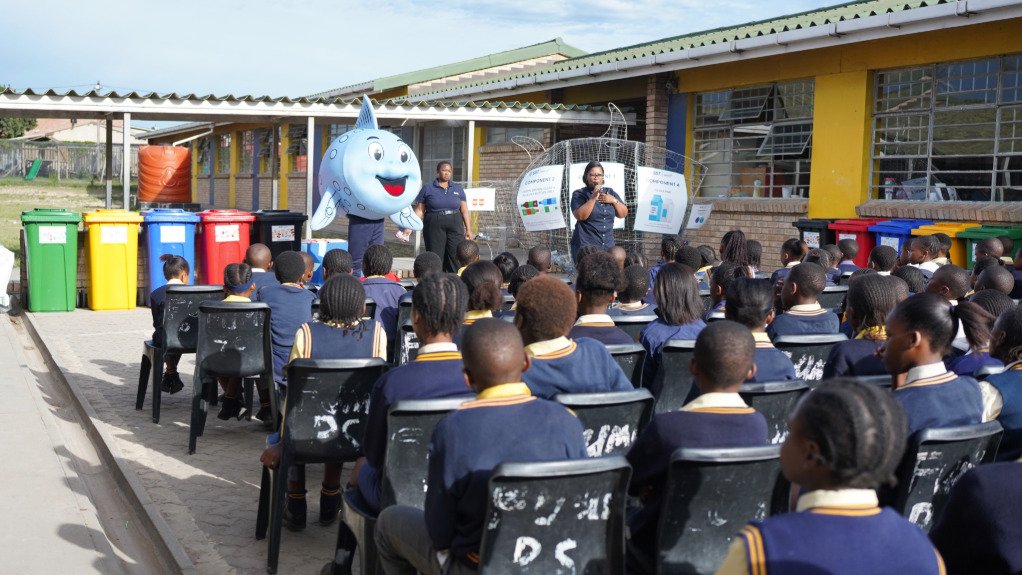


Nonprofit science-based organisation the Sustainable Seas Trust (SST) is advancing a grassroots recycling programme aimed at changing how South African school pupils think about waste.
Currently in its launch phase, the programme dubbed “Munch-on-the-Move” is being rolled out in 11 schools across Cape Town, Durban and Gqeberha, with a total of 22 expected to be onboarded by early 2027.
SST has unveiled a giant wire fish sculpture called Munch as a way of encouraging learners to separate recyclable waste at source.
The organisation says the programme’s engaging approach is driving measurable behavioural change, with pupils taking full ownership of the recycling system.
“It’s a great visible reminder that protecting our marine life and addressing ocean pollution starts with managing our land-based sources of waste,” says SST Operation Clean Spot (OCS) manager Carla Kampman.
Across several pilot schools, Kampman says, daily litter accumulation has dropped from between 244 and 400 litter items a day during baseline surveys to fewer than 100 items a day after the interventions were implemented, adding that, in some cases, daily litter counts decreased by more than 75%, while litter weight reductions of over 50% were recorded at multiple sites.
Given the continent’s status as one of the world’s most highly polluted, Kampman notes that Munch forms part of SST’s flagship OCS programme, which aims to implement systems-based waste solutions across Africa.
“What SST is testing in schools and communities is therefore not just locally relevant. It is foundational to understanding what effective behaviour change and waste recovery systems could look like at scale across the continent.
“Importantly, the impact extends far beyond the school grounds. Each new school introduced to the programme becomes a local hub for awareness, participation and behaviour change, helping strengthen recycling practices within households and communities while reducing the likelihood of recyclable waste leaking into rivers and the ocean,” Kampman says.
At Christmas Tinto Primary School in Strand, Cape Town, educator Bolekwa Malangeni says Munch has begun to have an impact on the wider community, with pupils educating their families about responsible waste management and getting their households involved in collecting recyclable materials.
“What is good about it is getting pupils involved, teaching them about recycling, the importance of recycling and keeping our school clean, not just the school, but also outside it,” says Malangeni.
In Gqeberha, in the Eastern Cape, educator Mihlali Pasiwe says the project will help to address the problem of environmental waste at Fumisikoma Primary School and also in the surrounding areas.
“Because we are surrounded by informal settlements, these residents don’t have access to municipal services. They don’t know where to dump their waste, so it ends up everywhere.
“Even in the classroom context, if there are papers on the floor, you need to tell the pupils to pick them up. It doesn’t come naturally to them. This project will definitely educate them on how to deal with waste, and also benefit the community and help them understand,” Pasiwe explains.
Kampman notes that participating schools were supported with training on how to use the free curriculum-aligned educational resources, along with the large wire mesh Munch sculpture, a recycling station and general waste bin for items not fed to Munch, as well as practical guidance on implementing recycling and awareness activities in ways that were locally appropriate and achievable.
She says the programme will focus on Grades 3 to 5 this year, and track the behaviour patterns in this group of learners until 2028, when the Grade 5 cohort will be in their final year of primary school.
Kampman concludes that one of the strongest findings from the pilot is that long-term environmental impact depends not only on awareness, but on strengthening the broader waste and recycling ecosystem around communities.
Article Enquiry
Email Article
Save Article
Feedback
To advertise email advertising@creamermedia.co.za or click here
Research Reports
Projects


Latest Multimedia
Latest News
Showroom
As one of South Africa's leading manufacturers, Bell Equipment distributes and exports its wide range of heavy equipment globally to mining,...
VISIT SHOWROOM
At Airshrink - CiP, we surpass customer expectations with innovative MV and LV cable accessories, including heat shrink joints, terminations,...
VISIT SHOWROOM
Press Office
Announcements
What's On
Subscribe to improve your user experience...
Option 1 (equivalent of R125 a month):
Receive a weekly copy of Creamer Media's Engineering News & Mining Weekly magazine
(print copy for those in South Africa and e-magazine for those outside of South Africa)
Receive daily email newsletters
Access to full search results
Access archive of magazine back copies
Access to Projects in Progress
Access to ONE Research Report of your choice in PDF format
Option 2 (equivalent of R375 a month):
All benefits from Option 1
PLUS
Access to Creamer Media's Research Channel Africa for ALL Research Reports, in PDF format, on various industrial and mining sectors
including Electricity; Water; Energy Transition; Hydrogen; Roads, Rail and Ports; Coal; Gold; Platinum; Battery Metals; etc.
Already a subscriber?
Forgotten your password?
Receive weekly copy of Creamer Media's Engineering News & Mining Weekly magazine (print copy for those in South Africa and e-magazine for those outside of South Africa)
➕
Recieve daily email newsletters
➕
Access to full search results
➕
Access archive of magazine back copies
➕
Access to Projects in Progress
➕
Access to ONE Research Report of your choice in PDF format
RESEARCH CHANNEL AFRICA
R4500 (equivalent of R375 a month)
SUBSCRIBEAll benefits from Option 1
➕
Access to Creamer Media's Research Channel Africa for ALL Research Reports on various industrial and mining sectors, in PDF format, including on:
Electricity
➕
Water
➕
Energy Transition
➕
Hydrogen
➕
Roads, Rail and Ports
➕
Coal
➕
Gold
➕
Platinum
➕
Battery Metals
➕
etc.
Receive all benefits from Option 1 or Option 2 delivered to numerous people at your company
➕
Multiple User names and Passwords for simultaneous log-ins
➕
Intranet integration access to all in your organisation