Extreme weather requires more than a visual inspection for solar plants


This article has been supplied.
By: Heather Dugmore
South Africa's largest insurers say claims for weather-related damage to solar assets have exponentially increased. As insurers tighten cover and claim conditions, the burden of proof on solar plant owners will increase.
According to industry association SAPVIA, the current estimate of South Africa’s cumulative installed solar capacity exceeded 10 GW in early 2026, and the country's exposure to weather-related asset damage has increased in step.
PV plants are continuously exposed to harsh and variable weather conditions, including hail, lightning and severe storms. The floods and wind speeds of 120km/h in early May this year in the Western and Eastern Cape are a case in point. Solar plant owners need to be aware that weather and storm damage does not end with what is visibly broken. Hailstones, lightning, airborne debris and severe wind can cause damage inside a module that is invisible from the outside and undetectable through standard inspection.
“A plant can appear to be generating normally while carrying hidden structural damage, such as microcracks, that will compound into material performance loss over months and years,” says PVinsight (Pty) Ltd’s Operations and Technical Manager, physicist Dr Jacqui McCleland. PVinsight is a specialist solar photovoltaic (PV) module testing, inspection, and engineering consulting company led by its CEO, physicist Professor Ernest van Dyk. It has the only SANAS-accredited ISO 17025 mobile laboratory testing service in South Africa for field testing.
Microcracks, McCleland explains, are linked to over 35% of long-term module failures, making them the single most consequential defect class in a post-storm assessment. “The gap between what is visible and what has actually happened is something that only high-resolution electroluminescence (EL) imaging on a ground-based system can reliably detect.”
Without an independent accredited EL baseline, plant owners have no documented reference point from which to demonstrate that weather or storm damage occurred, quantify its extent, or pursue an insurance or warranty claim.
"Wind is one of the most underestimated stress factors affecting module integrity over time,” adds PVinsight (Pty) Ltd’s Testing Services Manager, physicist Dr Monphias Vumbugwa. “Repeated wind-induced vibrations and flexing can lead to the development of microcracks in solar cells, even when modules are installed according to standards. These microcracks are invisible during routine visual inspections but can significantly impact module efficiency and accelerate degradation if left undetected."
Hail remains the single most expensive category of insured loss across the global solar industry, according to the kWh Analytics 2026 Solar Risk Assessment, published by kWh Analytics, a climate and renewable energy insurance provider with a proprietary database of over 300,000 renewable energy projects and $100 billion in loss data.
McCleland explains that thermal drone scanning is a frequently used post-event inspection tool for large PV plants. “It is effective for identifying hotspots and active electrical faults, but it is not effective for detecting micro-cracks, cell damage or early-stage defects, because these do not generate a thermal signature until degradation is already well advanced,” explains McCleland. “For this you need tripod-mounted, ground-based EL imaging which places the camera at module level under stable, controlled conditions.”
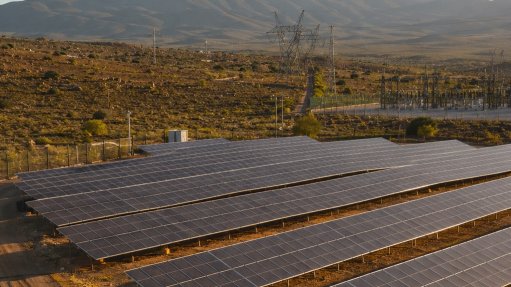
In March this year, PVinsight completed the largest in-situ EL imaging project ever undertaken in South Africa, testing 25,000 modules on a 155 MW plant in the Northern Cape. The project demonstrates that high-resolution ground-based EL imaging is now operationally viable at utility scale in South Africa. The dataset serves as the most comprehensive, independently accredited EL baseline ever established for a South African PV plant, giving the owner, lenders and insurers a documented reference point for the full operational life of the asset. This can be compared against any future assessment of weather damage or degradation.
EL imaging works by applying a current to energise a PV module and capture the light emitted by the solar cells. Healthy cells glow brightly and uniformly. Cracks, inactive cell areas and structural damage appear as dark patches or irregular patterns, revealing damage that is invisible to any other inspection method.
The defects that high-resolution EL identifies, and that drone EL or thermal scanning may miss, include:
Fine cell cracks caused by wind-induced module deflection
Impact damage from hail or airborne debris
Inactive cell areas resulting from crack propagation
Soldering defects exacerbated by mechanical stress
Lost substrings in modules
Each of these defect types reduces module output and compounds in its performance impact over time. Critically, EL imaging must be conducted at night. The technique requires darkness to detect the light emitted by energised cells without interference from ambient light, which means testing has no impact on daytime plant generation.
A documented, independently verified record of module condition can be compared against any future assessment of weather damage or degradation. A post-storm EL assessment serves two purposes. If it finds damage, it quantifies and documents it, providing the evidence base for insurance claims and warranty recourse. If it finds no damage, that result is equally valuable: it is a documented, accredited confirmation that the asset emerged from the event intact, which directly supports investor and lender confidence in the plant's projected performance over its remaining operational life.
The insurance industry is already moving in this direction. An accredited EL report from an ISO 17025 laboratory, conducted by an independent third party, is a materially stronger basis for a claim than a visual inspection report or thermal drone scan.
Article Enquiry
Email Article
Save Article
Feedback
To advertise email advertising@creamermedia.co.za or click here
Research Reports

Projects
Latest Multimedia


Latest News


Showroom
AirNox (Pty) Ltd is a level 1 BBBEE manufacturer of complete AdBlue® solutions for operators of SCR diesel engines and AUS40 across South Africa...
VISIT SHOWROOM
Stewarts & Lloyds is a leading steel, tube, and engineering product supplier in South Africa.
VISIT SHOWROOM


Press Office
Announcements
What's On
Subscribe to improve your user experience...
Option 1 (equivalent of R125 a month):
Receive a weekly copy of Creamer Media's Engineering News & Mining Weekly magazine
(print copy for those in South Africa and e-magazine for those outside of South Africa)
Receive daily email newsletters
Access to full search results
Access archive of magazine back copies
Access to Projects in Progress
Access to ONE Research Report of your choice in PDF format
Option 2 (equivalent of R375 a month):
All benefits from Option 1
PLUS
Access to Creamer Media's Research Channel Africa for ALL Research Reports, in PDF format, on various industrial and mining sectors
including Electricity; Water; Energy Transition; Hydrogen; Roads, Rail and Ports; Coal; Gold; Platinum; Battery Metals; etc.
Already a subscriber?
Forgotten your password?
Receive weekly copy of Creamer Media's Engineering News & Mining Weekly magazine (print copy for those in South Africa and e-magazine for those outside of South Africa)
➕
Recieve daily email newsletters
➕
Access to full search results
➕
Access archive of magazine back copies
➕
Access to Projects in Progress
➕
Access to ONE Research Report of your choice in PDF format
RESEARCH CHANNEL AFRICA
R4500 (equivalent of R375 a month)
SUBSCRIBEAll benefits from Option 1
➕
Access to Creamer Media's Research Channel Africa for ALL Research Reports on various industrial and mining sectors, in PDF format, including on:
Electricity
➕
Water
➕
Energy Transition
➕
Hydrogen
➕
Roads, Rail and Ports
➕
Coal
➕
Gold
➕
Platinum
➕
Battery Metals
➕
etc.
Receive all benefits from Option 1 or Option 2 delivered to numerous people at your company
➕
Multiple User names and Passwords for simultaneous log-ins
➕
Intranet integration access to all in your organisation