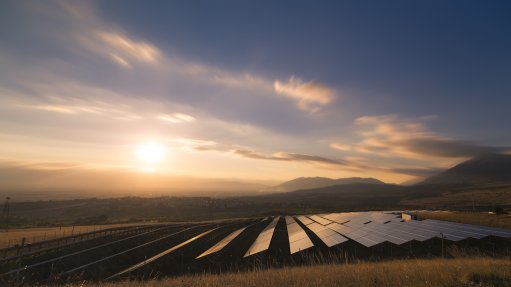
What’s next for South Africa’s gigawatt-scale yearly solar market?





The South African Photovoltaic Industry Association (SAPVIA) hosted its AGM this week and also released its annual report. The recognised voice of South Africa’s PV industry, representing almost 500 members across the value chain, Creamer Media’s Terence Creamer used the opportunity to pose some questions to CEO Dr Rethabile Melamu on the state of the industry and its outlook. The questions and Melamu’s responses follow:
Creamer Media: What was the performance of the solar market in South Africa during 2025, and what were the key drivers?
Rethabile Melamu: South Africa solidified its position as a mature, gigawatt-scale solar market during the 2025/26 financial year. Cumulative installed solar PV capacity officially crossed the 10 GW threshold, driven by 1.6 GW of new installations in 2025, making South Africa Africa's leading solar market and one of the top 20 globally.
Growth was anchored by public and private investment in the utility-scale and commercial and industrial (C&I) segments, with the Renewable Energy Independent Power Producer Procurement Programme (REIPPPP) contributing 0.3 GW and non-REIPPPP projects contributing 1.3 GW. Public procurement achieved major milestones through REIPPPP Bid Window 5, with projects reaching commercial operation, including the 225 MW Grootfontein Solar Cluster and the twin 75 MW Grootspruit and Graspan plants (150 MW combined).
The private corporate wheeling market achieved a breakthrough with the commercial launch of the 150 MW Springbok project serving Amazon, Sibanye-Stillwater and Vodacom. By contrast, the residential segment experienced a post-loadshedding normalisation.
The solar market has shifted from emergency energy security for households and businesses to structured utility-scale and C&I procurement. This momentum is sustained by REIPPPP allocations, private corporate power purchase agreements (PPAs), expanded wheeling frameworks and long-term cost optimisation in response to rising electricity tariffs.
What is the outlook for demand in 2026 and beyond, and what will be the key contributors to demand?
The principal contributors to solar PV demand from 2026 onwards will be the REIPPPP, alongside continued growth in corporate wheeled PPAs under a liberalised multi-buyer merchant model. Growth will be further augmented by C&I self-generation and increasingly hybrid solar-plus-battery energy storage systems (solar+BESS) configurations to mitigate high electricity costs and grid instability.
These trajectories underpin the national strategy towards the long-term solar deployment goal of 25 GW by 2039 outlined in the Integrated Resource Plan (IRP).
The 2025 South African Renewable Energy Grid Survey (SAREGS) identified a total renewable-energy pipeline exceeding 220 GW, an 86 GW increase on 2024, with over 46 GW of advanced-stage solar PV projects proposed for grid connection by 2030, supplemented by a further 11 GW of solar PV paired with BESS. This pipeline is supported by exponential growth in the private sector. National Energy Regulator of South Africa (Nersa) data shows that annual registered private capacity peaked at 5.23 GW in 2025, up from 0.13 GW in 2021. This pushed cumulative registered capacity past 12 GW.
What are the main constraints to higher levels of demand?
The principal constraints are grid-related and regulatory rather than demand-side. Transmission and distribution capacity remain the binding bottlenecks. While the approved Congestion Curtailment Proposal aims to unlock approximately 3.4 GW of grid capacity in constrained regions by allowing managed curtailment, grid limitations persist.
There has been a pattern of Eskom rejecting embedded-generation applications (including behind-the-meter projects) on network-capacity grounds, even where no material export exists.
Municipal-level friction adds further drag to small-scale embedded generation (SSEG), including burdensome multi-department SSEG approval workflows, with the City of Tshwane's 13-department process being a case in point; inconsistent application of NRS 097 and SANS 10142-1; and a fixed-charge gap of over R1 000 a month in the City of Johannesburg that disadvantages solar customers.
Furthermore, Eskom’s Retail Tariff Plan (RTP) restructuring fundamentally weakens wheeling economics. By unbundling tariffs to increase fixed-capacity charges while lowering variable energy rates and eliminating the ancillary-services rebate, the effective financial value, or "rebate", yielded by wheeled solar energy has been reduced.
Lastly, macroeconomic pressures such as the 10% import duty on PV modules, alongside newer International Trade Administration Commission of South Africa (Itac) proposals targeting duties of up to 15% across components and lithium-ion batteries, inject cost inflation and policy uncertainty into project capital-expenditure models.
How are SAPVIA and its members responding to these constraints?
SAPVIA members are responding to the prevailing constraints through coordinated policy advocacy and technical adaptation.
SAPVIA co-led the fourth SAREGS with the South African Wind Energy Association and the National Transmission Company South Africa (NTCSA), drawing 673 contributors and directly informing the NTCSA's Transmission Development Plan and the Congestion Curtailment Proposal.
Furthermore, strategic industry advocacy secured a major regulatory victory, with Nersa formally gazetting the permanent Grid Capacity Allocation Rules (GCAR) in late December 2025, successfully replacing Eskom's interim framework with a transparent, legally sound "first-ready, first-served" allocation mechanism.
At an operational level, SAPVIA has engaged NTCSA to address Grid Access Unit staffing bottlenecks and fast-track virtual wheeling. Concurrently, SAPVIA is advocating for municipal reform with major metros such as the City of Tshwane and City Power (Johannesburg) to digitise SSEG applications, reduce backlogs and remove prohibitive requirements such as mandatory professional-engineer sign-offs for residential systems.
Lastly, on the engineering and technical fronts, most of our members are pivoting towards co-located solar+BESS and multi-technology hybrid configurations, which now make up 22% of the pipeline (up 17 percentage points from the previous survey), to address grid-flexibility constraints, navigate localised capacity constraints and align with curtailment frameworks.
Is the South African market aligned with global market developments around PV, or is it showing signs of divergence?
The South African market is aligned with global PV developments rather than diverging from them, operating as a top-20 global market. Our members are deploying the same next-generation technologies being commercialised internationally, notably N-type TOPCon and back-contact (BC) modules achieving conversion efficiencies above 25%.
Furthermore, the global trend of co-locating solar PV with BESS has emerged as a cornerstone of the local landscape, with hybrid and storage configurations accounting for a large and rapidly expanding share of the advanced SAREGS development pipeline.
SAPVIA ensures international alignment through strategic knowledge-exchange partnerships, including participation in Global Solar Council working groups and the South African-German KVP-ZAF Partnership.
How is SAPVIA preparing its members for the launch of the South African Wholesale Electricity Market (SAWEM)?
SAPVIA is preparing its members for the transition to SAWEM through information sharing and working-group discussions. As well as acting as a unified voice, SAPVIA organised and submitted comprehensive inputs to Nersa regarding both the draft Electricity Trading Rules and the formalised SAWEM Market Code. The association’s advocacy prioritised three technical areas: the phased relaxation of volume restrictions on contestable customers; mitigating the impact of non-bypassable network charges on trading economics; and establishing a predictable timeline for market transition.
Furthermore, SAPVIA published a comprehensive Power Purchase Agreement Guide for Off-takers in December 2025, covering the South African regulatory context, international best practice, wheeling mechanics and a step-by-step implementation roadmap from feasibility to final regulatory approval. The Live Regulatory and Policy Tracker, managed under the Distributed Generation Working Group, gives members real-time visibility of regulatory changes as the market framework evolves.
Will SAWEM be supportive of demand, or could the balance-responsible-party stipulations constrain demand?
Our understanding is that SAWEM has the potential to be a demand catalyst by enabling bilateral trading, supplier switching and open competitive participation. However, we have not engaged our members to formulate a position on balance-responsible-party stipulations.
On the supply side, what sort of capacity has been developed across the South African supply chain to support the solar industry?
SAPVIA's membership spans the solar PV value chain. The South African solar supply chain has developed real depth at the downstream and balance-of-plant end of the value chain. Local structural fabrication, including single-axis tracker manufacturing, possesses the capacity, engineering expertise and local raw materials (steel and aluminium) to satisfy domestic utility-scale demand. Furthermore, the market boasts a developing portfolio of engineering, procurement and construction contractors, mature independent power producers and corporate developers capable of executing gigawatt-scale portfolios, backed by a national grid and an expansive distributor network supporting the C&I and residential segments.
The PV GreenCard programme has further professionalised the installer workforce, issuing 1 054 certificates in 2025/26 (up 54% year-on-year) and operating through 21 endorsed training centres and 17 assessment centres nationally, with 14 new entities endorsed during the year.
What potential is there to further industrialise and localise, and what criteria should be used to decide which parts of the supply chain to enter?
SAPVIA believes that the criteria need to be grounded in empirical evidence and, based on this, the association has commissioned two reports on localisation.
There is scope to deepen local industrialisation within the South African solar value chain, provided entry points are chosen strategically to protect project economics. The framework SAPVIA applies in its engagements with Itac and the Department of Trade, Industry and Competition (dtic), aligned with the South African Renewable Energy Masterplan (SAREM), establishes clear, pragmatic criteria for component selection.
Industrialisation should prioritise labour-intensive components where domestic capacity and raw-material access already exist. Single-axis trackers and mounting structures are prime examples; local fabricators are highly competitive but face severe pressure from heavily subsidised, duty-free imports.
Preference should be given to components with high transport costs relative to their value, such as heavy steel structures, enclosures and cabling.
Tariff and rebate regimes must be transparent, fast-tracked and predictable. If localisation policies impose blanket duties on highly specialised components lacking local manufacturing scale, such as PV modules, they inflate capital expenditure and compromise project bankability. Furthermore, Itac’s duty-rebate mechanism must be administratively streamlined to prevent costly project delays.
Decisions must be continuously grounded in rigorous, data-driven assessments that weigh the real-world outcomes of job creation and local capacity against the risk of localised supply monopolies. By utilising this multi-tiered framework, South Africa can successfully cultivate a resilient downstream assembly and structural balance-of-plant manufacturing hub while deferring highly capital-intensive, high-technology upstream manufacturing (such as ingot, wafer or cell fabrication) until a stable, multi-gigawatt long-term demand signal is guaranteed.
How has SAPVIA supported SAREM to date, and what are the immediate priorities for delivering on the masterplan?
SAPVIA has served on the SAREM Steering Committee since its inception, playing a foundational role in co-authoring the roadmap. Cabinet formally adopted SAREM on March 26, 2025, with the public launch following at the Africa Green Hydrogen Summit in Cape Town on June 12, 2025. I signed the SAREM Pledge on October 2, 2025, cementing the association's commitment to industry-led localisation. SAPVIA was subsequently invited to serve on SAREM's Executive Oversight Committee, elevating its role from adviser to custodian.
The immediate priorities for masterplan delivery are operationalising the quarterly SAPVIA-dtic localisation task force established in November 2025; aligning skills development through PowerUp and the PV GreenCard programme so that the workforce keeps pace with deployment; closing the grid and transmission gap highlighted by SAREGS; and ensuring that local-content implementation is informed by practical industry constraints, with skills development, investment mobilisation and local manufacturing mandates kept firmly aligned with commercial realities.
What is SAPVIA’s view on how the regulations associated with the Public Procurement Act could be leveraged to further develop local industry?
SAPVIA’s view is that procurement instruments are most effective when they are predictable, transparent and tied to demonstrated domestic capacity. Our engagements with the dtic and Itac outline a pragmatic blueprint for utilising public spending, including ensuring that local-content mandates under the Act are strictly aligned with empirical manufacturing capacity. Imposing aggressive thresholds on components where domestic supply cannot meet multi-gigawatt demand, such as utility-scale PV modules or inverters, will trigger severe supply bottlenecks.
Procurement levers must balance localisation targets against project-financing realities. Overly punitive enforcement of unverified local supply chains risks inflating capital expenditure, eroding developer margins and stalling the rollout of REIPPPP projects.
SAPVIA advocates for an evidence-based, phased framework in the Public Procurement Act’s regulations. In this way, the State can successfully drive orderly industrial expansion across the solar PV value chain without compromising the speed or commercial viability of South Africa’s clean-energy transition.
Article Enquiry
Email Article
Save Article
Feedback
To advertise email advertising@creamermedia.co.za or click here
Research Reports
Projects
Latest Multimedia
Latest News

Showroom
From batteries for boats and jet skis, to batteries for cars and quad bikes, SABAT Batteries has positioned itself as the lifestyle battery of...
VISIT SHOWROOM
AirNox (Pty) Ltd is a level 1 BBBEE manufacturer of complete AdBlue® solutions for operators of SCR diesel engines and AUS40 across South Africa...
VISIT SHOWROOM


Press Office
Announcements
What's On
Subscribe to improve your user experience...
Option 1 (equivalent of R125 a month):
Receive a weekly copy of Creamer Media's Engineering News & Mining Weekly magazine
(print copy for those in South Africa and e-magazine for those outside of South Africa)
Receive daily email newsletters
Access to full search results
Access archive of magazine back copies
Access to Projects in Progress
Access to ONE Research Report of your choice in PDF format
Option 2 (equivalent of R375 a month):
All benefits from Option 1
PLUS
Access to Creamer Media's Research Channel Africa for ALL Research Reports, in PDF format, on various industrial and mining sectors
including Electricity; Water; Energy Transition; Hydrogen; Roads, Rail and Ports; Coal; Gold; Platinum; Battery Metals; etc.
Already a subscriber?
Forgotten your password?
Receive weekly copy of Creamer Media's Engineering News & Mining Weekly magazine (print copy for those in South Africa and e-magazine for those outside of South Africa)
➕
Recieve daily email newsletters
➕
Access to full search results
➕
Access archive of magazine back copies
➕
Access to Projects in Progress
➕
Access to ONE Research Report of your choice in PDF format
RESEARCH CHANNEL AFRICA
R4500 (equivalent of R375 a month)
SUBSCRIBEAll benefits from Option 1
➕
Access to Creamer Media's Research Channel Africa for ALL Research Reports on various industrial and mining sectors, in PDF format, including on:
Electricity
➕
Water
➕
Energy Transition
➕
Hydrogen
➕
Roads, Rail and Ports
➕
Coal
➕
Gold
➕
Platinum
➕
Battery Metals
➕
etc.
Receive all benefits from Option 1 or Option 2 delivered to numerous people at your company
➕
Multiple User names and Passwords for simultaneous log-ins
➕
Intranet integration access to all in your organisation