



Davies unveils Ipap 2013/14


The Industrial Policy Action Plan (IPAP) 2013/2014, aimed at creating economic growth, was unveiled in Pretoria on Thursday.
Presenting the plan, Trade and Industry Minister Rob Davies said the document was a blueprint detailing what needed to be done to industrialise the economy.
It sought to build a competitive manufacturing sector with strong growth and employment.
The plan aimed to deepen support programmes in automotive, metals, agro-processing, clothing, textiles, leather, and footware.
IPAP 2013/2014 entailed action plans for supporting green industries, renewable energy efficiency, and advanced manufacturing and materials.
The plan would run until 2015/2016.
It set standards and a strategic tariff regime to clamp down on illegal and substandard imports.
It also introduced a strategic focus in minerals and resources beneficiation, and improved competition policy to clamp down on collusion and price-fixing.
Davies said the South African economy had structural problems which caused it to be driven by imports and consumption-based sectors.
The country had enjoyed growth these past years, but still battled with high levels of unemployment.
Davies said structural unemployment experienced in the South African economy over the years could not be addressed by mere economic growth.
"If we want to make a dent on unemployment we need to boost the productive sector of the economy."
The consumption sector of the economy had grown at twice the rate of production sectors, such as agriculture, mining, and manufacturing.
"Even if we have jobs in the services sector, those jobs are more secure and are stronger in quality if they are underpinned by a strong value added manufacturing sector."
The IPAP 2013/2014 sought to promote value-added productive activity in different sectors of the economy, and aligned government policies into one encompassing plan.
Davies said procurement was a priority identified by the plan to boost local production.
"We have taken a decision, as government, that we need to make sure that our procurement policies support deeper localisation and create more opportunities for locally-based productive enterprises to produce goods and supply services to government agencies."
Davies said particular sectors had been designated to boost local content through procurement. These included railway equipment, transmission lines, uniforms, and medicine or tablets used in public health institutions.
There were also new designations which were being prepared, and these included valves, manual and pneumatic actuators, power and telecoms cables, and components for solar water heaters.
Among other sectors identified as having potential for growth were green industries, pharmaceuticals, and agro-processing.
IPAP 2013/2014 identified beneficiation as an area with great potential to boost both the mining sector and manufacturing sector, while creating more jobs.
Davies said the South African economy had to create new export markets, particularly in Africa, improve innovation and technology, and align skills development with its industrial policy.
"We need to pursue regional integration."
The new plan would be put into practice and aligned to government's infrastructure programme, Davies said.
The trade and industry department had launched a comprehensive research project that would develop a strategy and action plan to beneficiate selected group of minerals.
These include iron ore, ferro-alloys, steel, platinum group of metals, titanium, and polymers from coal, gas, and oil.
Davies said port charges, input prices such as high electricity tariffs, and the volatility of the rand still posed problems for manufacturers.
"While the rand is much more competitive at the moment... it is still volatile. It can move 20 to 30 cents a day [against the US dollar] on things that often don't happen in South Africa," he said.
"At the level it is now, there is an opportunity for local production to compete more effectively against imports."
For a full version of the Industrial Policy Action Plan document, click here
Article Enquiry
Email Article
Save Article
Feedback
To advertise email advertising@creamermedia.co.za or click here
Research Reports

Projects


Latest Multimedia


Latest News

Showroom

Design, Construction and Maintenance of Site Erected, Welded Bulk Storage Tanks for the Petrochemical, LNG, Ammonia and Sustainable fuel Sectors.
VISIT SHOWROOM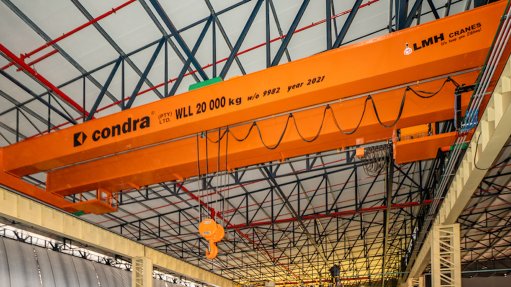
ISO-certified Condra manufactures overhead cranes, portal cranes, cantilever cranes and crane components: hoists, drives, end-carriages, brakes and...
VISIT SHOWROOM



Press Office
Announcements
What's On
Subscribe to improve your user experience...
Option 1 (equivalent of R125 a month):
Receive a weekly copy of Creamer Media's Engineering News & Mining Weekly magazine
(print copy for those in South Africa and e-magazine for those outside of South Africa)
Receive daily email newsletters
Access to full search results
Access archive of magazine back copies
Access to Projects in Progress
Access to ONE Research Report of your choice in PDF format
Option 2 (equivalent of R375 a month):
All benefits from Option 1
PLUS
Access to Creamer Media's Research Channel Africa for ALL Research Reports, in PDF format, on various industrial and mining sectors
including Electricity; Water; Energy Transition; Hydrogen; Roads, Rail and Ports; Coal; Gold; Platinum; Battery Metals; etc.
Already a subscriber?
Forgotten your password?
Receive weekly copy of Creamer Media's Engineering News & Mining Weekly magazine (print copy for those in South Africa and e-magazine for those outside of South Africa)
➕
Recieve daily email newsletters
➕
Access to full search results
➕
Access archive of magazine back copies
➕
Access to Projects in Progress
➕
Access to ONE Research Report of your choice in PDF format
RESEARCH CHANNEL AFRICA
R4500 (equivalent of R375 a month)
SUBSCRIBEAll benefits from Option 1
➕
Access to Creamer Media's Research Channel Africa for ALL Research Reports on various industrial and mining sectors, in PDF format, including on:
Electricity
➕
Water
➕
Energy Transition
➕
Hydrogen
➕
Roads, Rail and Ports
➕
Coal
➕
Gold
➕
Platinum
➕
Battery Metals
➕
etc.
Receive all benefits from Option 1 or Option 2 delivered to numerous people at your company
➕
Multiple User names and Passwords for simultaneous log-ins
➕
Intranet integration access to all in your organisation
