



SA may need to invest in desalination to mitigate water woes


With freshwater resources in South Africa almost fully used and heavily stressed – especially in the Western Cape, where drought conditions have left dam levels at 25% – water scarcity conditions are set to increase in the country, especially in the winter months, according to consulting engineering firm Gibb technical director Jacques Laubscher.
Addressing delegates at a Gibb media roundtable discussion on desalination, Laubscher noted that South Africa could expect a trend of little to no rainfall and that, by 2030, freshwater demand in South Africa would increase by 50%.
“This is one of many reasons why desalination is essential in South Africa. We need to invest in its technology to help address water shortage concerns in the country,” he said.
Desaliantion is the process of removing salts and minerals from water.
Laubscher pointed out that only 0.08% of the world’s water is accessible for human use and that 2.5-billion people live in areas that are water-stressed – South Africa being one of those areas.
“The Western Cape is faced with a major drought problem, which is why desalination has become so topical lately,” he said.
Last month, Cape Town mayor Patricia De Lille said that a solution to the ongoing drought problem in the Western Cape could be to temporarily establish several small, intermediate and possibly even large desalination plants to supply potable water.
It is contemplated that these plants could implement reverse osmosis, desalination or similar technologies to treat seawater, other surface-water sources or runoff to produce between 100-million litres and 500-million litres of potable water a day.
“It is envisaged that the first plants would be available for production towards the end of August,” De Lille said.
Laubscher, meanwhile, reiterated that the need for desalination was urgent. He pointed out that South Africa was an arid country with stretched water resources and that the country’s water-rich areas were localised and not widely spread.
He highlighted that a decrease of only 1% in water quality and usability in the country could result in the potential loss of 200 000 jobs, a drop of 6% in disposable income per capita and an increase of R1.8-billion in government spend.
“It’s obvious that water has a major impact on our economy and way of life,” said Laubscher, warning that, according to South Africa’s National Water Resource Strategy, the country’s water deficit by 2025 would be more than 240-million cubic litres a year.
He noted that nearly 90% of South Africa’s water went to agricultural and domestic use, with agriculture using two-thirds of that water, while domestic use took up the remaining third.
The other 10% of South Africa’s water is used for mining, industrial power generation and forestation.
Article Enquiry
Email Article
Save Article
Feedback
To advertise email advertising@creamermedia.co.za or click here
Research Reports

Projects


Latest Multimedia


Latest News
Showroom
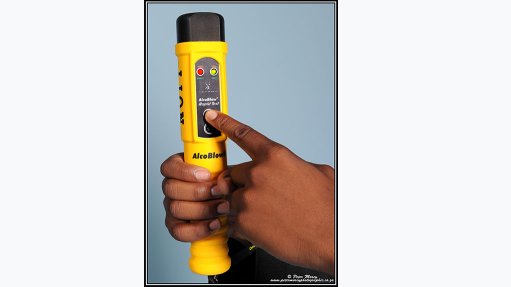
Developed to exceed the latest EN 15964 standards for police breathalysers proving that it will remain accurate and reliable for many years to come.
VISIT SHOWROOM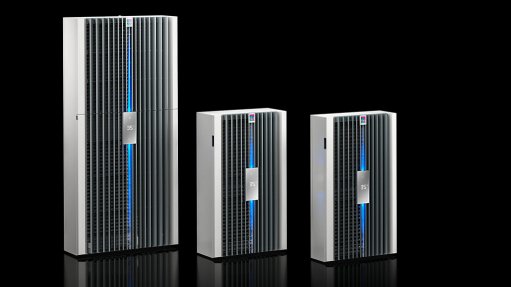
Rittal is a world leading provider of top-quality integrated systems for enclosures, power distribution, climate control, IT infrastructure and...
VISIT SHOWROOM



Announcements
What's On
Subscribe to improve your user experience...
Option 1 (equivalent of R125 a month):
Receive a weekly copy of Creamer Media's Engineering News & Mining Weekly magazine
(print copy for those in South Africa and e-magazine for those outside of South Africa)
Receive daily email newsletters
Access to full search results
Access archive of magazine back copies
Access to Projects in Progress
Access to ONE Research Report of your choice in PDF format
Option 2 (equivalent of R375 a month):
All benefits from Option 1
PLUS
Access to Creamer Media's Research Channel Africa for ALL Research Reports, in PDF format, on various industrial and mining sectors
including Electricity; Water; Energy Transition; Hydrogen; Roads, Rail and Ports; Coal; Gold; Platinum; Battery Metals; etc.
Already a subscriber?
Forgotten your password?
Receive weekly copy of Creamer Media's Engineering News & Mining Weekly magazine (print copy for those in South Africa and e-magazine for those outside of South Africa)
➕
Recieve daily email newsletters
➕
Access to full search results
➕
Access archive of magazine back copies
➕
Access to Projects in Progress
➕
Access to ONE Research Report of your choice in PDF format
RESEARCH CHANNEL AFRICA
R4500 (equivalent of R375 a month)
SUBSCRIBEAll benefits from Option 1
➕
Access to Creamer Media's Research Channel Africa for ALL Research Reports on various industrial and mining sectors, in PDF format, including on:
Electricity
➕
Water
➕
Energy Transition
➕
Hydrogen
➕
Roads, Rail and Ports
➕
Coal
➕
Gold
➕
Platinum
➕
Battery Metals
➕
etc.
Receive all benefits from Option 1 or Option 2 delivered to numerous people at your company
➕
Multiple User names and Passwords for simultaneous log-ins
➕
Intranet integration access to all in your organisation
