



Companies do not have to wait for govt reforms, says Standard Bank's Tshabalala

A panel of retail-focused experts discuss their approach to the African consumer
Standard Bank CEO Sim Tshabalala gives his view on current South African economic landscape
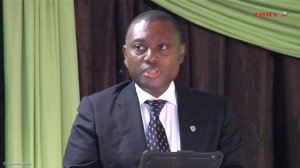


With the International Monetary Fund predicting a growth rate of 3.5% this year for sub-Saharan Africa, Standard Bank CEO Sim Tshabalala says South Africa will not be one of the region’s star performers until it works on a few issues.
Speaking at consultancy Deloitte’s Africa Outlook 2020 event on Thursday, he pointed out that while Ethiopia was forecast to grow at 7%, Kenya at 6% and Ghana at 5%, South Africa was anticipated to grow at only 0.8% this year.
Tshabalala noted that South Africa might reach a 2% gross domestic product growth rate, at best, if the country is able to resolve the financial challenges facing State-owned South African Airways; improve the operational performance at power utility Eskom; effect a more certain round of procurement for new electricity generation capacity and allow more self-generation by large firms; undertake short-term reforms for multiyear visas and ensure efficient provision of e-visas for visitors; and complete the broadband spectrum auction.
“The political barriers to achieve some of these reforms does not seem insurmountable. In the meantime, companies have shown that you do not need to be passive and wait for reforms to happen; there are opportunities to improve performance and stimulate South Africa’s growth by focusing on expanding operations into more dynamic environments in [the rest of] Africa and China.”
For example, Tshabalala pointed out that Standard Bank, in 2019, took a group of small and medium-sized enterprises to the China Import Expo, in Shanghai, after which they returned with full order books. The bank had also been able to promote exports to China with help from digital platforms, where manufacturers are able to sell their products on Chinese e-commerce platforms.
“Businesses with operations beyond South Africa have the ability to generate jobs within South Africa and [in other countries in which they operate]."
Moreover, Tshabalala said capitalism had created benefits for centuries, including the affluence of Western nations and China’s transition from poverty to an economic powerhouse in one generation.
“However, many of the world’s problems are consequences of shareholder capitalism, which is a way of doing business that is focused on maximising short-term profits and shareholder value. But we need a shift in style in which corporates provide staff with fair wages, better opportunities for skills development, dealing ethically with suppliers, adding value to communities in which you operate, minimising negative impacts on society and the environment, as well as transparently account for all the company’s impacts.
“For Africa, as with climate change, immediate consequences are not apparent but one should continue to lead companies in ways that aim to maximise inclusion and sustainability as well as long-run profits.
“Companies that do better on environmental and social metrics also do better in financial terms. What you might lose in one quarter, you make up over the medium term, as demonstrated by growing empirical evidence. Instead of aiming at stakeholder capitalism to replace shareholder capitalism, we should rather aim to create a social market economy, rather than a free market economy or a socialist economy,” Tshabalala said.
AFRICAN TRENDS FOR 2020
Deloitte emerging markets and Africa MD Dr Martyn Davies, meanwhile, discussed the global attention on Africa's infrastructure development, the threats that climate change poses for the continent, the rise in demand for electric vehicles (EVs) and the continent's plans for implementing the African Continental Free Trade Agreement.
With Africa’s population set to reach 1.5-billion people in the next decade, most people are expected to be vulnerable to climate change and slow economic growth.
Davies questioned whether Africa was leveraging the “new scramble” for the continent. “There is significant geopolitical and geo-economical interest in Africa from both emerging and traditional partners, but are these countries taking advantage of this to the best effect?”
He mentioned that 320 embassies were opened in Africa in the last six years, mostly by Turkey and India. He asked how businesses should be thinking about this opportunity and leveraging it.
Further, EVs are disrupting the metals and mining sector, with battery-related commodity markets set to face disruption. Davies said this could result in the geo-economics of mining changing, especially for base metals such as copper and cobalt.
In addition, Davies pointed out that the African Continental Free Trade Area was aimed at creating a single market valued at $3-trillion and integrating 1.2-billion people for the free movement of goods and services.
“This regional organisation will be the world’s largest free trade area since the formation of the World Trade Organisation. How can Africa benefit most from this liberalised trade?”
Article Enquiry
Email Article
Save Article
Feedback
To advertise email advertising@creamermedia.co.za or click here
Research Reports

Projects


Latest Multimedia

Latest News

Showroom

The Aluminium Federation of South Africa (AFSA), is the voice of the South African aluminium industry.
VISIT SHOWROOM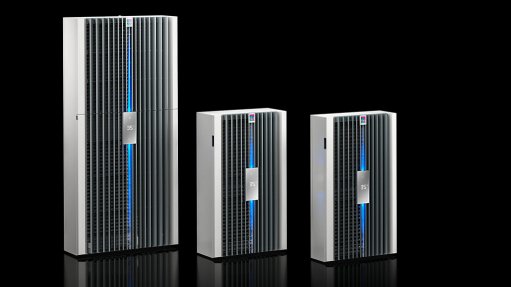
Rittal is a world leading provider of top-quality integrated systems for enclosures, power distribution, climate control, IT infrastructure and...
VISIT SHOWROOM



Announcements
What's On
Subscribe to improve your user experience...
Option 1 (equivalent of R125 a month):
Receive a weekly copy of Creamer Media's Engineering News & Mining Weekly magazine
(print copy for those in South Africa and e-magazine for those outside of South Africa)
Receive daily email newsletters
Access to full search results
Access archive of magazine back copies
Access to Projects in Progress
Access to ONE Research Report of your choice in PDF format
Option 2 (equivalent of R375 a month):
All benefits from Option 1
PLUS
Access to Creamer Media's Research Channel Africa for ALL Research Reports, in PDF format, on various industrial and mining sectors
including Electricity; Water; Energy Transition; Hydrogen; Roads, Rail and Ports; Coal; Gold; Platinum; Battery Metals; etc.
Already a subscriber?
Forgotten your password?
Receive weekly copy of Creamer Media's Engineering News & Mining Weekly magazine (print copy for those in South Africa and e-magazine for those outside of South Africa)
➕
Recieve daily email newsletters
➕
Access to full search results
➕
Access archive of magazine back copies
➕
Access to Projects in Progress
➕
Access to ONE Research Report of your choice in PDF format
RESEARCH CHANNEL AFRICA
R4500 (equivalent of R375 a month)
SUBSCRIBEAll benefits from Option 1
➕
Access to Creamer Media's Research Channel Africa for ALL Research Reports on various industrial and mining sectors, in PDF format, including on:
Electricity
➕
Water
➕
Energy Transition
➕
Hydrogen
➕
Roads, Rail and Ports
➕
Coal
➕
Gold
➕
Platinum
➕
Battery Metals
➕
etc.
Receive all benefits from Option 1 or Option 2 delivered to numerous people at your company
➕
Multiple User names and Passwords for simultaneous log-ins
➕
Intranet integration access to all in your organisation
