



Cape Town startup seeks to replace plastics with home compostable biomaterials

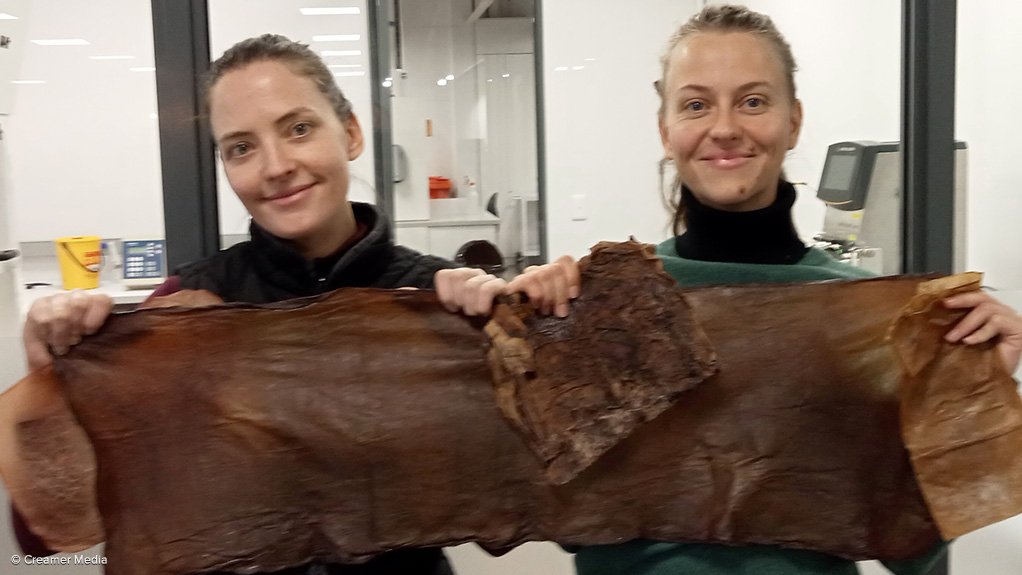
Melian Dott (left) and Chloe Cormack (right), holding biofilm samples of different thicknesses and textures
Photo by Creamer Media's Rebecca Campbell


Cape Town-based young-women-led award-winning biotech startup BAOM eco solutions (BAOM), which has developed compostable cellulose-based alternatives to plastics and other packaging materials, is now, seed investment permitting, ready to scale up to initial commercial production.
The company’s biofilms, as it calls its products, are not merely biodegradable but compostable, allowing end-users to process biofilm packaging themselves by actually burying it in their gardens or compost heaps, thereby helping nourish their plants. Alternatively, they can give the material to their local community garden or dispose of it to for-profit composting companies.
The company was able to further develop its prototype biofilms through scientific engagement, thanks to a micro-grant from Cape Town biotech enabler UVU-Bio. The grant allowed BAOM access to UVU-Bio’s laboratories. However, the startup has now outgrown the enabler’s micro-lab facilities.
“The next step for us is to scale up to macro-lab facilities,” explains BAOM product developer Melian Dott. “A macro-lab would be the beginning of a production facility. This would involve larger-scale laboratory equipment, such as an industrial-scale urn of, ideally, 500 litres capacity. If we get the capital and equipment we need, we could deliver our first production samples within two months.”
The company can produce biofilms with different thicknesses and with different textures. It has so far developed five distinct categories of biofilms, which it classifies as ‘thick plastic’, ‘thin plastic’, ‘vegan leather’, ‘cardboard’ and ‘paper’. ‘Thick plastic’ biofilms could be used basically for anything that flexible PVC sheeting is currently used for. ‘Thin plastic’ mimics clingwrap and laminated thin plastics. ‘Vegan leather’ mimics smooth cowhide, or textured crocodile or ostrich hide. ‘Cardboard’ would substitute for real cardboard, but BAOM’s material is fire-resistant and, if it gets wet, returns to its shape when it dries out. ‘Paper’ performs exactly like real paper, and can be printed on.
It should be noted that each of these categories can be subdivided into different variations. For example, ‘paper’ can be subdivided into ‘writing paper’, ‘baking paper’ and so on.
These biofilms were developed using the company’s own proprietary processes.
“Our first go-to-market product will actually be an intermediate thick/thin biofilm, to be used to wrap tree roots, for trees being planted in reforestation and rehabilitation projects,” reports company business developer Chloe Cormack. “There is a lot of investment going into reforestation and food security initiatives at the moment, because of the acceleration of climate change impacts that we are experiencing. Our product retains water, before breaking down and turning into compost, thereby being good for both the trees and the soil. Indeed, and importantly, BAOM root-wraps are so far showing efficacy in improving tree, and other plant, transplant survival rates, which is often a major challenge experienced in land restoration and food security projects.”
The second go-to-market product will be a food-compatible thin film for use in wrapping foods. This, once used, could be repurposed (composted) into consumers’ gardens, or, if thrown into a bin, would in due course decay just like waste food does, although BAOM strongly discourages the latter option, as food decay in landfills is a major source of greenhouse gas emissions, as well as health hazards.
The company’s future operating concept is to deploy a network of small factories, to serve local markets. This would be more efficient than centralised large production facilities with widespread distribution networks.
BAOM took first place in the ‘Green Sciences for Cosmetics Challenge’ category in the recent African Union-European Union Innovation Festival.
Article Enquiry
Email Article
Save Article
Feedback
To advertise email advertising@creamermedia.co.za or click here
Research Reports

Projects


Latest Multimedia


Latest News


Showroom
Established on 1 March, 2000, by Barries Barnard, Advanced Fire Suppression Technologies (AFST) and the Advanced Group stands as Sub-Saharan...
VISIT SHOWROOM
Complete range of security sealing solutions including security seals bags and labels.
VISIT SHOWROOM



Press Office
Announcements
What's On
Subscribe to improve your user experience...
Option 1 (equivalent of R125 a month):
Receive a weekly copy of Creamer Media's Engineering News & Mining Weekly magazine
(print copy for those in South Africa and e-magazine for those outside of South Africa)
Receive daily email newsletters
Access to full search results
Access archive of magazine back copies
Access to Projects in Progress
Access to ONE Research Report of your choice in PDF format
Option 2 (equivalent of R375 a month):
All benefits from Option 1
PLUS
Access to Creamer Media's Research Channel Africa for ALL Research Reports, in PDF format, on various industrial and mining sectors
including Electricity; Water; Energy Transition; Hydrogen; Roads, Rail and Ports; Coal; Gold; Platinum; Battery Metals; etc.
Already a subscriber?
Forgotten your password?
Receive weekly copy of Creamer Media's Engineering News & Mining Weekly magazine (print copy for those in South Africa and e-magazine for those outside of South Africa)
➕
Recieve daily email newsletters
➕
Access to full search results
➕
Access archive of magazine back copies
➕
Access to Projects in Progress
➕
Access to ONE Research Report of your choice in PDF format
RESEARCH CHANNEL AFRICA
R4500 (equivalent of R375 a month)
SUBSCRIBEAll benefits from Option 1
➕
Access to Creamer Media's Research Channel Africa for ALL Research Reports on various industrial and mining sectors, in PDF format, including on:
Electricity
➕
Water
➕
Energy Transition
➕
Hydrogen
➕
Roads, Rail and Ports
➕
Coal
➕
Gold
➕
Platinum
➕
Battery Metals
➕
etc.
Receive all benefits from Option 1 or Option 2 delivered to numerous people at your company
➕
Multiple User names and Passwords for simultaneous log-ins
➕
Intranet integration access to all in your organisation
