Binder helps with dust control, briquetting and beneficiation

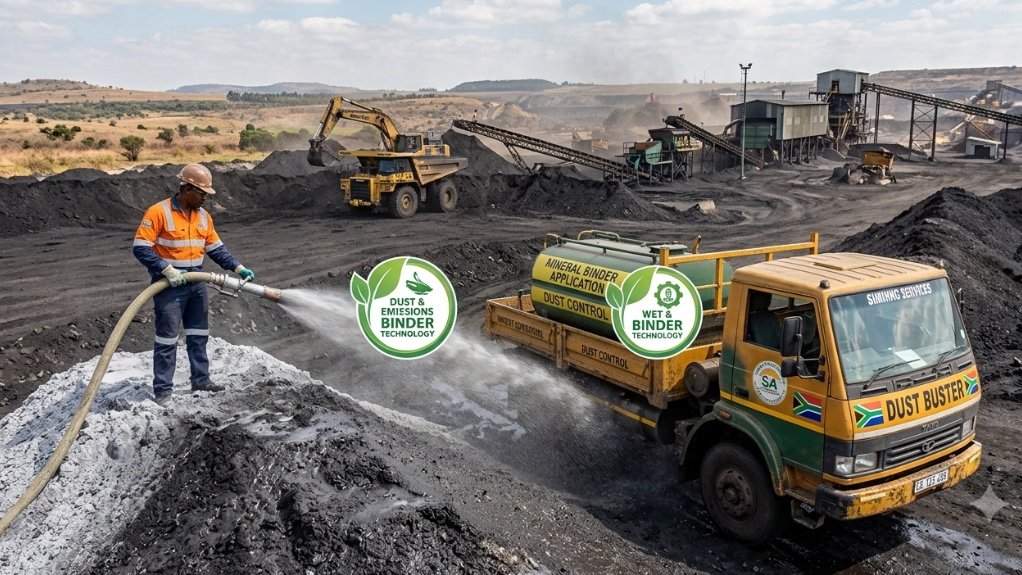
EFFECTIVE DUST CONTROL Using the chemical binder can supplement dust control measures, while the briquetting of fines can generate revenue


Mineral ore fines can create environmental concerns, such as fugitive dust, which can result in air pollution and, potentially, water pollution, owing to hazardous leachate from large dumps.
Using a chemical binder to reduce the prevalence of mineral waste dumps and fines can supplement existing dust control measures while creating a new source of revenue by briquetting fines into a saleable product, says South African Women in Mining Association member Advocate Simphiwe Damane-Mkhosana.
The STENCO binder has been acquired by a new company, called Celanet, to enhance the traditional briquetting process for fines recovered from mining dumps and waste streams, says Celanet director Mputumi Damane.
The binder – originally created and tested by briquetting company STENCO Contracting CEO Deon Kotze – will enable producers to recover and beneficiate chrome and manganese fines, while coal producers will be able to produce an export-grade briquette with a calorific value of 24 MJ/kg (or about 4 500 kcal/kg) for supply to thermal coal markets worldwide and State-owned power utility Eskom.
“Briquetting allows the mining companies to reclaim even the smallest quantities, which would otherwise have been abandoned in the dumps. Further, it allows South African companies to add value inside the country, beneficiating mined production, which political parties . . . laud as a way of providing jobs for local youth,” says Damane-Mkhosana.
She also states that the chemical binder helps to reduce the emissions released during the combustion of coal by up to 60%.
This technology will be particularly beneficial for the coal mining sector, given the prevalence of coal ash and waste fines across Eskom’s coal-producer base. It will, therefore, help to improve the environmental performance of coal producers, in line with the objectives of the Just Energy Transition.
Damane-Mkhosana says the binder is particularly effective for transforming coal waste products into low-smoke briquettes.
The technology will also enable chrome and manganese mining companies to “economically agglomerate” ultrafine material, improving producer margins and empowering further conversation around – and the eventual realisation – of local beneficiation, says Damane-Mkhosana.
Further, the binder can also be applied to manufacturing waste streams.
Damane-Mkhosana will commission the manufacture of the product under the Celanet company, which will commercialise the technology and engage with potential investors.
She says the product could not have come at a better time, as the industry is looking for coal ash and fines valorisation solutions, with the chrome and manganese industry continuing to engage in beneficiation conversations.
“The [technology] transfer was completed through a legal cession concluded in April 2026, supported by formal documentation from the attorneys who oversaw the process . . . The [beneficiation] conversations span coal producers, ferroalloy producers and other industry participants for whom the binder’s performance characteristics — particularly the cold-process briquetting, the rapid cycle time, and the suitability of finished briquettes for transport and combustion — represent a meaningful operational opportunity,” she notes.
“Producing a binder with no burning process, minimal water use and low pollution is a game changer . . . we are waiting for credible partners to form a joint venture. We believe we can work in partnership with interested parties in the different mining regions where there are coal, chrome or manganese deposits,” Damane-Mkhosana concludes.
Article Enquiry
Email Article
Save Article
Feedback
To advertise email advertising@creamermedia.co.za or click here
Research Reports

Projects


Latest Multimedia

Latest News
Showroom
CSIR International Convention Centre (CSIR ICC) - the leading conference and events venue in Pretoria/Tshwane.
VISIT SHOWROOM
The Aluminium Federation of South Africa (AFSA), is the voice of the South African aluminium industry.
VISIT SHOWROOM


Press Office
Announcements
What's On
Subscribe to improve your user experience...
Option 1 (equivalent of R125 a month):
Receive a weekly copy of Creamer Media's Engineering News & Mining Weekly magazine
(print copy for those in South Africa and e-magazine for those outside of South Africa)
Receive daily email newsletters
Access to full search results
Access archive of magazine back copies
Access to Projects in Progress
Access to ONE Research Report of your choice in PDF format
Option 2 (equivalent of R375 a month):
All benefits from Option 1
PLUS
Access to Creamer Media's Research Channel Africa for ALL Research Reports, in PDF format, on various industrial and mining sectors
including Electricity; Water; Energy Transition; Hydrogen; Roads, Rail and Ports; Coal; Gold; Platinum; Battery Metals; etc.
Already a subscriber?
Forgotten your password?
Receive weekly copy of Creamer Media's Engineering News & Mining Weekly magazine (print copy for those in South Africa and e-magazine for those outside of South Africa)
➕
Recieve daily email newsletters
➕
Access to full search results
➕
Access archive of magazine back copies
➕
Access to Projects in Progress
➕
Access to ONE Research Report of your choice in PDF format
RESEARCH CHANNEL AFRICA
R4500 (equivalent of R375 a month)
SUBSCRIBEAll benefits from Option 1
➕
Access to Creamer Media's Research Channel Africa for ALL Research Reports on various industrial and mining sectors, in PDF format, including on:
Electricity
➕
Water
➕
Energy Transition
➕
Hydrogen
➕
Roads, Rail and Ports
➕
Coal
➕
Gold
➕
Platinum
➕
Battery Metals
➕
etc.
Receive all benefits from Option 1 or Option 2 delivered to numerous people at your company
➕
Multiple User names and Passwords for simultaneous log-ins
➕
Intranet integration access to all in your organisation