



BHP Billiton aims to be lowest-cost iron supplier, mulls capacity expansion

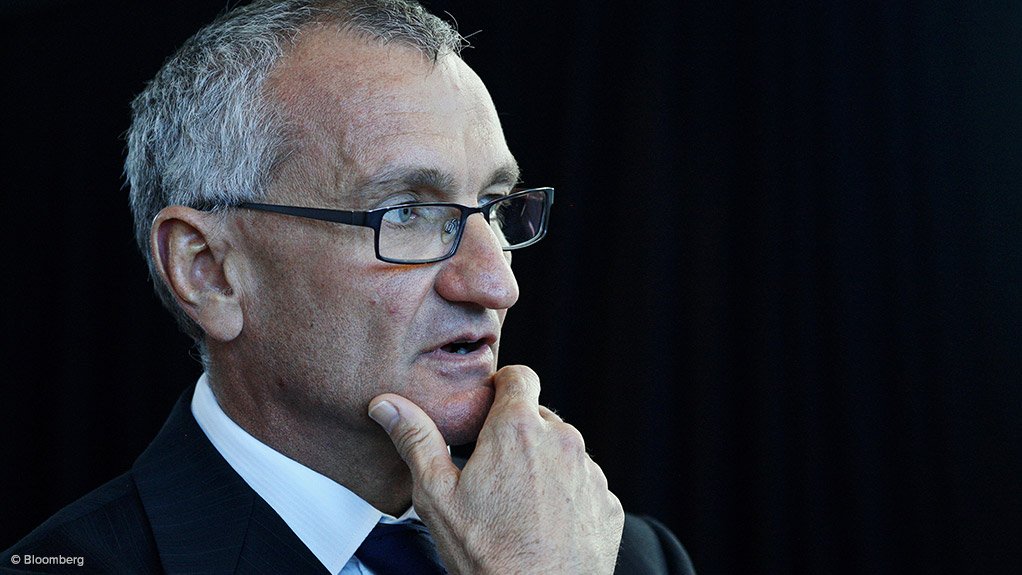



JOHANNESBURG (miningweekly.com) – Diversified mining group BHP Billiton iron-ore president Jimmy Wilson on Monday unveiled plans to cut unit costs at Western Australian Iron Ore (WAIO) by at least 25% and to potentially increase capacity by 65-million tonnes a year.
Unveiling the iron-ore cost reductions and growth plans, Wilson said BHP Billiton could lower its unit cash costs, excluding freight and royalties, to less than $20/t in the medium term. This compares with costs of about $25/t in the second half of the 2014 financial year.
“With annual sustaining capex [capital expenditure] of approximately $5/t over the next five years, we aim to be the lowest cost supplier to China on an all-in cash basis,” he said during an analyst site tour to the Australian iron-ore operations.
Wilson also said that the economics of further investing in production at WAIO, which consists of the four main joint ventures Mt Newman, Yandi, Mt Goldsworthy and Jimblebar, were “compelling”.
“We completed our major supply chain investments some time ago and have since focused on using BHP Billiton’s benchmarking systems to improve the performance of our equipment and systematically tackling the bottlenecks,” he said.
BHP Billiton was looking at adding about 65-million tonnes of capacity at WAIO at a capital intensity of about $30/t. This would increase total capacity to 290-million tonnes a year by the end of the 2017 financial year, from 225-million tonnes a year currently.
Wilson explained that the first step would increase WAIO capacity to 275-million tonnes a year without having to invest in fixed plant. When that capacity is reached, the bottleneck was expected to shift to the port. BHP Billiton would then focus on the 20-million-tonne-a-year Inner Harbour debottlenecking project and the Jimblebar Phase II project, which would increase hub capacity from 45-million tonnes a year to 60-million tonnes a year.
Analysts at Liberum said in a note that the debottlenecking expansion beat their expectations on both speed and costs. Liberum had modelled the expansion’s capital intensity at $50/t and had estimated that BHP Billiton would only hit 290-million tonnes a year by the 2019 financial year.
“While an incremental positive for BHP, it is symptomatic of the oversupply situation, which we think will continue to weigh on the sector,” the Liberum analysts commented.
Investec analysts described the proposed cost reduction as an "impressive target". "To some extent a weaker Australian dollar should be able to assist."
SUPPLY GLUT
Despite forecasting a glut in seaborne iron-ore supply, BHP Billiton remains upbeat about prospects for iron-ore, which accounts for 22% of the group’s production and 46% of the group’s total underlying earnings before interest and tax.
Growth in seaborne iron-ore supply, which expanded rapidly during the years of high iron-ore prices, would outweigh growth in demand this year. Total seaborne iron-ore supply would increase by about 140-million tonnes in the current calendar year, while demand would increase by about 55-million tonnes over the same period.
Low-cost seaborne iron-ore supply would increasingly displace high-cost supply, which Wilson said would flatten the cost curve.
Demand growth for iron-ore, which will be a key pillar in the proposed simplified BHP Billiton structure, remained healthy in the mid-term, Wilson said, adding that Chinese steel production was expected to increase by about 25%, peaking at between 1-billion and 1.1-billion tonnes in the early to mid-2020s.
Steel production growth in other emerging economies was expected to outpace China, supported by urbanisation and industrialisation. BHP Billiton is forecasting a compound growth rate for global steel production of between 2.5% and 3% between now and 2030. Global crude steel production would reach 2.5-billion tonnes by 2030.
With supply exceeding demand, steel prices have fallen to less than $80/t – reaching five-year lows. In 2011, iron-ore fetched about $190/t.
Article Enquiry
Email Article
Save Article
Feedback
To advertise email advertising@creamermedia.co.za or click here
Research Reports

Projects


Latest Multimedia

Latest News


Showroom
ALBIS FLANGES — founded in 1965 — is a petro-chemical approved manufacturer of flanges and fittings in most grades of steel, listed with Sasol,...
VISIT SHOWROOM
ISO-certified Condra manufactures overhead cranes, portal cranes, cantilever cranes and crane components: hoists, drives, end-carriages, brakes and...
VISIT SHOWROOM



Press Office
Announcements
What's On
Subscribe to improve your user experience...
Option 1 (equivalent of R125 a month):
Receive a weekly copy of Creamer Media's Engineering News & Mining Weekly magazine
(print copy for those in South Africa and e-magazine for those outside of South Africa)
Receive daily email newsletters
Access to full search results
Access archive of magazine back copies
Access to Projects in Progress
Access to ONE Research Report of your choice in PDF format
Option 2 (equivalent of R375 a month):
All benefits from Option 1
PLUS
Access to Creamer Media's Research Channel Africa for ALL Research Reports, in PDF format, on various industrial and mining sectors
including Electricity; Water; Energy Transition; Hydrogen; Roads, Rail and Ports; Coal; Gold; Platinum; Battery Metals; etc.
Already a subscriber?
Forgotten your password?
Receive weekly copy of Creamer Media's Engineering News & Mining Weekly magazine (print copy for those in South Africa and e-magazine for those outside of South Africa)
➕
Recieve daily email newsletters
➕
Access to full search results
➕
Access archive of magazine back copies
➕
Access to Projects in Progress
➕
Access to ONE Research Report of your choice in PDF format
RESEARCH CHANNEL AFRICA
R4500 (equivalent of R375 a month)
SUBSCRIBEAll benefits from Option 1
➕
Access to Creamer Media's Research Channel Africa for ALL Research Reports on various industrial and mining sectors, in PDF format, including on:
Electricity
➕
Water
➕
Energy Transition
➕
Hydrogen
➕
Roads, Rail and Ports
➕
Coal
➕
Gold
➕
Platinum
➕
Battery Metals
➕
etc.
Receive all benefits from Option 1 or Option 2 delivered to numerous people at your company
➕
Multiple User names and Passwords for simultaneous log-ins
➕
Intranet integration access to all in your organisation
