



ANC's ConCourt application an 'attempt to delay the inevitable' handing over of cadre deployment records - DA

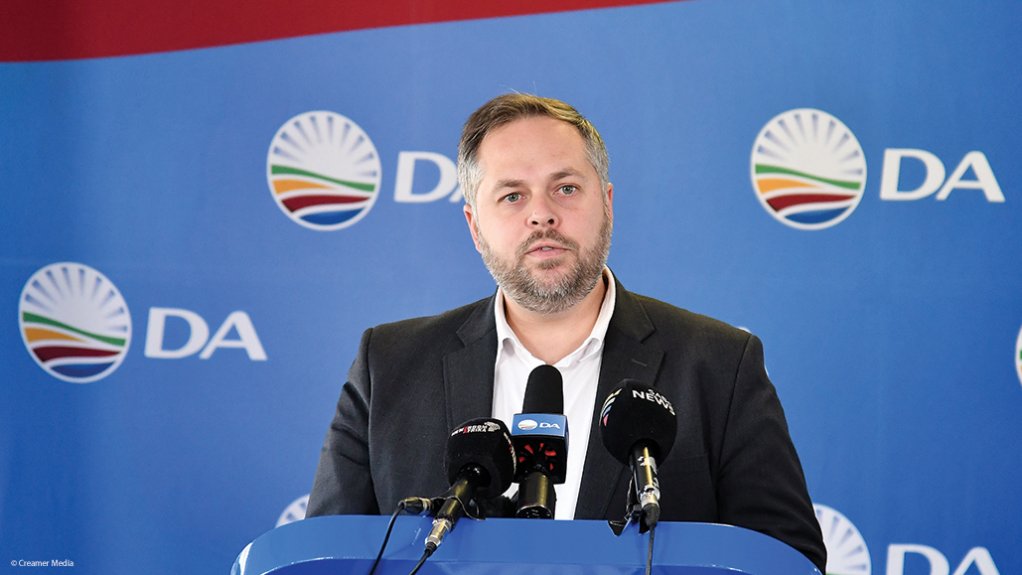



The African National Congress's (ANC's) application to the Constitutional Court to block the handing over of its cadre deployment records to the Democratic Alliance (DA) is "merely a further attempt...to delay the inevitable", argues DA MP Leon Schreiber.
He filed a responding affidavit to ANC secretary-general Fikile Mbalula's application to the apex court to overturn a high court ruling that the governing party must hand over its cadre deployment committee's records from January 2013, when President Cyril Ramaphosa became committee chairperson and several State capture-related appointments were made.
Mbalula's application was filed three days after the deadline for appealing a Supreme Court of Appeal (SCA) ruling.
Schreiber has been locked in lawfare with the ANC since 2021, when he approached the high court for relief after the ANC refused his application in terms of the Promotion of Access to Information Act (PAIA).
In February, Judge Willem Wepener of the Gauteng High Court in Johannesburg found the ANC's decision not to provide the documents unlawful and ordered the party to hand over the documents, including meeting minutes, WhatsApp conversations, email threads, CVs and all other records of the cadre deployment committee.
Schreiber had to convince the court that he needed the information to protect certain rights, and he advanced three rights:
- The first was the DA's wishes to enact legislation about cadre deployment and it, therefore, needed the information to understand what cadre deployment entails and what its impact could be.
- Second, as an MP, Schreiber has an oversight duty over appointments in state organs.
- Third, people not appointed in the public service could use the information to challenge unlawful and irregular appointments.
Wepener was not convinced by the third ground but agreed with Schreiber on the first two.
"In my view, it is indeed so that the parliamentary oversight is best served with full knowledge of all the factors that go into the appointment of officials," read his judgment.
He ordered the ANC to hand over the cadre deployment records within five days.
The ANC unsuccessfully applied for leave to appeal. Then, on the day it was meant to hand over the records, the governing party launched an application directly to the SCA.
In this application, Mbalula argued that Wepener had "incorrectly found" that the ANC was legally obliged to hand over the documents to Schreiber, who is spearheading the DA's fight against cadre deployment for the "exercise of his parliamentary oversight role or for the exercise of his unspecified rights, which have not been properly spelled out".
"The applicant's [ANC] constitutional rights to privacy, equality and dignity have been infringed by the high court's order and judgment," stated Mbalula.
He argued that the freedom to receive or impart information or ideas did not include a right to a private individual's information that they do not want to disclose.
Mbalula stated: "The public does not have a general right to receive information on cadre deployment."
On 4 September, the SCA found the ANC's application had "no reasonable prospects of success" and dismissed it with costs. This meant the ANC had to provide the documents to the DA within five days.
In his late application to the Constitutional Court, Mbalula argues that MPs don't have the right to access information through PAIA.
Section 32(1) of the Constitution, which gave rise to the PAIA, states: "Everyone has the right of access to (a) any information held by the state; and (b) any information that is held by another person and that is required for the exercise or protection of any rights."
However, Mbalula said, MPs aren't "everyone".
He stated: "I am advised that while Section 32 of the Constitution guarantees the right of 'everyone', this does not extend to organs of state.
"I am advised that, in seeking to rely on his powers and privileges as a Member of Parliament, Mr Schreiber was exercising a power or performing a function in terms of the Constitution. He was therefore acting as the embodiment of an organ of state for the purposes of section 32, and not entitled to utilise PAIA to access the ANC's information."
Mbalula contends that MPs must access information through Section 56 of the Constitution, which reads: "The National Assembly or any of its committees may (a) summon any person to appear before it to give evidence on oath or affirmation, or to produce documents; (b) require any person or institution to report to it; (c) compel, in terms of national legislation or the rules and orders, any person or institution to comply with a summons or requirement in terms of paragraph (a) or (b); and (d) receive petitions, representations or submissions from any interested persons or institutions."
Mbalula contended, "There is no general right of MPs established in PAIA to demand access to documents held by private parties. MPs have a right and duty to use the mechanisms of Parliament to access any documents held by any private body."
Tellingly, he also pointed out that the parliamentary mechanisms have "protections" in place for members of the public compelled to provide information.
"Section 16 of the Powers and Privileges Act provides that any incriminating evidence given to Parliament may not be used in criminal proceedings," Mbalula stated.
"Rule 189 of the National Assembly Rules provides that any information that is confidential may not be disclosed to the public unless ordered by a committee, the Speaker or a resolution of the assembly.
"PAIA, however, does not provide similar protection."
In his responding affidavit, Schreiber points out that Mbalula raises a new argument which is, in any event, "untenable".
Schreiber argues that he "plainly qualifies as 'any person' for the purpose of Section 1 of PAIA and am accordingly entitled to seek to invoke [his] rights as a requestor under PAIA", including to obtain the information on the ANC's cadre deployment committee.
Responding to Mbalula's contention that MPs should access information under Section 56 of the Constitution, Schreiber states that he didn't request the information on behalf of the National Assembly or a committee.
"I did so as a private individual and a member of the DA," he states, adding that section 56 does not imply that he doesn't have rights under PAIA.
"PAIA should be interpreted to assist Members of Parliament to guard against the secretive and unresponsive culture in private bodies which often leads to an abuse of power and human rights violations. PAIA should also be understood to help foster a culture of transparency and accountability in private bodies and promote a society in which the people of South Africa have effective access to information. All of these imperatives count strongly in favour of Members of Parliament to invoke PAIA's provisions to access records held by private parties like the ANC."
Schreiber said the ANC's contention that the high court erred because the right to conduct oversight vests in Parliament rather than individual MPs was "revealing".
"Individual Members of Parliament, but perhaps not the ANC, regularly engage in oversight business. For Parliament to properly exercise its collective oversight function, its members must all be individually empowered to fulfil their respective oversight functions," he stated.
Schreiber also asked that the apex court dismiss the ANC's application for condonation for filing its application late with costs.
"The ANC's dilatory conduct is calculated to delay the disclosure of the information I seek. This application is a continuation of that conduct," he said.
Article Enquiry
Email Article
Save Article
Feedback
To advertise email advertising@creamermedia.co.za or click here
Research Reports

Projects


Latest Multimedia


Latest News


Showroom

Sika South Africa is a trusted partner for the nation’s infrastructure, commercial, residential, and industrial sectors.
VISIT SHOWROOM
Developed to exceed the latest EN 15964 standards for police breathalysers proving that it will remain accurate and reliable for many years to come.
VISIT SHOWROOM



Press Office
Announcements
What's On
Subscribe to improve your user experience...
Option 1 (equivalent of R125 a month):
Receive a weekly copy of Creamer Media's Engineering News & Mining Weekly magazine
(print copy for those in South Africa and e-magazine for those outside of South Africa)
Receive daily email newsletters
Access to full search results
Access archive of magazine back copies
Access to Projects in Progress
Access to ONE Research Report of your choice in PDF format
Option 2 (equivalent of R375 a month):
All benefits from Option 1
PLUS
Access to Creamer Media's Research Channel Africa for ALL Research Reports, in PDF format, on various industrial and mining sectors
including Electricity; Water; Energy Transition; Hydrogen; Roads, Rail and Ports; Coal; Gold; Platinum; Battery Metals; etc.
Already a subscriber?
Forgotten your password?
Receive weekly copy of Creamer Media's Engineering News & Mining Weekly magazine (print copy for those in South Africa and e-magazine for those outside of South Africa)
➕
Recieve daily email newsletters
➕
Access to full search results
➕
Access archive of magazine back copies
➕
Access to Projects in Progress
➕
Access to ONE Research Report of your choice in PDF format
RESEARCH CHANNEL AFRICA
R4500 (equivalent of R375 a month)
SUBSCRIBEAll benefits from Option 1
➕
Access to Creamer Media's Research Channel Africa for ALL Research Reports on various industrial and mining sectors, in PDF format, including on:
Electricity
➕
Water
➕
Energy Transition
➕
Hydrogen
➕
Roads, Rail and Ports
➕
Coal
➕
Gold
➕
Platinum
➕
Battery Metals
➕
etc.
Receive all benefits from Option 1 or Option 2 delivered to numerous people at your company
➕
Multiple User names and Passwords for simultaneous log-ins
➕
Intranet integration access to all in your organisation
