



AMCU, gold producers meet to hash out representation dispute

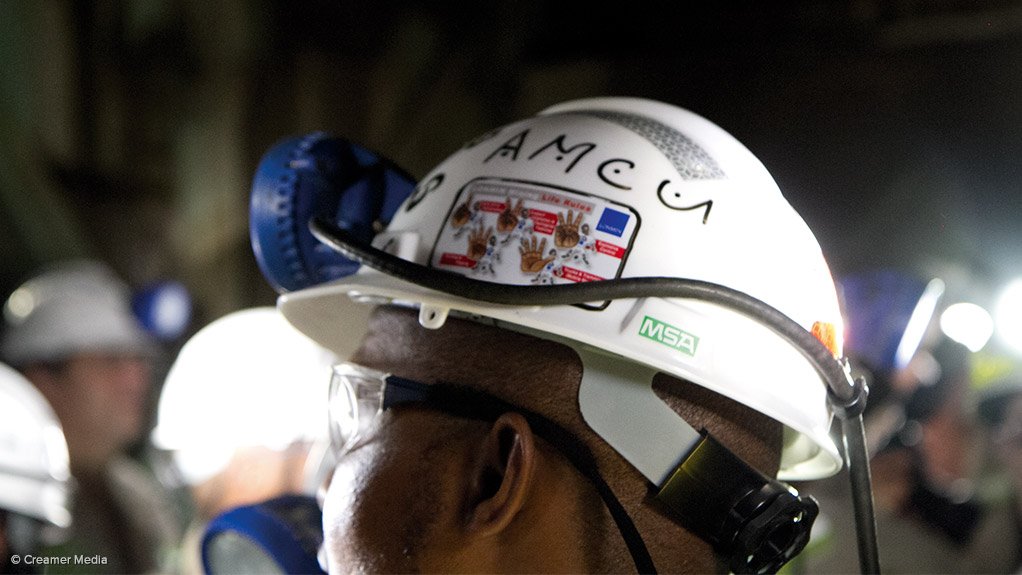



JOHANNESBURG (miningweekly.com) – Progress is being made to resolve the union representation dispute between gold producers and the Association of Mineworkers and Construction Union (AMCU).
The Chamber of Mines (CoM) on Friday reported that “constructive” engagement continued as gold producers AngloGold Ashanti, Harmony Gold and Sibanye Gold individually met with AMCU to resolve differences of opinion on representation.
The union last week walked out of wage negotiations, taking issue with the findings of a producer-sanctioned audit that put AMCU’s membership at around 30% of the companies’ total workforce.
“The companies confirm that [the renewed] discussions were constructive and that where further feedback or processes have been agreed to, the parties will meet,” the chamber said in a statement.
The companies maintained that the membership data presented to AMCU and the other unions on a monthly basis was an accurate reflection of employees’ union membership.
According to data released by the gold producers, the National Union of Mineworkers (NUM) currently accounted for 52% of union representation in the gold industry, followed by AMCU, with 30%, and Uasa and Solidarity at 7% and 2% respectively.
Meanwhile, the current gold wage negotiations between the unions and the gold producers were set to resume next week after the CoM on Friday said that, despite the tabling of revised demands from both unions and gold producers, the parties were no closer to a resolution.
The NUM, Solidarity, Uasa and the chamber this week continued talks, but further “intensive dialogue” was required, as the parties remained “far apart”.
“We have revised those offers that we have been able to do, but we cannot increase our current wage and gain-share offers without affecting the sustainability of the sector and threatening jobs,” CoM negotiator Dr Elize Strydom said in a statement, noting that discussions with AMCU had also been held.
Next week’s negotiations would include bilateral meetings with each union to discuss union-specific issues, after which the parties would reconvene the wage talks, Strydom explained.
The CoM, representing gold producers AngloGold Ashanti, Evander Gold, Harmony Gold, Sibanye Gold and Village Main Reef, maintained its offer of a basic wage increase of 7.8% to 13% for category four to eight employees and 4.5% to 6% for miners, artisans and officials.
The offer, which was based on a gold price of $1 200/oz, also included a 3.5% to 5% gain-share proposal over and above basic wages, benefits and all other bonuses and incentive payments.
Solidarity general secretary Gideon du Plessis expressed the union’s disappointment over the lack of adjustments to the salary increase offer.
However, he welcomed the gold producers’ decision to raise the retirement age for surface workers to 63, one of the demands tabled by Solidarity in an effort to retain valuable skills and knowledge in the mining industry.
However, a similar proposal for underground workers would require “greater discussion” as the chamber probed any potential issues, including occupational health, retirement funds and productivity, as well as Rand Mutual and Occupational Diseases in Mines and Works Act funding, for which the CoM suggested a task team to investigate be formed.
“We are satisfied with the CoM undertaking to investigate the changes as far as the retirement age is concerned,” Du Plessis noted.
The chamber also proposed a 50% increase, from R20 000 to R30 000 over five years, in the minimum amount an employee may be entitled to in the event of retrenchment.
A 37.5% increase in medical incapacity benefits, from R40 000 to R55 000 over five years, was also tabled for category four to eight employees, as was an increase in the extension of the 2013 agreement where the employer’s current medical aid co-contribution ratio for category four to eight employees would be 60%.
“The Economic and Social Sustainability Agreement is critical to the long-term sustainability of the industry and its ability to preserve jobs. We encourage the unions to engage with their members on the details contained within our proposal,” Strydom said.
The CoM added that the gold producers altered their approach to the negotiations, opening with good across-the-board increases and a suite of proposals that were expected to have “positive and far-reaching consequences” for employees, including improved job security and home ownership.
There were indications that houses owned by the mines would be sold to the workers at a lower amount than the municipal and market value, Du Plessis said.
Article Enquiry
Email Article
Save Article
Feedback
To advertise email advertising@creamermedia.co.za or click here
Research Reports

Projects


Latest Multimedia


Latest News

Showroom

The Beneficiation Academy is a certified training institution that follows all compliance legislation and is accredited with various Sector...
VISIT SHOWROOM
The SAIMM started as a learned society in 1894 after the invention of the cyanide process that saved the South African gold mining industry of the...
VISIT SHOWROOM



Announcements
What's On
Subscribe to improve your user experience...
Option 1 (equivalent of R125 a month):
Receive a weekly copy of Creamer Media's Engineering News & Mining Weekly magazine
(print copy for those in South Africa and e-magazine for those outside of South Africa)
Receive daily email newsletters
Access to full search results
Access archive of magazine back copies
Access to Projects in Progress
Access to ONE Research Report of your choice in PDF format
Option 2 (equivalent of R375 a month):
All benefits from Option 1
PLUS
Access to Creamer Media's Research Channel Africa for ALL Research Reports, in PDF format, on various industrial and mining sectors
including Electricity; Water; Energy Transition; Hydrogen; Roads, Rail and Ports; Coal; Gold; Platinum; Battery Metals; etc.
Already a subscriber?
Forgotten your password?
Receive weekly copy of Creamer Media's Engineering News & Mining Weekly magazine (print copy for those in South Africa and e-magazine for those outside of South Africa)
➕
Recieve daily email newsletters
➕
Access to full search results
➕
Access archive of magazine back copies
➕
Access to Projects in Progress
➕
Access to ONE Research Report of your choice in PDF format
RESEARCH CHANNEL AFRICA
R4500 (equivalent of R375 a month)
SUBSCRIBEAll benefits from Option 1
➕
Access to Creamer Media's Research Channel Africa for ALL Research Reports on various industrial and mining sectors, in PDF format, including on:
Electricity
➕
Water
➕
Energy Transition
➕
Hydrogen
➕
Roads, Rail and Ports
➕
Coal
➕
Gold
➕
Platinum
➕
Battery Metals
➕
etc.
Receive all benefits from Option 1 or Option 2 delivered to numerous people at your company
➕
Multiple User names and Passwords for simultaneous log-ins
➕
Intranet integration access to all in your organisation
