



Wits Junction district heating project continues to exemplify solar cogen success

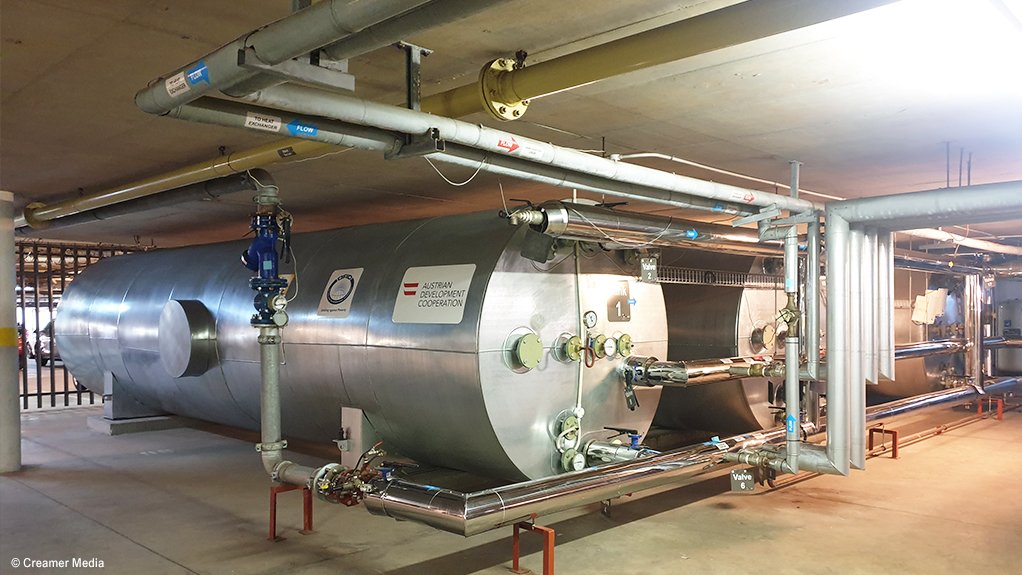
The water tankers at Wits' solar district cogen heating system
Photo by Creamer Media's Simone Liedtke


The 60 000 ℓ district heating project at the University of the Witwatersrand (Wits) Junction student residence continues to exemplify the success of a solar co-generation project, and how a relationship with Austria is being developed through a partnership facilitated by the South African Solar Thermal Training and Demonstration Initiative (Soltrain).
Soltrain is funded by the Austrian Development Agency and co-funded by the Organisation of the Petroleum Exporting Countries’ Fund for International Development, and is a regional initiative aimed at building capacity and demonstrating the potential of solar thermal systems in the South African Development Community (SADC) region.
The aim of Soltrain is to support the target countries in changing from a largely fossil-based energy supply system to a sustainable supply structure based on renewable energy, in general, and solar thermal, in particular.
Blackdot Energy renewable energy engineer Wally Weber has said the “true beauty” of the project this year was found in how the relationship with Soltrain bore fruit with investment in industry training and investment systems that “enabled the industry to talk about district heating”.
“What makes it so unique is that thermal energy is completely underestimated in the South African economy,” Weber enthused to Engineering News during a site visit on November 5.
He noted that “people think of solar as being a rooftop geyser and shower water”, but he argued that, considering the amount of heat that is consumed in the South African economy in industrial heating, the majority of which is below 100 °C, “it’s insane how much coal-based power is being used to generate thermal energy”.
Through the project at the Wits Junction, Weber stated, his company and Soltrain were able to prove that district heating was viable in South Africa, especially considering that this specific installation involved thermal energy being moved 2 km across campus.
“It shows that the technology is ready to be taken up by industry, because we can move thermal energy, which is so cheap, and it can be moved over vast distances and stored,” he said, adding that it was also accessible at any point in a 24-hour cycle.
The Wits Junction district heating project combines solar, co-generation and gas heating technologies, servicing 14 student residence buildings with hot water from one centralised hot water plant room.
Installation included a 600 m2 solar heating plant with 10 m2 Austrian collectors.
There are about 1 200 students living in the 14 buildings, with an average consumption of 94 000 ℓ of hot water a day. Peak demand is in the morning, averaging 30% of daily consumption, with a maximum demand of 28 200 ℓ in an hour.
The system supplies the entire hot water demand, including kitchens, laundry, cleaning and other domestic uses. Each student has his/her own kitchen and there are some centralised service rooms for cleaning staff.
Since the system was commissioned, the complaints of not having hot water have reduced by 98%, Weber said at the system’s initial launch in 2019.
The redundancy design guarantees supply, including during maintenance periods.
The estimated cost savings are R40-million over the next 20 years and Wits had, at the time, already seen substantial electricity savings over the trial period of eight months.
As the electricity cost from the co-generator is equal to municipal cost, the thermal energy is free and the centralised plant requires a lot less maintenance intervention, hence lower costs, Weber explained.
There is also currently a backup water system installation in progress, with 300 000 ℓ tanks.
SOLTRAIN
The Austrian investment is the result of a decade of relationship building as part of the Soltrain programme, which Weber said “helped the whole process of getting momentum to train the industry on solar thermal”.
Over a three-year period, about €1-million a year is being invested into the South African arm of Soltrain, further enabling the donor-funded systems to enable education and the roll-out of more systems.
The launch of the Wits Junction project is proving pivotal in demonstrating how the application of water heating through solar energy can be used on a large scale, as well as a commercial scale, to decrease costs and emissions (as less power is required from commercial coal-fired power stations) and ensure that energy-intensive processes are increasingly sustainable in the future, Engineering News reported in 2019, though this was reiterated by Weber during the site visit.
The success of the programme has led to the Soltrain programme going into a fourth phase from July 2019 until December 2022, of which the Wits Junction forms part.
The 326 solar thermal systems built to date in the Soltrain programme have a solar yield of 1 834 MWh/y and save about 2 000 MWh/y of electricity and avoid 638 t of carbon dioxide yearly.
If one kilowatt-hour of electricity is valued at R0.2139, the installed solar thermal systems save R4.3-million in electricity costs a year, Engineering News reported in 2019.
Article Enquiry
Email Article
Save Article
Feedback
To advertise email advertising@creamermedia.co.za or click here
Research Reports

Projects


Latest Multimedia

Latest News


Showroom
The Beneficiation Academy is a certified training institution that follows all compliance legislation and is accredited with various Sector...
VISIT SHOWROOM
Sulzer South Africa, established in 1922, partners with critical industries like power, oil & gas, water, mining, and chemicals to boost...
VISIT SHOWROOM



Announcements
What's On
Subscribe to improve your user experience...
Option 1 (equivalent of R125 a month):
Receive a weekly copy of Creamer Media's Engineering News & Mining Weekly magazine
(print copy for those in South Africa and e-magazine for those outside of South Africa)
Receive daily email newsletters
Access to full search results
Access archive of magazine back copies
Access to Projects in Progress
Access to ONE Research Report of your choice in PDF format
Option 2 (equivalent of R375 a month):
All benefits from Option 1
PLUS
Access to Creamer Media's Research Channel Africa for ALL Research Reports, in PDF format, on various industrial and mining sectors
including Electricity; Water; Energy Transition; Hydrogen; Roads, Rail and Ports; Coal; Gold; Platinum; Battery Metals; etc.
Already a subscriber?
Forgotten your password?
Receive weekly copy of Creamer Media's Engineering News & Mining Weekly magazine (print copy for those in South Africa and e-magazine for those outside of South Africa)
➕
Recieve daily email newsletters
➕
Access to full search results
➕
Access archive of magazine back copies
➕
Access to Projects in Progress
➕
Access to ONE Research Report of your choice in PDF format
RESEARCH CHANNEL AFRICA
R4500 (equivalent of R375 a month)
SUBSCRIBEAll benefits from Option 1
➕
Access to Creamer Media's Research Channel Africa for ALL Research Reports on various industrial and mining sectors, in PDF format, including on:
Electricity
➕
Water
➕
Energy Transition
➕
Hydrogen
➕
Roads, Rail and Ports
➕
Coal
➕
Gold
➕
Platinum
➕
Battery Metals
➕
etc.
Receive all benefits from Option 1 or Option 2 delivered to numerous people at your company
➕
Multiple User names and Passwords for simultaneous log-ins
➕
Intranet integration access to all in your organisation
