What ADNOC really bought for a billion US dollars



This article has been supplied.
By: Jeremy Sampson - Chairman: Brand Finance Africa
Earlier this month, the retail arm of the Abu Dhabi National Oil Company (ADNOC) agreed to pay approximately US$1 billion (more than R16 billion) for Shell's downstream business in South Africa: 580 service stations, together with its wholesale fuel, aviation and lubricants operations. It is ADNOC Distribution's largest acquisition outside the Gulf and its first major step into Africa's most industrialised economy.
But the most interesting aspect of the deal is not the price. It is this: ADNOC, a state-owned energy giant whose name appears on more than a thousand service stations across the Middle East, will not place that name on a single South African forecourt. Instead, it will continue trading under the Shell brand through a long-term licensing agreement, paying for the right to use someone else's identity.
Consider what that means: one of the world's wealthiest energy companies concluded that the smartest thing it could do with a billion dollars in South Africa was not to replace the brand above the door. Its chief executive, Bader Al Lamki, captured the rationale: “Shell has been in South Africa for more than 120 years, and customers are used to it.” He is absolutely right.
The transaction also offers a lesson in how global investors assess strategic assets. ADNOC is not simply acquiring service stations; it is acquiring an established route to market in Africa, customer relationships, distribution infrastructure and decades of accumulated brand equity. Preserving the Shell brand substantially reduces the commercial risk of the expansion.
Brands, moreover, often outlive and even transcend their ownership. The automotive industry is full of brands with what might be termed “silent” or “foster” parents: Volvo Cars (Zhejiang Geely, China), Bentley and Lamborghini (Volkswagen Group, Germany), Mini and Rolls-Royce Motor Cars (BMW, Germany), and Jaguar Land Rover (Tata Motors, India). Consumers continue to buy familiar brands with little regard for who ultimately owns the company; brand equity remains intact while corporate control shifts behind the scenes.
Why brand still matters in fuel retail
South African fuel retail is, on paper, the last place where brand should matter. Government sets the pump price, and the petrol in one tanker is chemically indistinguishable from the petrol in the next. If ever there were a sector designed to be brand-proof, then this is it.
Yet, our consumer research for South Africa's Top 100 Brands 2026 tells a different story. It measures how consumers experience brands in practice, how familiar they are, how much they are trusted, considered, preferred and recommended, gauging local perception rather than passing a verdict on global enterprises. And it reveals fuel retail as one of the country's most fiercely contested brand battlegrounds, where loyalty, forecourt experience and recognition translate directly into volume, site selection and long-term commercial performance.
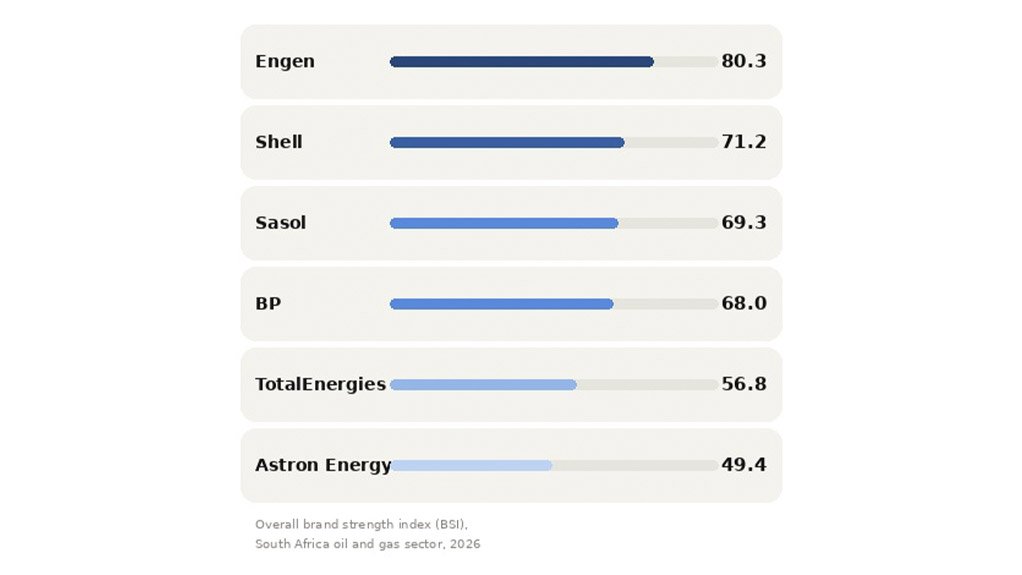
Engen leads with a Brand Strength Index score of 80.3, built on more than a century of heritage, a network of over a thousand stations, and a forecourt strategy that recognised long ago that the future lies in convenience, not fuel.
Shell follows at 71.2, ahead of Sasol at 69.3 and BP at 68.0, while TotalEnergies scores 56.8. Sasol's position is particularly impressive: until relatively recently, its retail presence was largely limited to the familiar “blue pump” at independently branded service stations, and its transition to a national network of Sasol-branded forecourts shows over the last twenty years just how much brand equity it has successfully built.
These differences are far from academic: they can determine whether a motorist drives past a station or stops to fill up.
The lessons written in a retired brand
If you want to know what happens when a company underestimates that difference, the evidence is already on our roads.
When Astron Energy, owned by mining group Glencore, acquired Chevron South Africa's downstream business in 2018, it ultimately chose to retire Caltex, one of the country's most recognisable fuel retail brands, in favour of its wholly owned Astron Energy brand.
The result has been one of the largest rebranding exercises in South African corporate history. Today, nearly 90% of the network has been converted, with more than 700 forecourts rebranded and the 800-site milestone now in sight.
However, our BSI data illustrates just how challenging that journey is. Astron has successfully built scale, visibility and operational credibility, but consumer brand equity takes much longer to establish. Its Brand Strength Index score stands at 49.4, more than 30 points behind Engen, and still below that of the Caltex brand it retired.
Even so, the trajectory is encouraging. Astron is building a new national fuel retail brand in real time, in the shadow of one of South Africa's most familiar forecourt names. That is a demanding assignment, and its progress should not be underestimated.
Building a brand from scratch is considerably harder than building on an established one. The lesson is not that Astron has failed, but rather how long brand equity takes to accumulate. Infrastructure can be replaced relatively quickly; recognition, trust and habitual consumer preference are earned over years, sometimes decades.
This provides a neat contrast with ADNOC's strategy. Astron chose the more difficult path of creating a new brand; ADNOC has elected to preserve and leverage one that already commands decades of consumer familiarity and trust.
What ADNOC should do next
None of this means ADNOC's work is done. Our data show that South Africans regard Shell more favourably than it is routinely chosen; its perception scores outpace its behaviour scores. Engen's nine-point lead is built on retail's most valuable currency: habit. And just as ADNOC inherits that advantage, the battleground is shifting beneath everyone's feet.
With fuel volumes under pressure from more efficient vehicles, constrained consumers and changing mobility patterns, the industry's profit pool is migrating from the pump to the shop. Engen recognised this early through Woolworths Foodstop and its convenience partnerships, while Sasol's new Mark V forecourts, positioning convenience rather than
fuel as the primary value proposition, offer a genuinely differentiated platform.
The brand that wins the next decade of South African fuel retail will be the one that transforms the forecourt from a fuel stop into a destination. ADNOC has paid handsomely for a head start in that race.
It is worth remembering what was really acquired here: a state-owned energy company with a formidable reputation of its own paid US$1 billion, in part, for the right to trade under a brand it does not own. Preserving and strengthening the Shell brand experience will therefore be paramount: customers may understand that ownership has changed, but they will judge the business through the lens of the Shell name and the expectations that accompany it.
And that reveals a powerful truth: in business, the most valuable assets are often the ones that never appear on the balance sheet.
Article Enquiry
Email Article
Save Article
Feedback
To advertise email advertising@creamermedia.co.za or click here
Research Reports

Projects


Latest Multimedia
Latest News
Showroom
Established in 1983, the ASTPM is an industry association and representative body of the welded carbon steel tube and pipe manufacturers of South...
VISIT SHOWROOM
Occupational health services, mobile clinics, wellness campaigns, aviation.
VISIT SHOWROOM
Press Office
Announcements
What's On
Subscribe to improve your user experience...
Option 1 (equivalent of R125 a month):
Receive a weekly copy of Creamer Media's Engineering News & Mining Weekly magazine
(print copy for those in South Africa and e-magazine for those outside of South Africa)
Receive daily email newsletters
Access to full search results
Access archive of magazine back copies
Access to Projects in Progress
Access to ONE Research Report of your choice in PDF format
Option 2 (equivalent of R375 a month):
All benefits from Option 1
PLUS
Access to Creamer Media's Research Channel Africa for ALL Research Reports, in PDF format, on various industrial and mining sectors
including Electricity; Water; Energy Transition; Hydrogen; Roads, Rail and Ports; Coal; Gold; Platinum; Battery Metals; etc.
Already a subscriber?
Forgotten your password?
Receive weekly copy of Creamer Media's Engineering News & Mining Weekly magazine (print copy for those in South Africa and e-magazine for those outside of South Africa)
➕
Recieve daily email newsletters
➕
Access to full search results
➕
Access archive of magazine back copies
➕
Access to Projects in Progress
➕
Access to ONE Research Report of your choice in PDF format
RESEARCH CHANNEL AFRICA
R4500 (equivalent of R375 a month)
SUBSCRIBEAll benefits from Option 1
➕
Access to Creamer Media's Research Channel Africa for ALL Research Reports on various industrial and mining sectors, in PDF format, including on:
Electricity
➕
Water
➕
Energy Transition
➕
Hydrogen
➕
Roads, Rail and Ports
➕
Coal
➕
Gold
➕
Platinum
➕
Battery Metals
➕
etc.
Receive all benefits from Option 1 or Option 2 delivered to numerous people at your company
➕
Multiple User names and Passwords for simultaneous log-ins
➕
Intranet integration access to all in your organisation