



US Orion spacecraft on first test flight

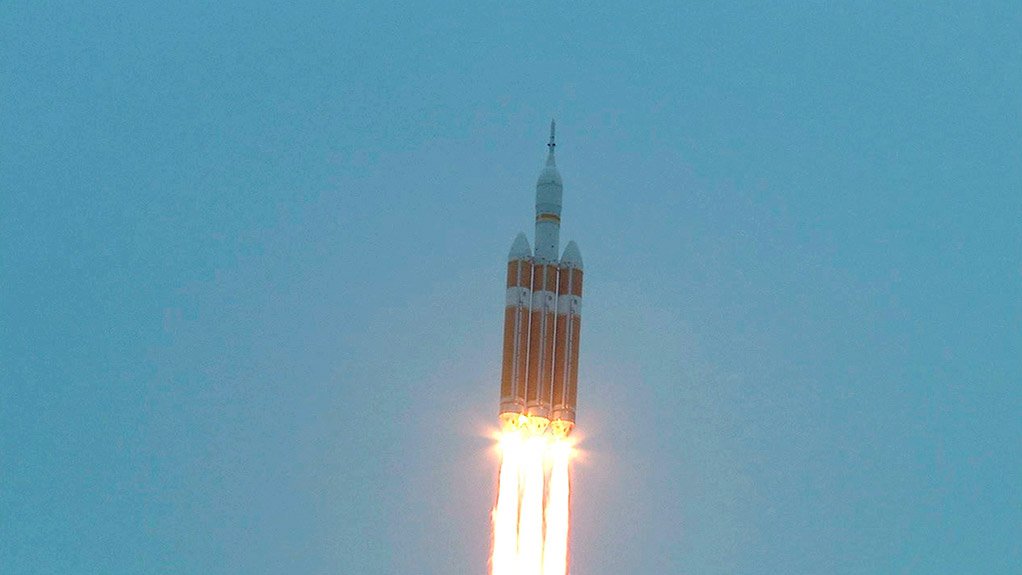
The Delta IV rocket carrying the Orion lifts off
Photo by NASA
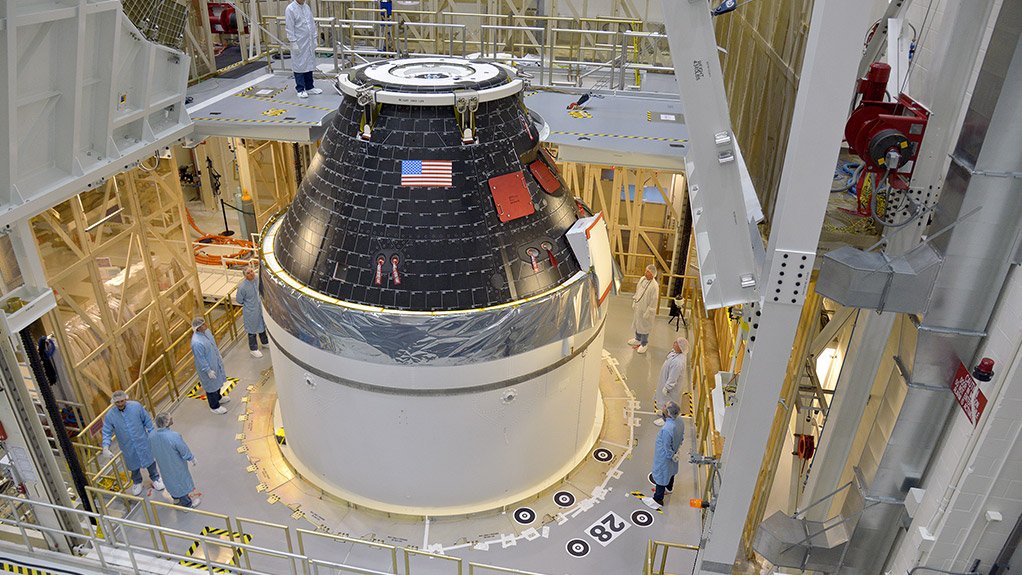
The conical Orion capsule, attached to its service module, but before integration with its Delta IV launch rocket
Photo by NASA


The prototype of America’s latest manned space craft, Orion, was launched on its first flight at 14:05 South African time on Friday. The vessel was carried aloft from the National Aeronautics and Space Administration’s (Nasa’s) Kennedy Space Flight Centre at Cape Canaveral in the US state of Florida by a Delta IV heavy rocket. The flight is planned to last for a little more than four hours, with splashdown scheduled for about 18:30 South African time.
Because this is the first flight of a new spacecraft, the Orion is unmanned. The purpose of this flight is to test essential technologies, such as the heat shield and the landing parachutes. The spaceship’s orbit will extend as far as 6 000 km above the Earth.
The Orion is intended as a space exploration vessel and not an Earth-to-orbit transport system. All being well, it take its crews to asteroids, the Moon and, ultimately, forms part of a Mars ship.
As a result, it reverts in design philosophy to the conical space capsule concept employed by Nasa in its Mercury, Gemini and Apollo programmes, instead of the “space plane” concept of the Space Shuttle. Consequently, the Orion will, after re-entry, parachute to the Earth’s surface and splashdown in the sea.
On exploration missions it will carry a crew of four, but could carry more on short-range, short endurance missions. It is thus significantly larger than Nasa’s previous space capsules.
Orion will re-enter the atmosphere at a speed of about 30 000 km/h, close to the speed of a spacecraft returning from the Moon. It was to achieve this speed that Orion’s maximum orbit is so high (the International Space Station orbits at an average height of just 400 km).
The spacecraft successfully completed its first orbit at about 15:56 South African time. It is programmed to splashdown into the eastern Pacific Ocean, where it will be retrieved by the US Navy amphibious ship USS Anchorage.
Article Enquiry
Email Article
Save Article
Feedback
To advertise email advertising@creamermedia.co.za or click here
Research Reports

Projects


Latest Multimedia




Showroom
ATI systems comprises five divisions: electrical assemblies, drives and controls, feedback sensors, enclosures, and strip guiding.
VISIT SHOWROOM
Your global lifecycle technology & service partner for materials & minerals processing equipment for coal, iron ore, copper, manganese & other...
VISIT SHOWROOM



Announcements
What's On
Subscribe to improve your user experience...
Option 1 (equivalent of R125 a month):
Receive a weekly copy of Creamer Media's Engineering News & Mining Weekly magazine
(print copy for those in South Africa and e-magazine for those outside of South Africa)
Receive daily email newsletters
Access to full search results
Access archive of magazine back copies
Access to Projects in Progress
Access to ONE Research Report of your choice in PDF format
Option 2 (equivalent of R375 a month):
All benefits from Option 1
PLUS
Access to Creamer Media's Research Channel Africa for ALL Research Reports, in PDF format, on various industrial and mining sectors
including Electricity; Water; Energy Transition; Hydrogen; Roads, Rail and Ports; Coal; Gold; Platinum; Battery Metals; etc.
Already a subscriber?
Forgotten your password?
Receive weekly copy of Creamer Media's Engineering News & Mining Weekly magazine (print copy for those in South Africa and e-magazine for those outside of South Africa)
➕
Recieve daily email newsletters
➕
Access to full search results
➕
Access archive of magazine back copies
➕
Access to Projects in Progress
➕
Access to ONE Research Report of your choice in PDF format
RESEARCH CHANNEL AFRICA
R4500 (equivalent of R375 a month)
SUBSCRIBEAll benefits from Option 1
➕
Access to Creamer Media's Research Channel Africa for ALL Research Reports on various industrial and mining sectors, in PDF format, including on:
Electricity
➕
Water
➕
Energy Transition
➕
Hydrogen
➕
Roads, Rail and Ports
➕
Coal
➕
Gold
➕
Platinum
➕
Battery Metals
➕
etc.
Receive all benefits from Option 1 or Option 2 delivered to numerous people at your company
➕
Multiple User names and Passwords for simultaneous log-ins
➕
Intranet integration access to all in your organisation
