The IE3 electric motor illusion: Why premium efficiency cannot fix a bad system curve

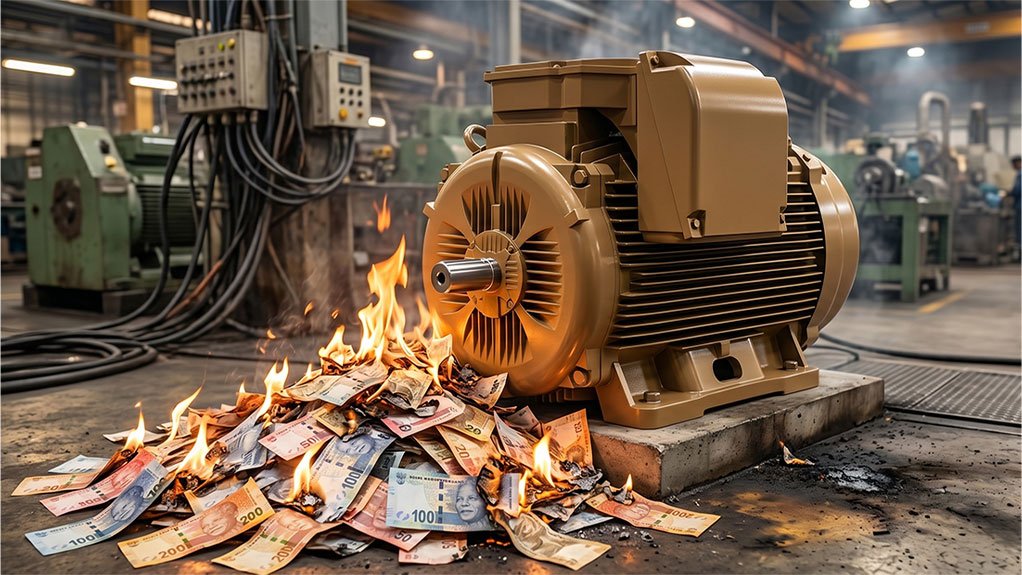
Industrial electric motor burning Rands, demonstrating how upgrading to an IE3 motor without fixing the driven equipment's system curve results in massive electrical and financial waste.


South Africa’s transition to the Minimum Energy Performance Standards (MEPS) under the VC 9113 regulation is now an immediate reality. As of the May 30, 2026, deadline, the grace period for selling existing IE1 and IE2 stock has officially expired. It is a hard legal requirement that most new low-voltage, three-phase industrial electric motors sold in the country must meet the IE3 (premium efficiency) standard. On paper, this is a massive win for environmental, social and governance targets, corporate sustainability reports, and the national power grid.
But in the real world of heavy industry, fluid dynamics, and actual rands and cents, this mandate creates a dangerous financial illusion.
Procurement departments are signing off on massive capital expenditures for expensive IE3 and IE4 prime movers, believing that bolting a premium electric motor onto an existing baseplate will automatically slash energy bills. It will not. If the driven equipment's system curve was never accurately established, that expensive new IE3 motor will never pay itself off. Ever.
The uncomfortable truth that the industry rarely discusses is this: A 20-year-old, standard-efficiency IE1 motor driving a perfectly specified hydraulic wet end at its Best Efficiency Point (BEP) will beat a state-of-the-art IE3 motor driving a poorly selected load.
Here is why.
The BEP Fallacy: Total Wire-to-Water Efficiency
When we discuss the power your facility pays for at the meter, we mean total wire-to-water efficiency.
Electric motor efficiency has hard thermodynamic limits. The difference in electrical efficiency between the copper windings and stator design of an old IE1 motor and a new IE3 motor is typically only 4% to 8%.
Hydraulic efficiency, however, is drastically more volatile. Driven equipment operating at its BEP might run at 80% efficiency. If that same equipment operates far off its curve—due to incorrectly calculated system head, degraded pipework, or a throttled discharge valve—its efficiency can easily plummet to 40% or worse.
The electrical energy saved by the premium design in an IE3 motor is instantaneously destroyed by fluid recirculation, cavitation, and turbulent flow inside a mismatched casing.
The Reality
Consider a real-world scenario. Assume an industrial plant requires a continuous output of exactly 25 kW of pure fluid power.
Setup A: The Mandate-Chaser (IE3 + Bad System Curve)
The plant upgrades to a brand new, expensive IE3 or IE4 motor to satisfy corporate targets. However, the existing wet end was poorly specified and runs way off its curve at a dismal 45% efficiency.
- To overcome that massive mechanical loss, the facility must buy a massive 75 kW IE3 motor.
- The result means that the system pulls a continuous 58.7 kW of electrical power from the grid.
Setup B: The Engineered Solution (IE1 + Good System Curve)
The plant fixes the fluidic demand first. They specify a perfectly matched wet end running smoothly at its BEP of 80% efficiency. They power it with an older, "inefficient" IE1 motor.
- Because the driven load is highly efficient, a much smaller, cost-efficient 37 kW IE1 motor easily handles the duty.
- The result means the system pulls only 34.7 kW of electrical power from the grid.
The Financial Verdict
The "inefficient" IE1 setup draws 24 kW less power than the premium IE3 setup.
If this system runs 24/7 at a conservative industrial tariff of R2.50 per kWh, Setup A wastes over R525 000 yearly in excess electricity.
Consider the outright capital cost. The price difference between a 37 kW standard motor and a 75 kW premium IE3 motor is staggering. You pay tens of thousands of rands extra—jumping two frame sizes—just to overcome a bad mechanical load. If you bolt that IE3 motor to equipment operating at 45% efficiency, the payback period on the IE3 premium is infinity. The tiny 4.5% electrical gain can never outpace the 35% mechanical loss.
Additionally, equipment operating violently off its curve destroys mechanical seals, shatters bearings and causes structural vibration. The expensive new IE3 motor attached to it will likely suffer premature drive-end bearing failure long before its 20-year lifespan is realised.
Why Pole Count Dictates the Cost
Before checking the efficiency class on the motor nameplate, you must check the speed. In South Africa's 50Hz power grid, the internal magnetic poles dictate the rotational speed. A 2-pole motor runs at a nominal 3 000 RPM, a 4-pole at 1 500 RPM, and a 6-pole at 1 000 RPM.
Why does this matter for your budget? Centrifugal performance is strictly governed by the affinity laws. Power required from the electric motor does not scale linearly; it increases with the cube of the rotational speed.
If procurement purchases a 2-pole IE3 electric motor simply because it was in stock, but the driven equipment was designed to run at BEP with a 4-pole motor, the results are catastrophic. If you double the speed, you do not double the power demand—you multiply it by eight.
Even if you throttle a discharge valve to compensate for excess output, you artificially induce massive head pressure, driving the system completely off its curve. Suddenly, your premium IE3 "upgrade" draws exponentially more power, turning excess energy into heat and vibration. Motor speed dictates the hydraulic curve, and the curve dictates the cost.
Engineering Must Precede Procurement
The South African government’s MEPS legislation is well-intentioned. If your mechanical load is sized perfectly, upgrading the prime mover to an IE3 or IE4 electric motor yields genuine, highly profitable energy savings.
This principle applies across the board. While the VC 9113 mandate governs three-phase units, ignoring the system curve when replacing smaller single-phase electric motors in lighter commercial applications yields the exact same mechanical failures and power waste on a smaller scale.
Legislation cannot bypass the laws of physics. You do not solve high energy bills starting at the electrical panel. You start at the fluidic demand. Audit the system curve. Specify the correct impeller trim, casing size, and operational speed to hit the exact duty point. Once the hydraulic foundation operates within 10% of its BEP, then you specify the electric motor.
The Bottom Line
Buying an IE3 or IE4 motor to bolt onto a badly-sized wet end is the industrial equivalent of putting high-octane racing fuel into a vehicle with four flat tires. It might meet the regulatory checklist, but it bleeds your operational budget dry.
At M Bond Pumps, we do not just sell components; we engineer systems. Before you blindly upgrade to meet the VC 9113 mandate, let us help you specify the correct drive from our vast WEG electric motor stock. Ensuring your system operates at its peak BEP is our primary metric for success—because true efficiency is measured in total rands saved, not just the nameplate on the motor.
This article is Part 2 of a four-part Industry Insights series by M Bond Pumps focusing on industrial fluid management and energy autonomy.
Written by M Bond Pumps MD and lead engineer Conrad Strehlau (Pr Eng, BSc Eng, MBA). With deep expertise in industrial fluid dynamics and electric motor systems, Strehlau’s company specialises in turning complex hydraulic challenges into commercially viable, high-efficiency solutions. As a premier online wholesale distributor, M Bond Pumps supplies robust pumping and drive infrastructure across South Africa, the SADC region, and the broader African continent.
Article Enquiry
Email Article
Save Article
Feedback
To advertise email advertising@creamermedia.co.za or click here
Research Reports

Projects


Latest Multimedia

Latest News


Showroom
Rentech provides renewable energy products and services to the local and selected African markets. Supplying inverters, lithium and lead-acid...
VISIT SHOWROOM
The Beneficiation Academy is a certified training institution that follows all compliance legislation and is accredited with various Sector...
VISIT SHOWROOM



Press Office
Announcements
What's On
Subscribe to improve your user experience...
Option 1 (equivalent of R125 a month):
Receive a weekly copy of Creamer Media's Engineering News & Mining Weekly magazine
(print copy for those in South Africa and e-magazine for those outside of South Africa)
Receive daily email newsletters
Access to full search results
Access archive of magazine back copies
Access to Projects in Progress
Access to ONE Research Report of your choice in PDF format
Option 2 (equivalent of R375 a month):
All benefits from Option 1
PLUS
Access to Creamer Media's Research Channel Africa for ALL Research Reports, in PDF format, on various industrial and mining sectors
including Electricity; Water; Energy Transition; Hydrogen; Roads, Rail and Ports; Coal; Gold; Platinum; Battery Metals; etc.
Already a subscriber?
Forgotten your password?
Receive weekly copy of Creamer Media's Engineering News & Mining Weekly magazine (print copy for those in South Africa and e-magazine for those outside of South Africa)
➕
Recieve daily email newsletters
➕
Access to full search results
➕
Access archive of magazine back copies
➕
Access to Projects in Progress
➕
Access to ONE Research Report of your choice in PDF format
RESEARCH CHANNEL AFRICA
R4500 (equivalent of R375 a month)
SUBSCRIBEAll benefits from Option 1
➕
Access to Creamer Media's Research Channel Africa for ALL Research Reports on various industrial and mining sectors, in PDF format, including on:
Electricity
➕
Water
➕
Energy Transition
➕
Hydrogen
➕
Roads, Rail and Ports
➕
Coal
➕
Gold
➕
Platinum
➕
Battery Metals
➕
etc.
Receive all benefits from Option 1 or Option 2 delivered to numerous people at your company
➕
Multiple User names and Passwords for simultaneous log-ins
➕
Intranet integration access to all in your organisation