



Sustainable long-term AMD solutions floated

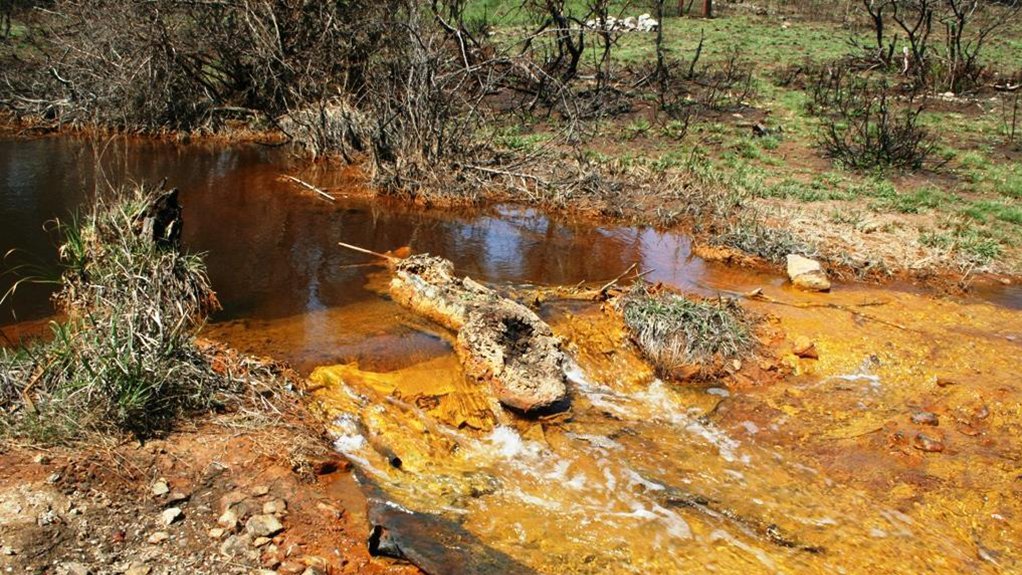
LEGACY ISSUE Acid mine drainage, particularly in Gauteng, is a long-standing issue, following the post-boom closure of underground gold mines during the twentieth century


With a State-led long-term solution to treating acid mine drainage (AMD) in the Eastern and Central basins of the greater Witwatersrand Goldfields being provisionally deferred to 2040, environmental organisation Federation for a Sustainable Environment (FSE) proposes five key measures as a more holistic and sustainable long-term solution to treating AMD.
Such measures comprise the optimum use of appropriate and cost-effective water management technologies, the apportionment of liabilities, new mining ventures being compelled to prove that the costs to deal with the residual impacts associated with mining – such as AMD – are catered for, the prohibition of mining activities in water- sensitive areas, and advocacy for progressive or concurrent implementation of intervention measures to manage mine water, says FSE CEO Mariette Liefferink.
AMD, particularly in Gauteng, is a long-standing issue, following the post-boom closure of underground gold mines during the twentieth century.
As a result, decanting of accumulated AMD occurred in 2002 from the flooded Western basin into the Tweelopiespruit. This served as a “stark reminder” of the impacts of delayed action by the South African government and mining industry in proactively addressing the issue, she highlights.
In 2013, the Department of Water and Sanitation conducted a feasibility study with short-, medium- and long-term phases to address AMD associated with the East, Central and West Rand basins. The department’s long-term solution recommended the desalination of water so that it could be reused for potable, industrial or agricultural supply.
Despite this, Liefferink says the feasibility study recommendations for the long-term solution have, to date, not been implemented because of cost and funding disputes, liability and ownership issues, departmental disagreements, land and contracting problems, as well as policy shifts.
Other delays included the recalibration of the salinity and hydrology models of the Vaal river system.
Nonetheless, Liefferink reiterates that AMD has been a long-recognised problem, pointing out that, in 1903, it was already referred to as an established phenomenon concerning pumped water on the Witwatersrand.
Measures for Combating AMD
As part of the FSE’s advocating to treat AMD, Liefferink says that appropriate and cost- effective treatment technology needs to be implemented based on its specific application and desired output use case, such as for irrigation, potable purposes or industrial uses.
“The technology should be self-funding and compatible with the ‘polluter-pays’ principle,” she notes, adding that the principle is based on the internalisation of externalities, which is central to the equitable resolution of pollution costs currently being borne by end-users.
“There should be no financial burden to the fiscus or to the public, who is . . . carrying the cost burden of combating salinity.”
Liefferink adds that the liabilities for dealing with AMD, or mine-influenced water, should be divided between the State, the mining company responsible or the broader mining sector.
“If the company ceases to exist, the liability will shift to the general public, which will be contrary to the principle of retrospective liability as provided in Section 28 of the National Environmental Management Act Number 107 of 1998.”
Further, it must be shown that all reasonable steps necessary were taken to prevent pollution, and even an unintentional but nonetheless negligent unlawful act or omission which causes pollution or the degradation of the environment can make a company director personally liable, she notes.
As for the FSE’s advocacy that mining ventures prove beforehand that the cost to deal with the residual impacts associated with mining are catered for, Liefferink says a cost-to-benefit-analysis should be demonstrated particularly by mines that have the potential to produce AMD or are discharging mine water that is not compliant with wastewater quality standards.
The federation also supports the prohibition of mining activities in water-sensitive areas or strategic water-source areas where any sulphide-producing or other acid-generating material occurs in the mineral deposit.
It also proposes the progressive or concurrent implementation of intervention measures to manage mine water, with Liefferink noting that the magnitude of the task to overcome mine-influenced water and AMD increases exponentially in instances where the implementation of intervention measures is delayed until mine closure.
“The closure of a mining operation incorporates a process which must start at the commencement of the operation and continue throughout the life of the mine. Risks must be quantified and managed proactively.”
However, this is where a critical shortcoming arises, as she says any holder of a mining right needs to obtain a closure certificate, including an environmental risk report that must be submitted to the Department of Mineral and Petroleum Resources (DMPR), upon the lapsing or abandonment of such a right, the cessation of mining operations or relinquishment of an portion of land to which the mining right pertains.
“The FSE has no knowledge of any closure certificates that have been issued by the DMPR to gold mining companies within the Witwatersrand. This often results in ‘pass the parcel’ care and maintenance, liquidation or abandonment,” says Liefferink.
No response had been received from the DMPR regarding the issuing of any such closure certificates at the time of going to print.
Article Enquiry
Email Article
Save Article
Feedback
To advertise email advertising@creamermedia.co.za or click here
Research Reports

Projects


Latest Multimedia


Showroom

Design, Construction and Maintenance of Site Erected, Welded Bulk Storage Tanks for the Petrochemical, LNG, Ammonia and Sustainable fuel Sectors.
VISIT SHOWROOM
Sika South Africa is a trusted partner for the nation’s infrastructure, commercial, residential, and industrial sectors.
VISIT SHOWROOM



Press Office
Announcements
What's On
Subscribe to improve your user experience...
Option 1 (equivalent of R125 a month):
Receive a weekly copy of Creamer Media's Engineering News & Mining Weekly magazine
(print copy for those in South Africa and e-magazine for those outside of South Africa)
Receive daily email newsletters
Access to full search results
Access archive of magazine back copies
Access to Projects in Progress
Access to ONE Research Report of your choice in PDF format
Option 2 (equivalent of R375 a month):
All benefits from Option 1
PLUS
Access to Creamer Media's Research Channel Africa for ALL Research Reports, in PDF format, on various industrial and mining sectors
including Electricity; Water; Energy Transition; Hydrogen; Roads, Rail and Ports; Coal; Gold; Platinum; Battery Metals; etc.
Already a subscriber?
Forgotten your password?
Receive weekly copy of Creamer Media's Engineering News & Mining Weekly magazine (print copy for those in South Africa and e-magazine for those outside of South Africa)
➕
Recieve daily email newsletters
➕
Access to full search results
➕
Access archive of magazine back copies
➕
Access to Projects in Progress
➕
Access to ONE Research Report of your choice in PDF format
RESEARCH CHANNEL AFRICA
R4500 (equivalent of R375 a month)
SUBSCRIBEAll benefits from Option 1
➕
Access to Creamer Media's Research Channel Africa for ALL Research Reports on various industrial and mining sectors, in PDF format, including on:
Electricity
➕
Water
➕
Energy Transition
➕
Hydrogen
➕
Roads, Rail and Ports
➕
Coal
➕
Gold
➕
Platinum
➕
Battery Metals
➕
etc.
Receive all benefits from Option 1 or Option 2 delivered to numerous people at your company
➕
Multiple User names and Passwords for simultaneous log-ins
➕
Intranet integration access to all in your organisation
