



Stimulus package leaves many questions, uncertainties − analysts

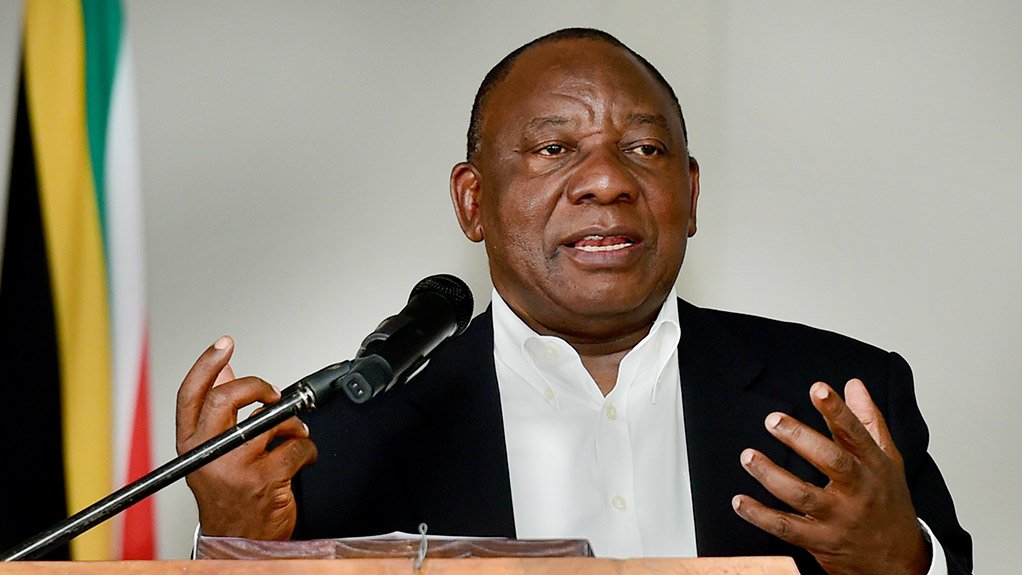


Market research and consultancy firm Intellidex says the R500-billion economic recovery package announced by President Cyril Ramaphosa on April 21 is positive, but chasing a growing hole.
“A huge stimulus has been announced by the President, which is long overdue and very welcome. It consists of a R200-billion guaranteed loan support programme from banks and R300-billion of balance sheet stimulus. This is clearly a bazooka but there are questions over how implementable large parts of it are.
“It would also be a mistake to consider it simply sitting on top of the existing lockdown until the end of April and then recovery as, on April 23, government will announce the next steps of lockdown until September, which will be highly bureaucratic and likely result in district and metro lockdowns particularly towards September,” Intellidex states.
Intellidex capital markets research head Peter Attard Montalto notes that an International Monetary Fund rapid financing instrument has been applied for, valued at $4.2-billion, while another $6.5-billion comes from the Brics' New Development Bank, the African Development Bank, the World Bank and South Africa’s Unemployment Insurance Fund.
However, this still leaves a funding gap of R64-billion, or $3.4-billion, that needs to be filled, says Intellidex, despite the R130-billion of spending reprioritisation that the President announced.
The Democratic Alliance (DA), in turn, finds that the package falls short with R38-billion, while it is also unclear how the borrowing components will be repaid.
While an emergency budget update is coming soon, Montalto believes an urgent explanation to markets is needed both of how the numbers add up and of the funding mix – including what will happen to South African government bonds – to keep the market onside.
“There is also a serious issue of how we will exit this – a fiscal rule is needed urgently given potentially many issues like new unemployment support risk becoming permanent and as we have seen over history – nominal gross domestic product (GDP) growth does not come to the rescue and nor do structural reforms.
“Thinking on the growth impact, the recovery package will mainly see R200-billion go into working capital and not investment capital, which is less growth positive, while the spending reprioritisation lowers growth,” Montalto says.
Intellidex maintains its forecast that South Africa's economy is likely to contract by 9.7% this year.
“So far our -9.7% growth forecast only accounts for the lockdown ending at the end of April, and then some assumptions about travel until end June. The reality which will be announced on April 23 is that there will be a much more challenging extended period of targeted local, data-led lockdowns that will run from May until September that will be highly bureaucratic for companies to reopen business.
“As the crisis peaks in September, we may well see what is, in effect, full national lockdowns again or lockdowns that are targeting the most important metropolitan economic hubs,” Montalto explains.
He adds that there are significant risks – especially adding in Eskom's liquidity risks, Land Bank recapitalisation, possible requests for a petrochemical company Sasol backstop and South African Airways equity injections.
“There is zero room for error here, however, and credibility is key as we keep saying. The National Treasury has stepped up to the plate, clearly, but now has to flesh out the detail to keep markets onside,” Intellidex says.
CMS South Africa tax and governance director Bernard Mofokeng is also left with questions following the President’s economic recovery announcement.
“The challenge with the proposed tax incentives announced by Ramaphosa is in the detail: how are they going to be implemented by the South African Revenue Service (Sars) and also by Treasury.
"We will have to wait and see what the proposed amendments by Treasury will look like and also hear from Sars how they are going to implement the deferrals of pay-as-you-earn (PAYE) up to 35% and also the amendment to the Donation Tax regime relating to the Solidarity Fund,” he notes.
Mofokeng questions how that will be implemented, as well as how Sars' information technology systems are going to be adjusted, as most of the taxes like PAYE and value added tax are all electronic through the eFiling system, which is not easy to manipulate at such short notice.
DA leader John Steenhuisen says if long-term economic reforms are not committed to by the leading governing party, then the recovery package's effect will be short-lived.
He strongly states that increased transparency is necessary around Covid-19 testing, hospital capacities and the rollout of the economic stimulus package. "A lot of money will be facilitated at local government level, but there are concerns around their capability and accountability to manage funds properly.
He further believes that although the economy loses about R13-billion a day during the lockdown period, it is necessary for government to formulate its response to the virus and prepare healthcare facilities to manage the infections.
Further, Nedbank expects the economy to contract by around 7% in 2020, but believes that the loan guarantee fund is a major positive development., which was announced by the President.
“It is soundly targeted and strategic assistance, which will reduce the long-term damage to the economy and government finances by helping to ensure that smaller firms and the jobs they sustain survive the crisis,” the bank states.
Corruption Watch executive director David Lewis has called for increased transparency, vigilance and accountability, particularly against the backdrop of the extremely high levels of corruption that have characterised South African public life for so long, around managing the funds.
"We have gained considerable experience in identifying red flags for corruption and we will continue to serve the public in this way. It is government’s duty to ease our task by promoting maximum transparency and by acting against transgressors."
SMALL BUSINESS COMPONENT
The Small Business Institute (SBI) has lauded the President for increasing the economic support for formal, job-creating small and medium enterprises (SMEs) by R2-billion.
"While we appreciate the additional allocation for distressed SMEs, we need to take into account all the lessons of the last three weeks.
"For example, the fact that only about R100-million of the R500-million (earmarked for SMEs) has been approved means that the money isn’t flowing into those who need it fast enough. We need to get the money out to SME and informal traders on time before they file for liquidation and start mass retrenchments,” SBI CEO John Dludlu says.
The SBI also calls on government to significantly simplify and streamline the access requirements for SMEs and informal businesses. “There’s no point in the money finding a business that has already shut its doors. Here’s our humble suggestion to Small Business Minister Khumbudzo Ntshavheni to please consider retrospectively assisting beneficiaries with full compliance so that money does indeed flow into the economy,” Dludlu says.
He adds that this period demands trust, mutual respect and collaboration between all role players.
BEYOND THE OUTBREAK
Asset management company Investec says there needs to be an enormous reduction in the regulatory burden in South Africa to spark growth, red tape needs to be cut by over a third as per Treasury’s growth plan.
"Increasing the ease of doing business has been unsuccessful, despite the new regime in place for over two years, as various political obstacles in a number of quarters have still been in place.
"Unified political will for the structural reforms of Treasury’s growth plan is needed. Government/regulatory efficiency needs to improve substantially to lift the ease of doing business, with government departments quickening delivery time in issuing compliance certificates, clearing their backlogs and activity aiding businesses in compliance," Investec recommends, beyond the recovery plan.
North West University Business School economist Professor Raymond Parsons says the economic support package announced by the President to address the economic fallout of Covid-19 represents a highly substantial raft of measures designed to assist distressed businesses and households, adding up to about 10% of South Africa’s GDP.
He points out that the economic decisions now need to enjoy the same degree of urgency as the public health decisions that have to be taken. The economic outlook for this year is one of deep recession, business failures and rising unemployment and the economic support package, although substantial, will only cushion some of those outcomes, he states.
Even prior to Covid-19, South Africa’s public finances were under great strain and the additional spending and borrowing that will now arise will inevitably see debt ratios deteriorate further.
Parsons says it is nonetheless welcome that government is prepared to tap into emergency financial facilities from multilateral institutions. At least South Africa is incurring more debt as cheaply as possible.
Looking beyond Covid-19, Parsons says it is now even more imperative that inclusive pro-growth reforms be implemented to lift the growth rate, reduce unemployment and improve tax revenues.
Helen Suzman Foundation research head Charles Simkins says there were two key omissions from the President’s announcement; first, there was no mention of South African Airways and there was no attention paid to restoring the ecology of the informal sector in the next few months.
However, perhaps more will become clear on April 23 when the President elaborates on the economic recovery plan.
“It is clear the 2020 Budget will have to be redone, and the amendments would have to be introduced through parliament by the end of July,” Simkins notes.
Article Enquiry
Email Article
Save Article
Feedback
To advertise email advertising@creamermedia.co.za or click here
Research Reports

Projects


Latest Multimedia


Latest News
Showroom

Roytec Global is an international company specializing in liquid / solid and mineral separation technologies for the Mining and Industrial sectors.
VISIT SHOWROOM
Virtual Gas Network supplies compressed natural gas via a virtual gas distribution network.
VISIT SHOWROOM


Announcements
What's On
Subscribe to improve your user experience...
Option 1 (equivalent of R125 a month):
Receive a weekly copy of Creamer Media's Engineering News & Mining Weekly magazine
(print copy for those in South Africa and e-magazine for those outside of South Africa)
Receive daily email newsletters
Access to full search results
Access archive of magazine back copies
Access to Projects in Progress
Access to ONE Research Report of your choice in PDF format
Option 2 (equivalent of R375 a month):
All benefits from Option 1
PLUS
Access to Creamer Media's Research Channel Africa for ALL Research Reports, in PDF format, on various industrial and mining sectors
including Electricity; Water; Energy Transition; Hydrogen; Roads, Rail and Ports; Coal; Gold; Platinum; Battery Metals; etc.
Already a subscriber?
Forgotten your password?
Receive weekly copy of Creamer Media's Engineering News & Mining Weekly magazine (print copy for those in South Africa and e-magazine for those outside of South Africa)
➕
Recieve daily email newsletters
➕
Access to full search results
➕
Access archive of magazine back copies
➕
Access to Projects in Progress
➕
Access to ONE Research Report of your choice in PDF format
RESEARCH CHANNEL AFRICA
R4500 (equivalent of R375 a month)
SUBSCRIBEAll benefits from Option 1
➕
Access to Creamer Media's Research Channel Africa for ALL Research Reports on various industrial and mining sectors, in PDF format, including on:
Electricity
➕
Water
➕
Energy Transition
➕
Hydrogen
➕
Roads, Rail and Ports
➕
Coal
➕
Gold
➕
Platinum
➕
Battery Metals
➕
etc.
Receive all benefits from Option 1 or Option 2 delivered to numerous people at your company
➕
Multiple User names and Passwords for simultaneous log-ins
➕
Intranet integration access to all in your organisation
