



SRK pushes innovation, collaboration for Africa’s mining future

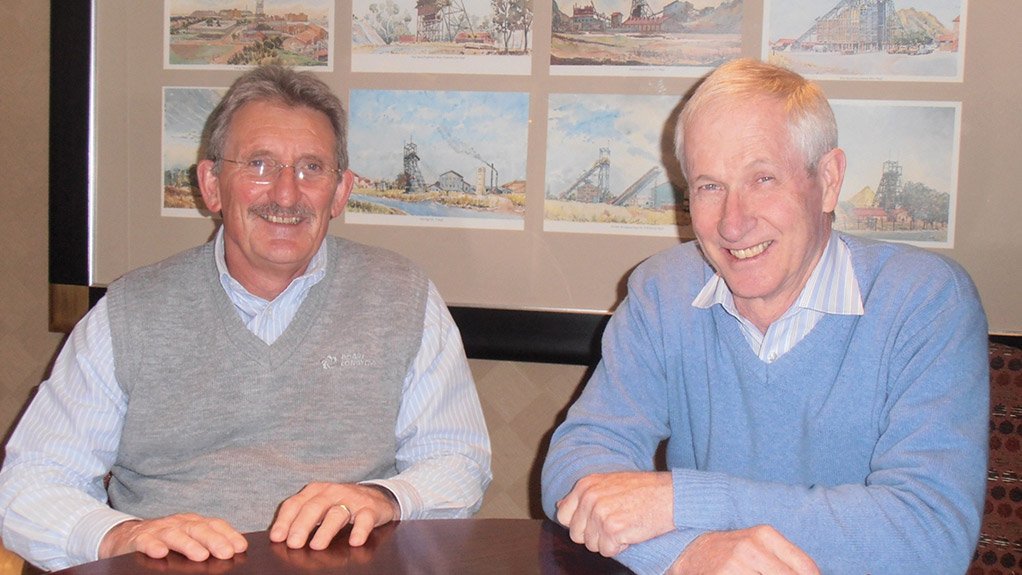
ROGER DIXON, PETER LABRUM The best way for African countries to get more value from mining is to leverage the related infrastructure more effectively


As Africa seeks innovative ways to encourage its mining sector, mining consultant SRK Consulting has put its engineering and broader expertise at the service of collaborative, win-win initiatives that will chart an exciting way forward for the continent.
“Our recent engagement by the government of Cameroon as technical advisors – to help negotiate an important mining convention with their private sector partner – has convinced us that well-informed, constructive collaboration is what the industry needs to focus on,” says SRK chairperson Roger Dixon.
“Our presence in Africa – which includes our offices in Accra, Ghana; Lubumbashi, Democratic Republic of Congo (DRC); Harare, Zimbabwe; Luanda, Angola and around South Africa – gives us invaluable insights into mining challenges and solutions,” says Dixon.
“At this critical time in the history of the sector, we are finding new ways to apply this experience that will benefit clients and the continent in general.”
Key among these challenges includes the capacity of governments to develop and manage a conducive and predictable mining investment framework that relevant departments can implement effectively.
Another is ensuring the commitment of mining companies to earning their social licence to mine, on the basis of good corporate citizenship, local skills transfer, respect for the environment, and sustainable community upliftment.
While SRK has earned its global reputation from specialised geotechnical and engineering skills, it is also a front-runner in the field of environmental and social impact assessment. This know-how, along with its capabilities in infrastructural and financial disciplines, has equipped it uniquely to support clients in taking a broad view of project optimisation while fully appreciating the technical details.
“The best way for African countries to get more value from mining is to leverage the related infrastructure more effectively, so that the local and national economies can broaden their foundations into non-mineral sectors,” says SRK MD Peter Labrum.
“It is always heartening to be involved in mineral projects around Africa, as the economic spin-off generally gives a boost to both the local economy and the host country’s state revenues,” says Labrum. “SRK’s traditional involvement is usually on the mining side but just as often extends to the infrastructural elements of these projects – including roads, rails, ports and water supply.”
As an independent consulting firm, SRK has been able to work with both the private and the public sector to the highest professional standards. It was initially engaged by Cameroon to review iron-ore miner Sundance Resources’ feasibility study on the Mbalam-Nabeba iron-ore project in the southeast of the country.
SRK was also requested to comment on areas where government felt it required further assurances or more detailed responses on certain aspects.
The approach taken by Cameroon – cognisant that these are early days for its ambitions as a mining country – has been careful and considered; it is eager to ensure that the interests of all stakeholders are served, and that first mining projects create a good example for those that follow.
Guiding the Sundance convention process was a 15-member steering committee representing various government departments, including the President’s office. Chaired by a minister, the committee facilitated the process by putting decision-makers around a table to ensure that all concerns were heard and addressed.
“This kind of process is a breakthrough for how African countries could engage more productively with investors in the mining sector,” says Dixon.
“Working with different arms of government to find the best financial, legal, technical and socio-economic solutions has been exciting and rewarding. We hope that the model can be tried elsewhere.”
SRK’s office in Lubumbashi is also looking at a similar structure in DRC, according to country manager Susa Maleba. A special government committee exists to develop the mining industry in conjunction with infrastructure and power requirements.
“Our mining code emphasises sustainable development, and to achieve this we need an infrastructure development plan that looks at the needs of the mining industry as a whole, not just individual projects,” says Maleba.
Ghana, Africa’s second largest producer of gold and host to another SRK office, is also seeing the broader impact of mineral investment. With more than 20 large mining companies active there, as well as over 300 small-scale miners and about 90 mining service companies, Ghana is also poised to see substantial developments in the oil sector following recent important discoveries.
“With growing interest on the continent and the potential for sound economic growth in Africa, under-explored countries are likely to see considerable investments in exploration, mining, energy and infrastructure,” says SRK Ghana country manager John Kwofie.
Mindful of the technical complexities of mining-driven economic development, SRK has recently formed an expert group on Strategy and Policy for Sustainable Mining – to add value to the mandates of governments, corporations, investment funds, communities, donor agencies and other stakeholders, by ensuring a mutually beneficial approach to minerals development in Africa.
“It will be particularly valuable to large, complex projects requiring infrastructure coordination, and will draw on SRK’s considerable expertise in sustainable resource development on the continent,” says Dixon.
This team of highly qualified and seasoned practitioners offers:
• Macro-level insights into minerals governance policy, including legal and financial aspects of developing and implementing a minerals management policy.
• Facilitation of engagement between government authorities, mining companies and aid agencies on development of regional mining and fiscal policy.
• Alignment of corporate long-term operational horizons with the development priorities of host countries and communities – to earn and maintain a social licence to mine.
• Successful strategic outcomes of projects through a unique blend of collaborative planning, compliance, implementation monitoring and social skills.
“For mining companies working in Africa, long-term economic value can only be optimised when environmental and social issues are built into company strategy and not externalised,” says Dixon.
“By tackling these issues early in the project life-cycle, we help clients to unlock and sustain value over time.” He adds that one of the greatest opportunities for developing the continent’s minerals sector is better collaboration within and between governments. Highlighting the frequent need for greenfield initiatives in Africa to be accompanied by substantial infrastructure development, Dixon says that these projects could be expedited by spreading the investment between more than one country or role-player; this would also help extend the benefits beyond one country or community.
“It is common for large minerals projects to comprise at least three vital but costly elements: a mine to extract the material, a rail line to transport it and a port to access global markets,” he notes.
“It is unlikely that one funder for all aspects of this kind of project will be found – it is simply too large. So it has to be split up – perhaps even across borders – requiring governments and private funders to come on board in a complex, collaborative effort.”
An important iron ore deposit, for instance, lies on both sides of the border between the Congo-Brazzaville and Cameroon.
It is these scenarios that the SRK Strategy and Policy Group will help clients to address, bringing unmatched African experience and expertise to the engineering, environmental and social expertise elements of Africa’s mining future.
Article Enquiry
Email Article
Save Article
Feedback
To advertise email advertising@creamermedia.co.za or click here
Research Reports

Projects


Latest Multimedia


Latest News

Showroom
As one of South Africa's leading manufacturers, Bell Equipment distributes and exports its wide range of heavy equipment globally to mining,...
VISIT SHOWROOM
From batteries for boats and jet skis, to batteries for cars and quad bikes, SABAT Batteries has positioned itself as the lifestyle battery of...
VISIT SHOWROOM


Announcements
What's On
Subscribe to improve your user experience...
Option 1 (equivalent of R125 a month):
Receive a weekly copy of Creamer Media's Engineering News & Mining Weekly magazine
(print copy for those in South Africa and e-magazine for those outside of South Africa)
Receive daily email newsletters
Access to full search results
Access archive of magazine back copies
Access to Projects in Progress
Access to ONE Research Report of your choice in PDF format
Option 2 (equivalent of R375 a month):
All benefits from Option 1
PLUS
Access to Creamer Media's Research Channel Africa for ALL Research Reports, in PDF format, on various industrial and mining sectors
including Electricity; Water; Energy Transition; Hydrogen; Roads, Rail and Ports; Coal; Gold; Platinum; Battery Metals; etc.
Already a subscriber?
Forgotten your password?
Receive weekly copy of Creamer Media's Engineering News & Mining Weekly magazine (print copy for those in South Africa and e-magazine for those outside of South Africa)
➕
Recieve daily email newsletters
➕
Access to full search results
➕
Access archive of magazine back copies
➕
Access to Projects in Progress
➕
Access to ONE Research Report of your choice in PDF format
RESEARCH CHANNEL AFRICA
R4500 (equivalent of R375 a month)
SUBSCRIBEAll benefits from Option 1
➕
Access to Creamer Media's Research Channel Africa for ALL Research Reports on various industrial and mining sectors, in PDF format, including on:
Electricity
➕
Water
➕
Energy Transition
➕
Hydrogen
➕
Roads, Rail and Ports
➕
Coal
➕
Gold
➕
Platinum
➕
Battery Metals
➕
etc.
Receive all benefits from Option 1 or Option 2 delivered to numerous people at your company
➕
Multiple User names and Passwords for simultaneous log-ins
➕
Intranet integration access to all in your organisation
