



Square Kilometre Array project, Australia and Africa





Name and Location
Square Kilometre Array (SKA) project, Australia and Africa.
Client
The international SKA project is run by the UK-based SKA Organisation, which currently comprises ten countries – Australia, Canada, China, Germany, Italy, the Netherlands, New Zealand, South Africa, Sweden and the UK. India is an associate member and is expected to become a full member shortly.
The SKA Organisation formalises relationships between the international partners and centralises the leadership project.
The project in South Africa is the responsibility of a separate, local organisation, SKA SA.
Project Description
The SKA will provide one-million square metres of collecting area, which demands a revolutionary break from traditional radio telescope design.
Three types of antennas (radio-wave receptors) – dishes, midfrequency aperture arrays and low-frequency aperture arrays – will be used by the SKA to provide continuous frequency coverage from 70 MHz to 10 GHz. Combining the signals from the antennas will create a telescope with a collecting area equivalent to a dish with an area of about one square kilometre.
Built over two sites, in Australia and Africa, the SKA will achieve high-sensitivity and high-resolution images by having antennas densely distributed in the central region of the arrays and then positioned in clusters along five spiral arms – the clusters will become more widely spaced further away from the centre.
The central regions, in Australia and in South Africa, will contain cores, each 5 km in diameter – one for each antenna type. Fifty percent of the collecting area will be within the central cores. The aperture array antennas will extend to about 200 km from the core regions. In Africa, the dishes will be positioned in distant stations out to at least 3 000 km.
The construction of the SKA will be phased.
Phase 1 (SKA1) will comprise about 10% of the array and will include dishes and low-frequency aperture arrays.
The Australian Square Kilometre Array Pathfinder, and South Africa’s Meerkat precursor dishes will be incorporated in the first phase of the SKA. The Murchison Widefield Array, located at the Australia site, is another precursor telescope to the SKA.
Phase 2 (SKA2) will extend the array with midfrequency aperture arrays and further dishes.
All the dishes for Phase 2 will be located in Africa.
All the low-frequency aperture arrays will be located in Australia.
All the midfrequency aperture arrays will be built in Southern Africa.
The phased construction of the telescope will mean that the SKA can start operating before construction is completed.
Value
SKA1 is expected to cost €650-million (about R8.9-billion).
Duration
The first elements of SKA1 should be deployed in 2016 and construction of SKA1 should start in 2018 and be completed in 2023
Latest Developments
Negotiations are under way to establish how much each country involved will pay for the first phase of the SKA.
According to SKA South Africa project director Bernie Fanaroff, the big issue is the funding model.
The SKA’s board of directors put a cap on the capital costs on SKA1 in July.
This cost will be covered by all members of the SKA Organisation, which is actively recruiting other countries to join.
“So, it is possible there will be other contributions. The [US] will almost certainly come in after 2020. We hope the European Union will find some way of contributing as well,” says Fanaroff.
He says the project’s second and final phase will cost less than the first.
“The cost of SKA2 will be clear only when the design is done . . . but we expect it to be cheaper because the technologies will be cheaper by that time.”
Still being negotiated is the ‘in-kind contribution’ value to be placed on South Africa’s MeerKat radio telescope, which, Fanaroff says, is “on track” and set to deliver its first science in 2017.
The plan is to integrate the MeerKat radio telescope into the SKA in 2021 or 2022.
The SKA Organisation wants South Africa and Australia, as the countries in which the telescope will be located, to contribute more to the cost of its construction than the other countries. However, the two countries have said there is a limit to what they can contribute.
Some countries have taken a “very hard line” on contributions, although it has not been disclosed which countries have taken such a position.
Meanwhile, in mid-March, the SKA office issued a request for proposals, inviting research organisations and industry to participate in the design of the SKA telescope. As stated at that time, the purpose of the design activities was to prepare the SKA project at element level to proceed with the construction of SKA1. The deadline for the receipt of proposals was June 10.
The SKA office has received proposals that cover all the work-breakdown structure elements. In addition to technical proposals that address the baseline design, the proposals include the required management and product assurance plans, as well as other managerial and programmatic documentation necessary for the smooth execution of the work.
The SKA board members have authorised the office to proceed with the negotiation phase with the consortia.
The outcome of these negotiations is expected to be concluded by the end of September 2013.
Key Contracts and Suppliers
South Africa: Neotel/Broadband Infraco joint venture, or JV (bandwidth network); Eskom (electricity); Telkom (telecommunications); and Nokia Siemens Networks, Intel, Seacom, Dimension Data, Microsoft and IBM (connectivity support).
On Budget and on Time?
The project is reportedly on course, with the initial phases scheduled to go ahead in 2013.
Contact Details for Project Information
Council for Scientific and Industrial Research general and technical enquiries, Tendani Tsedu, tel +27 12 841 3417.
SKA South Africa, tel +27 11 442 2434, fax +27 11 442 2454 or email tcheetham@ska.ac.za.
SKA Organisation chief communication officer William Garnier,tel +44 161 306 9613 or email w.garnier@skatelescope.org.
Article Enquiry
Email Article
Save Article
To advertise email advertising@creamermedia.co.za or click here
Research Reports

Projects

Latest Multimedia
Latest News


Showroom
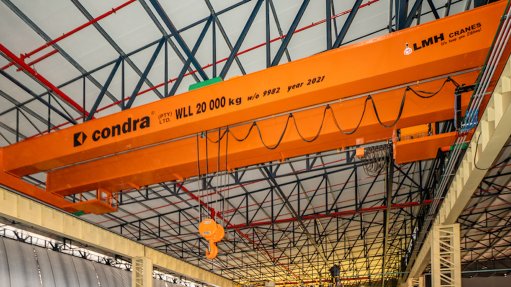
ISO-certified Condra manufactures overhead cranes, portal cranes, cantilever cranes and crane components: hoists, drives, end-carriages, brakes and...
VISIT SHOWROOM
Columbus Stainless, based in Middelburg, Mpumalanga, is Africa’s only producer of stainless steel flat products. In addition, Columbus is the only...
VISIT SHOWROOM


Press Office
Announcements
What's On
Subscribe to improve your user experience...
Option 1 (equivalent of R125 a month):
Receive a weekly copy of Creamer Media's Engineering News & Mining Weekly magazine
(print copy for those in South Africa and e-magazine for those outside of South Africa)
Receive daily email newsletters
Access to full search results
Access archive of magazine back copies
Access to Projects in Progress
Access to ONE Research Report of your choice in PDF format
Option 2 (equivalent of R375 a month):
All benefits from Option 1
PLUS
Access to Creamer Media's Research Channel Africa for ALL Research Reports, in PDF format, on various industrial and mining sectors
including Electricity; Water; Energy Transition; Hydrogen; Roads, Rail and Ports; Coal; Gold; Platinum; Battery Metals; etc.
Already a subscriber?
Forgotten your password?
Receive weekly copy of Creamer Media's Engineering News & Mining Weekly magazine (print copy for those in South Africa and e-magazine for those outside of South Africa)
➕
Recieve daily email newsletters
➕
Access to full search results
➕
Access archive of magazine back copies
➕
Access to Projects in Progress
➕
Access to ONE Research Report of your choice in PDF format
RESEARCH CHANNEL AFRICA
R4500 (equivalent of R375 a month)
SUBSCRIBEAll benefits from Option 1
➕
Access to Creamer Media's Research Channel Africa for ALL Research Reports on various industrial and mining sectors, in PDF format, including on:
Electricity
➕
Water
➕
Energy Transition
➕
Hydrogen
➕
Roads, Rail and Ports
➕
Coal
➕
Gold
➕
Platinum
➕
Battery Metals
➕
etc.
Receive all benefits from Option 1 or Option 2 delivered to numerous people at your company
➕
Multiple User names and Passwords for simultaneous log-ins
➕
Intranet integration access to all in your organisation
