


Square Kilometre Array project, Africa and Australia




Name and Location
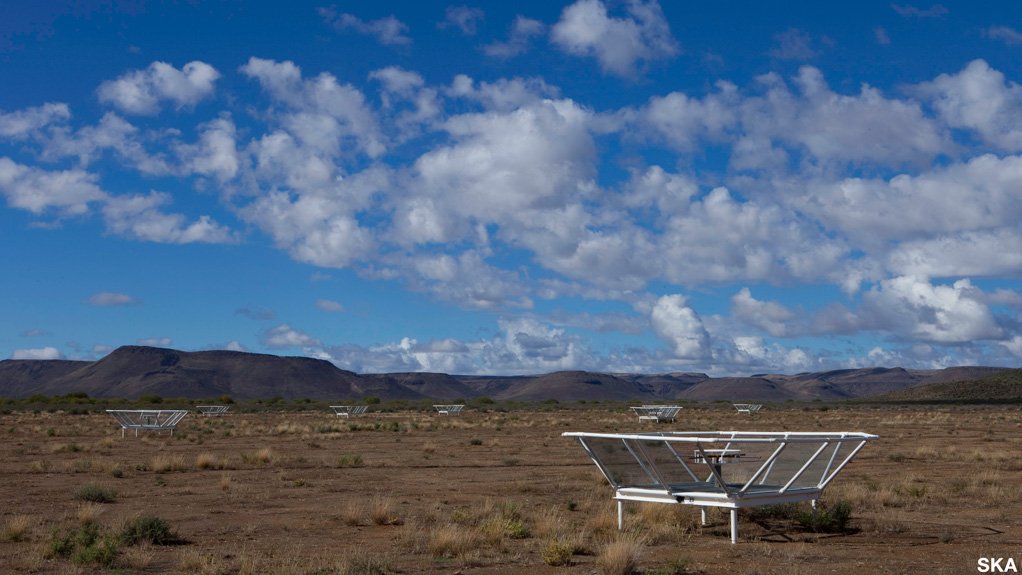
Square Kilometre Array (SKA) project, Africa and Australia.
Client
The international SKA project is run by the UK-based SKA Organisation, which currently comprises ten countries – Australia, Canada, China, Germany, Italy, the Netherlands, New Zealand, South Africa, Sweden and the UK. India is an associate member and is expected to become a full member shortly.
The SKA Organisation formalises relationships between the international partners and centralises the leadership project.
The project in South Africa is the responsibility of a separate, local organisation, SKA SA.
Project Description
The SKA will provide one-million square metres of collecting area, which demands a revolutionary break from traditional radio telescope design.
Three types of antennas (radio-wave receptors) – dishes, midfrequency aperture arrays and low-frequency aperture arrays – will be used by the SKA to provide continuous frequency coverage from 70 MHz to 10 GHz. Combining the signals from the antennas will create a telescope with a collecting area equivalent to a dish with an area of about one square kilometre.
Built over two sites, in Australia and Africa, the SKA will achieve high-sensitivity and high-resolution images by having antennas densely distributed in the central region of the arrays and then positioned in clusters along five spiral arms – the clusters will become more widely spaced further away from the centre.
The central regions, in Australia and in South Africa, will contain cores, each 5 km in diameter – one for each antenna type. Fifty per cent of the collecting area will be within the central cores. The aperture array antennas will extend to about 200 km from the core regions. In Africa, the dishes will be positioned in distant stations out to at least 3 000 km.
The construction of the SKA will be phased.
Phase 1 (SKA1) will comprise about 10% of the array and will include dishes and low-frequency aperture arrays.
The Australian Square Kilometre Array Pathfinder, and South Africa’s Meerkat precursor dishes will be incorporated in the first phase of the SKA. The Murchison Widefield Array, located at the Australia site, is another precursor telescope to the SKA.
Phase 2 (SKA2) will extend the array with midfrequency aperture arrays and further dishes.
All the dishes for Phase 2 will be located in Africa.
All the low-frequency aperture arrays will be located in Australia.
All the midfrequency aperture arrays will be built in Southern Africa.
The phased construction of the telescope will mean that the SKA can start operating before construction is completed.
Value
SKA1 is expected to cost €650-million (about R8.9-billion).
Duration
The first elements of SKA1 should be deployed in 2016; and construction of SKA1 should start in 2018 and be completed in 2023.
Latest Developments
In early November last year, the SKA Organisation announced the different work packages that would be used to develop the technologies for the SKA and the consortiums that would carry them out.
There are ten work packages, although one of comrpises two packages with eleven consortia being subsequently involved. The dish work packages, which include the phased array feeds – is the responsibility of a consortium led by Dr Mark McKinnon of Australia’s CSIRO; the Low Frequency Aperture Array (or LFAA) package, led by Jan Geralt Bij de Vaate of the Netherlands Institute for Radio Astronomy, who also leads the Mid-Frequency Aperture Array (MFAA); the Telescope Manager (TM) is headed by Professor Yashwant Gupta of India’s NCRA; the Science Data Processor (SDP), led by the University of Cambridge’s Professor Paul Alexander; the Central Signal Processor (CSP), headed by David Loop of Canada’s National Research Council; Signal and Data Transport (SaDT), which includes synchronisation, is led by Dr Keith Grainge of the University of Manchester (UK); Assembly, Integration and Verification (AIV), is headed by SKA South Africa’s (SKA SA’s) Dr Richard Lord; Infrastructure, which is divided into Infrastructure South Africa (INFRA-SA), led by Tracy Cheetham of SKA SA, and Infrastructure Australia (INFRA-AUS), headed by Dr Michelle Storey of the CSIRO; and the Wideband Single Pixel Feeds (WBSPF), is led by Professor John Conway of Sweden’s Chalmers University.
The dish work package incorporates everything required for the acquisition and operation of the dishes for the SKA. This includes all the associated electronics, feeds, local control (pointing the dish) and monitoring, local infrastructure, as well as planning for their manufacture, transport, erection, fitting out and testing.
A final design for the SKA dishes has not yet been selected. Three options are under consideration – a Canadian design headed by that country’s NRC, a Chinese design being developed by China Electronics Technology Corporation No 54, and South Africa’s MeerKAT dish, which is being developed by SKA SA and US company General Dynamics Satcom (most of the key intellectual property belonging to South Africans). Prototypes of all three dishes will be completed during this year, with the Canadian design starting testing first, followed by the MeerKAT dish and the Chinese dish.
The LFAA consortium covers the antennas, antenna-mounted amplifiers and the local processing for this component of the SKA. It includes the hardware needed to link the antennas and convey their data to the local processing station, as well as the design of the local station signal processing system. Again, local control and monitoring are incorporated, as is the aperture array software development.
The MFAA team forms part of the advanced instrumentation programme. This package essentially replicates the work of the LFAA, but for midrange frequencies.
The TM group is responsible for developing the system that will monitor the entire SKA, including the monitoring of the engineering and operational condition of all the telescope’s components.
The SDP package will be concerned with computing the algorithm, software and hardware design for the processing of the data from the correlator, which is the nonimaging data processor for the SKA, to produce usable science data products.
The CSP consortium will be responsible for the telescope’s brain. The CSP itself will convert the data gathered by the dishes and other antennas into the information needed by the SDP system to produce detailed images of the phenomena being observed by the SKA. Further, this team will design a nonimage processor to allow for unprecedentedly large-scale search for undiscovered pulsars and to precisely time already known pulsars.
The SaDT team is responsible for designing the SKA’s backbone. The telescope will have three data transport networks – the digital data backhaul (taking signals from the antennas to the CSP), the network carrying the converted data from the CSP to the SDP and the network linking the SDP to regional SKA data centres.
The AIV package incorporates the planning of all remote site activities needed to connect the SKA elements, including SKA precursor telescopes, with existing infrastructures.
The INFRA-SA and INFRA-AUS groups are in charge of their respective local facilities, and will have to take care of all the SKA infrastructure, across huge distances, in their respective countries and regions. Their responsibilities include the construction and maintenance of buildings, roads, power generation and distribution facilities and water reticulation systems, as well as the deployment and use of vehicles, cranes and other specialist maintenance equipment. These teams will not be responsible for land access rights, protection against external interference, environmental monitoring.
The WBSPF consortium is also part of the advanced instrumentation programme and aims to develop a broad spectrum band single-pixel feed for the SKA.
“The hardest bit is data transport and processing: the computing,” affirms Diamond. “That’s where we’re pushing the state of the art. On Phase 1, we’ll have to handle huge data rates – ten times the current global Internet traffic.”
“SKA SA, South African industries and academics are involved in all of the SKA design consortia relevant to the SKA midfrequency dish array – the component of the SKA to be deployed in South Africa,” highlights SKA SA associate director: science and engineering professor Justin Jonas.
“There is also some academic involvement in SKA-low, to be deployed in Australia. South Africa has concentrated its efforts in the systems-engineering aspects of the various consortia, so we will have a significant influence on the design of the various subsystems and of the instrument as a whole. Assembly, integration and verification form an essential part of systems engineering, hence, our leadership of this work package. South Africa is also significantly involved in specialist technical domains such as single-pixel receivers, digital signal processing, computing and dish design.”
Key Contracts and Suppliers
South Africa: Neotel/Broadband Infraco joint venture, or JV (bandwidth network); Eskom (electricity); Telkom (telecommunications); and Nokia Siemens Networks, Intel, Seacom, Dimension Data, Microsoft and IBM (connectivity support).
On Budget and on Time?
The project is reportedly on course, with the initial phases scheduled to go ahead in 2013.
Contact Details for Project Information
Council for Scientific and Industrial Research general and technical enquiries, Tendani Tsedu, tel +27 12 841 3417.
SKA South Africa, tel +27 11 442 2434, fax +27 11 442 2454 or email tcheetham@ska.ac.za.
SKA Organisation chief communication officer William Garnier, tel +44 161 306 9613 or email w.garnier@skatelescope.org.
Article Enquiry
Email Article
Save Article
To advertise email advertising@creamermedia.co.za or click here
Research Reports

Projects


Latest Multimedia


Latest News


Showroom

Rooted in the hearts of South Africans, combining technology and a quest for perfection to bring you a battery of peerless standing. Willard...
VISIT SHOWROOM
The Steel Tube Export Association of South Africa was established to develop sustainable, internationally competitive carbon steel tube and pipe...
VISIT SHOWROOM



Announcements
What's On
Subscribe to improve your user experience...
Option 1 (equivalent of R125 a month):
Receive a weekly copy of Creamer Media's Engineering News & Mining Weekly magazine
(print copy for those in South Africa and e-magazine for those outside of South Africa)
Receive daily email newsletters
Access to full search results
Access archive of magazine back copies
Access to Projects in Progress
Access to ONE Research Report of your choice in PDF format
Option 2 (equivalent of R375 a month):
All benefits from Option 1
PLUS
Access to Creamer Media's Research Channel Africa for ALL Research Reports, in PDF format, on various industrial and mining sectors
including Electricity; Water; Energy Transition; Hydrogen; Roads, Rail and Ports; Coal; Gold; Platinum; Battery Metals; etc.
Already a subscriber?
Forgotten your password?
Receive weekly copy of Creamer Media's Engineering News & Mining Weekly magazine (print copy for those in South Africa and e-magazine for those outside of South Africa)
➕
Recieve daily email newsletters
➕
Access to full search results
➕
Access archive of magazine back copies
➕
Access to Projects in Progress
➕
Access to ONE Research Report of your choice in PDF format
RESEARCH CHANNEL AFRICA
R4500 (equivalent of R375 a month)
SUBSCRIBEAll benefits from Option 1
➕
Access to Creamer Media's Research Channel Africa for ALL Research Reports on various industrial and mining sectors, in PDF format, including on:
Electricity
➕
Water
➕
Energy Transition
➕
Hydrogen
➕
Roads, Rail and Ports
➕
Coal
➕
Gold
➕
Platinum
➕
Battery Metals
➕
etc.
Receive all benefits from Option 1 or Option 2 delivered to numerous people at your company
➕
Multiple User names and Passwords for simultaneous log-ins
➕
Intranet integration access to all in your organisation
