Southern Africa’s regional uranium production looking up as demand outlook rises

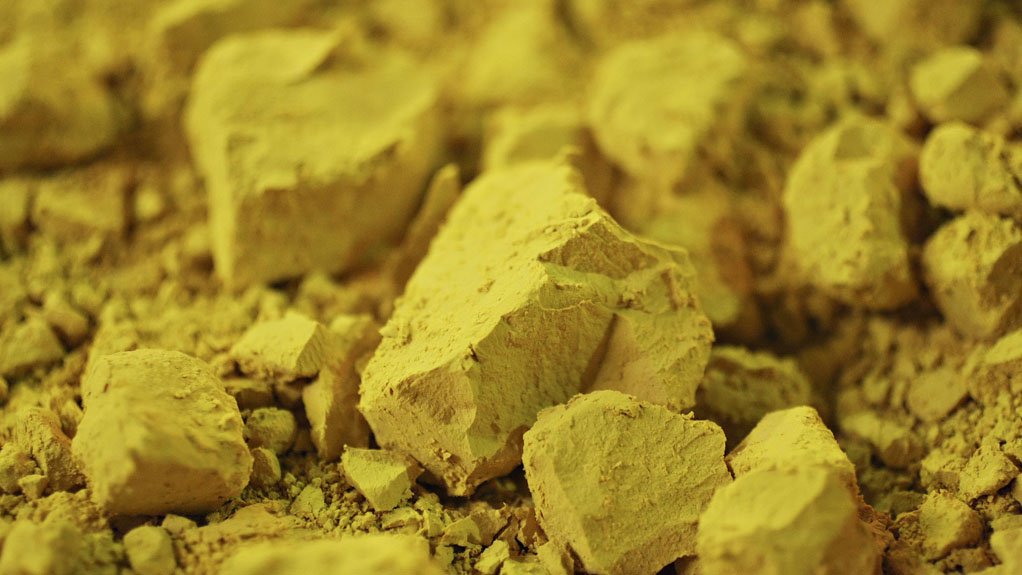


JOHANNESBURG (miningweekly.com) – The symbol U and the atomic number 92 are once again among the energy elements being looked at with greater intensity amid global fossil fuel supply disruption and growing demand for triuranium octoxide, or U3O8, commonly known as “yellow cake”.
Coupled to the current disruption is also the aspiration for a decarbonised energy alternative, which the naturally occurring radioactive uranium can provide.
While uranium’s primary use is in nuclear power plants and South Africa mines uranium as a gold-mining byproduct, South Africa’s State-owned Koeberg nuclear power station sources its uranium from international rather than local suppliers.
Uranium is not traded in any significant volume on global commodity exchanges. Contracted selling prices are determined by pricing mechanisms that reference common industry published prices for spot and term uranium contracts and may be subject to escalating floor prices and ceiling prices. These include base-escalated, fixed-price, and market-related pricing mechanisms.
Following the 1973 oil crisis, France initiated a large State-driven pivot toward nuclear energy to secure energy independence and McKinsey & Company reports now that the US may need up to 300 gigawatts (GW) of new nuclear capacity by 2050 to keep up with the electricity demand from AI and hyperscale data centres. The US currently has a capacity of 97 GW.
McKinsey also reports that US uranium mining capacity has declined dramatically from its peak of 20 000 t of U3O8 a year in 1980. In fact, in 2023, 90% of the uranium purchased by US reactor operators came from Kazakhstan, Russia, Uzbekistan, Canada and Australia. While the US has the world’s greatest uranium demand, less than 1% is sourced from domestic mines.
The Southern African region’s insight into uranium comes largely from Namibia in general and Paladin Energy in particular, which on Wednesday, May 13, published an interim financial report recording a gross profit of $34.4-million for the nine months to March 31.
WTS Energy positions Namibia after Kazakhstan and Canada as the world’s third-largest extractor of uranium. It calculates that Kazakhstan provides 39% of global uranium, Canada 24%, and Namibia 12%, while Australia, Russia, Uzbekistan, Niger, and China also play uranium mining roles.
During the three months to March 31, Paladin reported that ramp-up of production at its Langer Heinrich mine continued, when the mine produced 1.29-million pounds of U3O8 at an average recovery rate of 92%, driven by strong processing plant performance. The completion of its ramp-up is expected by the end of the 2026 financial year.
The average price realised for 1.03-million pounds of U3O8 was $68.3/lb and the cost of production for the quarter was $40.3/lb.
The opencast Langer Heinrich, located in the Erongo region, has estimated reserves, Wikipedia reports, of 57 000 t of 0.055% uranium ore.
Also in Namibia, outside of the Paladin group, are the Rössing uranium mine, which turns 50 this year and is extending mine life to at least 2036, as well as the Husab uranium mine, formerly known as Rössing South.
Although the western central Damara Belt hosts Namibia’s best-known Rössing, Langer Heinrich and Valencia deposits, uranium has also been found in the northern Engo Valley and in the southern Namaqua Belt.
In Canada, Paladin has the Patterson Lake South project in Saskatchewan and the Michelin project in Newfoundland and Labrador.
In Australia, it has uranium exploration assets in Queensland and Western Australia.
Article Enquiry
Email Article
Save Article
Feedback
To advertise email advertising@creamermedia.co.za or click here
Research Reports

Projects
Latest Multimedia
Latest News


Showroom

CMTS is a leading, well-established EC&I contractor with 37+ years of mining and industrial experience. We execute full-scope EC&I projects with...
VISIT SHOWROOM
Multotec, recognised industry leaders in metallurgy and process engineering help mining houses across the world process minerals more efficiently,...
VISIT SHOWROOM

Press Office
Announcements
What's On
Subscribe to improve your user experience...
Option 1 (equivalent of R125 a month):
Receive a weekly copy of Creamer Media's Engineering News & Mining Weekly magazine
(print copy for those in South Africa and e-magazine for those outside of South Africa)
Receive daily email newsletters
Access to full search results
Access archive of magazine back copies
Access to Projects in Progress
Access to ONE Research Report of your choice in PDF format
Option 2 (equivalent of R375 a month):
All benefits from Option 1
PLUS
Access to Creamer Media's Research Channel Africa for ALL Research Reports, in PDF format, on various industrial and mining sectors
including Electricity; Water; Energy Transition; Hydrogen; Roads, Rail and Ports; Coal; Gold; Platinum; Battery Metals; etc.
Already a subscriber?
Forgotten your password?
Receive weekly copy of Creamer Media's Engineering News & Mining Weekly magazine (print copy for those in South Africa and e-magazine for those outside of South Africa)
➕
Recieve daily email newsletters
➕
Access to full search results
➕
Access archive of magazine back copies
➕
Access to Projects in Progress
➕
Access to ONE Research Report of your choice in PDF format
RESEARCH CHANNEL AFRICA
R4500 (equivalent of R375 a month)
SUBSCRIBEAll benefits from Option 1
➕
Access to Creamer Media's Research Channel Africa for ALL Research Reports on various industrial and mining sectors, in PDF format, including on:
Electricity
➕
Water
➕
Energy Transition
➕
Hydrogen
➕
Roads, Rail and Ports
➕
Coal
➕
Gold
➕
Platinum
➕
Battery Metals
➕
etc.
Receive all benefits from Option 1 or Option 2 delivered to numerous people at your company
➕
Multiple User names and Passwords for simultaneous log-ins
➕
Intranet integration access to all in your organisation