



Sedibeng mine, South Africa

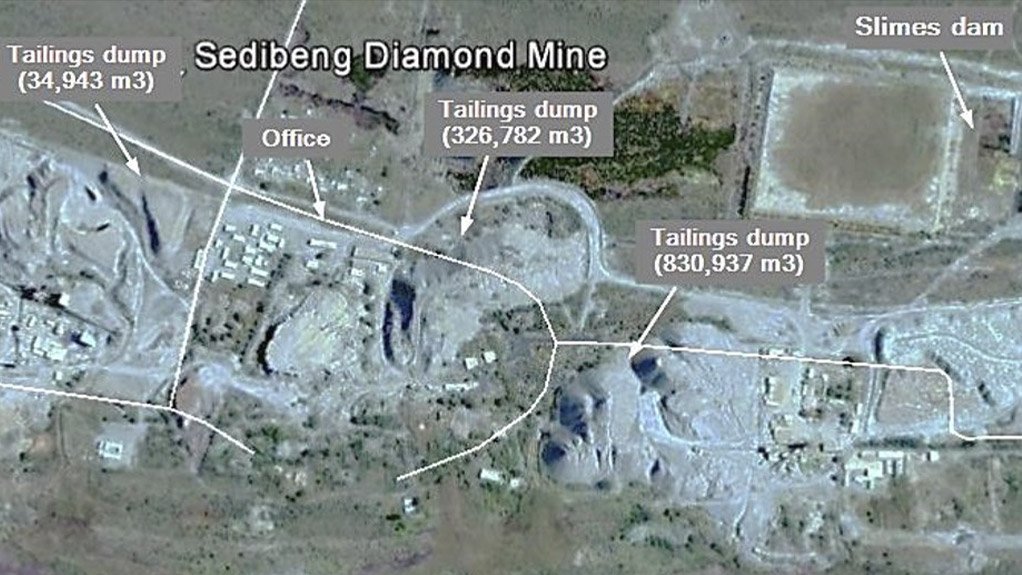


Name: Sedibeng mine.
Location: The Sedibeng mine is located about 40 km north of Delpoortshoop and 80 km west of Warrenton, in the Northern Cape, in South Africa.
Mine Owner/s: Frontier Diamonds.
Brief Description: The Sedibeng mine includes the merged historical Dancarl and Messina mines. The property comprises two mining licences – ML 12/94 and ML 1/1995 – totalling 89.62 ha.
Brief History: The Sedibeng mine has been operating for more than 60 years.
The earliest reported mining of the Bobbejaan fissure was in the 1930s, with small-scale systematic mining starting in the 1950s. Since then the mine has operated continuously.
By 1981, small-scale miners had mined the Bobbejaan fissure through five vertical shafts as deep as 275 m below surface.
Minvest acquired the northern portion of the Messina mine property in 1981. Minvest acquired an additional 200 m of strike length of the fissure to the south in 1991.
Messina Diamond Corporation acquired Minvest in December 1996 and conducted an extensive review of the operations before developing a five-year mining and development plan designed to open additional working faces and expand production.
Messina Diamonds bought the property in March 1999.
Crown Diamonds acquired the Messina mine in July 2003.
Petra Diamonds acquired the Sedibeng diamond mine from Crown Diamonds in 2005. In 2014, Sedi Diamonds acquired the project from Petra through the acquisition of Star Diamonds.
Frontier Diamonds acquired 100% of the issued capital of Sedi Star Diamonds in December 22, 2017, which, on the same date, acquired 74% of Sedi Diamonds that owned 100% interests in companies that owned the Sedibeng and Star diamond mines.
The transaction is considered as a capital reorganisation, as the controlling shareholders of Sedi Star Diamonds are the same controlling shareholders of Frontier Diamonds.
Primary Metals: Diamonds.
Secondary Metals: None stated.
Geology/Mineralisation: ML 12/94 and ML 1/1995 straddle the Bobejaan fissure. Kimberlitic fissure deposits are formed when diamond-bearing kimberlite is intruded along deep-seated fractures in the earth’s crust.
The Bobbejaan fissure is a compound structure, comprising an en echelon arrangement of vertically oriented, discus-shaped kimberlite lenses that generally range in thickness from 45 cm to 80 cm in width but barely exceed 100 cm. Each lens tapers in all directions from 100 cm at the centre to less than 20 cm at its margins, where it breaks into several dykelets or ‘horsetails’, which splay over 2 m to 3 m. Typically dyke lenses are disk-like in shape, tapering off in all directions, with 60 cm average widths, 70 m to 80 m strike lengths and about 40 m vertical extents.
The wall rocks of the fissure are reported to be quite fractured in areas of lens horsetailing and where the fissure is particularly wide. The en echelon-arranged lenses overlap and are offset from each other by 1 m to 20 m along strike, but normally less than 10 m. The units sometimes overlap in a vertical longitudinal section, although there are areas where this is not the case and an effective loss of ground occurs. Given a less complicated structure, with fewer displacements and relative continuity in longitudinal section, the Bobbejaan fissure may be considered as a single fissure with variable widths along strike and depth.
Reserves: Total mineral reserves as at June 30, 2018, were estimated at 654 000 t grading 21.6 carats per hundred tonnes.
Mining Method: Underground, using the shrinkage overhand stoping method.
Major Infrastructure and Equipment: Sedibeng has ten vertical shafts.
It also operates dense-medium separation and final recovery plants capable of treating the ore at an annualised rate of 110 000 t/h and 180 000 t/h respectively.
Prospects: Frontier plans to process previously mined tailings stockpiles at Sedibeng. The processing of tailings is simple from an operational perspective, requires minimal initial capital and ongoing expenditure to maintain, and is expected to produce up to 1 350 ct a month, ramping up to 2 250 ct a month once the second crushing circuit and slimes pipeline are completed.
Contact Details:
Frontier Diamonds
Tel +61 3 9347 2409
Email investorrelations@frontierdiamonds.com
Website www.frontierdiamonds.com
Article Enquiry
Email Article
Save Article
Feedback
To advertise email advertising@creamermedia.co.za or click here
Research Reports

Projects


Latest Multimedia


Latest News

Showroom

The Steel Tube Export Association of South Africa was established to develop sustainable, internationally competitive carbon steel tube and pipe...
VISIT SHOWROOM
Rentech provides renewable energy products and services to the local and selected African markets. Supplying inverters, lithium and lead-acid...
VISIT SHOWROOM



Press Office
Announcements
What's On
Subscribe to improve your user experience...
Option 1 (equivalent of R125 a month):
Receive a weekly copy of Creamer Media's Engineering News & Mining Weekly magazine
(print copy for those in South Africa and e-magazine for those outside of South Africa)
Receive daily email newsletters
Access to full search results
Access archive of magazine back copies
Access to Projects in Progress
Access to ONE Research Report of your choice in PDF format
Option 2 (equivalent of R375 a month):
All benefits from Option 1
PLUS
Access to Creamer Media's Research Channel Africa for ALL Research Reports, in PDF format, on various industrial and mining sectors
including Electricity; Water; Energy Transition; Hydrogen; Roads, Rail and Ports; Coal; Gold; Platinum; Battery Metals; etc.
Already a subscriber?
Forgotten your password?
Receive weekly copy of Creamer Media's Engineering News & Mining Weekly magazine (print copy for those in South Africa and e-magazine for those outside of South Africa)
➕
Recieve daily email newsletters
➕
Access to full search results
➕
Access archive of magazine back copies
➕
Access to Projects in Progress
➕
Access to ONE Research Report of your choice in PDF format
RESEARCH CHANNEL AFRICA
R4500 (equivalent of R375 a month)
SUBSCRIBEAll benefits from Option 1
➕
Access to Creamer Media's Research Channel Africa for ALL Research Reports on various industrial and mining sectors, in PDF format, including on:
Electricity
➕
Water
➕
Energy Transition
➕
Hydrogen
➕
Roads, Rail and Ports
➕
Coal
➕
Gold
➕
Platinum
➕
Battery Metals
➕
etc.
Receive all benefits from Option 1 or Option 2 delivered to numerous people at your company
➕
Multiple User names and Passwords for simultaneous log-ins
➕
Intranet integration access to all in your organisation
