



SA team makes giant leap towards a 3D quantum camera



This article has been supplied.
By improving the principle of “Ghost imaging” researchers manage to create images of an object that stays completely in the dark.
In order for anything to be seen with the human eye, it needs to be illuminated by light. However, researchers at the University of the Witwatersrand in Johannesburg, South Africa, have found a way to “see” objects that never interact with light, by improving on a hi-tech technique, called “ghost imaging”.
The researchers of the Structured Light Laboratory in the School of Physics at Wits University have found a simpler and more effective way to look at objects that stays completely in the dark by optimising ghost imaging protocols. The research has been published in the journal Optica.
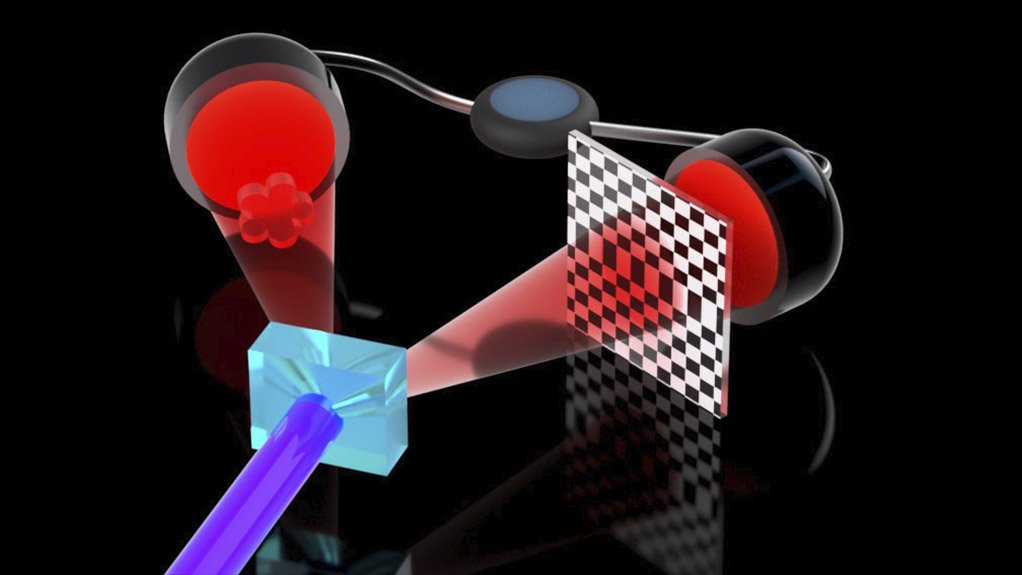
Ghost imaging is a technique used by physicists, where two “entangled” photons are used to “see” an object in the dark. Entanglement is a phenomenon where two particles, such as photons, share the same quantum properties, and, where if the properties of one of the particles are changed, the properties of its “entangled” particles are affected in the same way.
The entangled photons are created by sending light through a non-linear crystal such that one photon is destroyed to create two entangled ones. The two photons share physical properties, such as wavelength, and one of the photons are then sent through a medium to a remote area, while the other one is kept close in order to monitor it.
“We would send one of the entangled photons to the object that we want to look at in the dark, and by looking at the photon that stays with us, we can see the properties of the object in the dark,” says Bereneice Sephton, the lead author of the study.
While the technique of ghost imaging is not new to the study of quantum physics, the team enhanced the technique by adding new layers of intensity to the protocol.
“Previously, with ghost imaging it was only possible to see amplitude (whether light is going through the object in the dark), but by adjusting and adding another mask, we were able to add phase (whether light is sped up or slowed down by the object) to the technique, which makes it able to see extra information about the object.”
The technique allows researchers to interrogate samples at extremely low light or in light sensitive situations, where too much light can change or destroy the object. For instance, we expect it would be possible to reconstruct additional features arising out of phase in certain biological samples with this technique, where before, additional adjustments would have been required.
“We took the existing technique and added a way to get the phase information in a simple and stable way,” says Sephton, whose PhD study at Wits focussed on teleportation.
“It was really exciting to develop this as it was not something we initially expected to see, and it was exciting to have a team project such as this produce such great results. Sephton’s co-authors on the study were all members of the Structured Light Laboratory, Dr Isaac Nape, Chane Moodley and Jason Francis. The Structured Light Laboratory is headed by Professor Andrew Forbes.
Article Enquiry
Email Article
Save Article
Feedback
To advertise email advertising@creamermedia.co.za or click here
Research Reports

Projects


Latest Multimedia


Latest News


Showroom
Industrial Nozzles & Systems (Pty) Ltd (Est. 2000) exclusive representative in Southern Africa for LECHLER GmbH (Est. 1879) - Europe's leading...
VISIT SHOWROOM
ATI systems comprises five divisions: electrical assemblies, drives and controls, feedback sensors, enclosures, and strip guiding.
VISIT SHOWROOM



Announcements
What's On
Subscribe to improve your user experience...
Option 1 (equivalent of R125 a month):
Receive a weekly copy of Creamer Media's Engineering News & Mining Weekly magazine
(print copy for those in South Africa and e-magazine for those outside of South Africa)
Receive daily email newsletters
Access to full search results
Access archive of magazine back copies
Access to Projects in Progress
Access to ONE Research Report of your choice in PDF format
Option 2 (equivalent of R375 a month):
All benefits from Option 1
PLUS
Access to Creamer Media's Research Channel Africa for ALL Research Reports, in PDF format, on various industrial and mining sectors
including Electricity; Water; Energy Transition; Hydrogen; Roads, Rail and Ports; Coal; Gold; Platinum; Battery Metals; etc.
Already a subscriber?
Forgotten your password?
Receive weekly copy of Creamer Media's Engineering News & Mining Weekly magazine (print copy for those in South Africa and e-magazine for those outside of South Africa)
➕
Recieve daily email newsletters
➕
Access to full search results
➕
Access archive of magazine back copies
➕
Access to Projects in Progress
➕
Access to ONE Research Report of your choice in PDF format
RESEARCH CHANNEL AFRICA
R4500 (equivalent of R375 a month)
SUBSCRIBEAll benefits from Option 1
➕
Access to Creamer Media's Research Channel Africa for ALL Research Reports on various industrial and mining sectors, in PDF format, including on:
Electricity
➕
Water
➕
Energy Transition
➕
Hydrogen
➕
Roads, Rail and Ports
➕
Coal
➕
Gold
➕
Platinum
➕
Battery Metals
➕
etc.
Receive all benefits from Option 1 or Option 2 delivered to numerous people at your company
➕
Multiple User names and Passwords for simultaneous log-ins
➕
Intranet integration access to all in your organisation
