



Sovereign wealth fund may be only Zim entity able to pay for stakes in mines

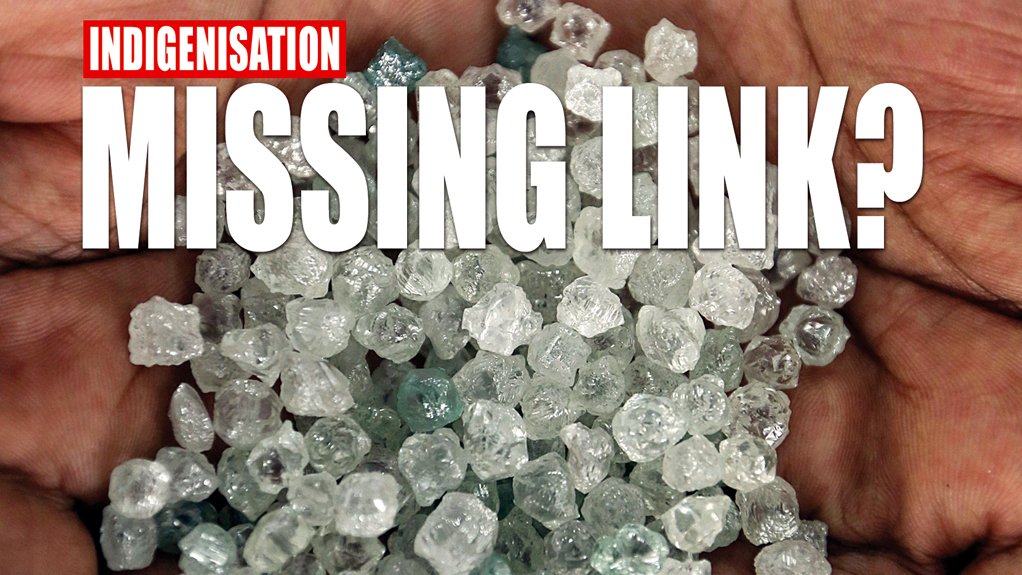


The introduction of the Sovereign Wealth Fund (SWF) by the Zimbabwe government could not have been more timeous, according to experts, as it will be used for much-needed infrastructure development.
This also comes amid investor dissatisfaction in the Zimbabwean mining industry, owing to the country’s Indigenisation and Economic Empowerment Act and mining royalties policies.
In his speech at the Zimbabwe Chamber of Mines’ (CoM’s) seventy-fourth annual general meeting in May last year, CoM president John Chikombero said the operating environment for the mining industry in 2012 was, to a large extent, similar to that of 2011: the country’s mining industry remains a primary contributor to Zimbabwe’s gross domestic product and was expected to provide impetus for economic growth.
“The high rates of royalties for gold (7%), platinum (10%) and diamonds (15%), which became effective in January 2012, increased the total operating cost of mining operations. This came at a time when the fiscal burden from other charges had also increased, resulting in a significant shift upwards in production costs. In early 2012, there was a steep increase in mining fees and charges pertaining mostly to the acquisition and maintenance of mining titles,” he said.
Zimbabwe-based law firm Nyakutombwa Mugabe Legal Counsel senior counsel Tafadzwa Ralph Mugabe explains that the deducted royalties are remitted to the Zimbabwe Revenue Authority (Zimra) on or before the tenth day of the following month. If royalties are not remitted by the deadline, interest is calculated at a rate fixed by the Minister of Finance on the outstanding amounts from the deadline to the date of payment. The commissioner-general of Zimra is also empowered to institute recovery measures in respect of any amounts not charged or remitted as prescribed.
Chikombero stated that discussing the operating environment for 2012 would not be complete without mentioning the efforts of various companies to comply with the requirements of the Indigenisation and Economic Empowerment Act, noting that CoM members were at various stages of discussions with government regarding compliance with the provisions of the Act.
The Act obliges foreign-owned companies operating in Zimbabwe to cede at least a 51% controlling stake to local partners.
African law firm Webber Wentzel partner Bruce Dickinson states that the 51% requirement by the Zimbabwe government has impacted negatively on the industry, as it has become a power struggle between government and investors.
Dickinson notes that investors feel that economic returns are being eroded and continued regulatory uncertainty is making it frustrating for investors to invest in such an environment.
“The situation becomes uneconomical and it just does not make sense for investors to invest on a large scale, particularly with the continued uncertainty. Investors simply cannot price potential investments.
“Mines regard this Act as taking away their control over the mining operations, while they are the drivers of economic growth and the providers of operating and expansion capital. This has been a constant argument by mining company owners and, as a result, it has directed the interest of foreign investors elsewhere,” he points out.
The lack of foreign investment is a challenge for Zimbabwe’s mining sector, as Mugabe stresses that the mining economy in the country largely depends on foreign investment.
“Investment has taken place through South Africa-based companies, resulting in investment growth for major platinum miners Unki, Zimplats and Mimosa. However, one cannot say the same about the holistic growth of Zimbabwe’s economy, as long as it continues to export raw platinum instead of refined platinum. Likewise, the growth of the economy is still insignificant, as long as economic participation is calculated on the basis of the number of Zimbabwean mineworkers, as opposed to Zimbabwean mine owners,” Mugabe highlights.
“Clients already invested in Zimbabwe are doing their best to deal with an ever changing policy environment; however, clients looking to invest are rather investing on a small scale with a view to getting a foot in the door or are holding off entirely until there is greater policy and regulatory certainty,” Dickinson highlights.
SOVEREIGN WEALTH FUND
The Zimbabwe government officially announced the introduction of the SWF in January 2013, noting that it would support fiscal or macroeconomic stabilisation of government, including its long-term economic and social development objectives.
At the time, government highlighted that the fund was awaiting Parliamentary approval before it was signed into law. Through the fund, the proceeds of mining royalties from gold, platinum, nickel and diamonds would be invested in gold bullion, precious stones stockpiles and other foreign assets.
“The proposed SWF will be entitled to at least 25% of all royalties collected, which are actually paid to, or are due to, the State in respect of the following minerals: gold, diamonds, coal, coal-bed methane gas, nickel, chrome and platinum, as well as other minerals, which may be specified on behalf of the Minerals Marketing Corporation of Zimbabwe and are payable by the corporation to the Consolidated Revenue Fund of Zimbabwe,” says Mugabe.
The proposed SWF expects to get a significant chunk of its finance from the mining industry, based on government’s view that the natural resources of the country should be exploited to benefit the locals and that a portion of the revenue be preserved for future generations.
In its current draft form, the SWF Bill does not introduce direct taxes or other charges for mining companies or associated businesses. The fund will receive only a portion of what miners currently pay.
“There is genuine apprehension that there may be an inclination towards collecting more from miners so that there is more for the SWF. However, indications on the ground are that this is not yet so. The SWF will have the capacity to transact as a partner in private–public partnerships. Its existence may be the missing link in empowerment transactions, as it may very well be the only Zimbabwean entity that will be able to pay for shareholding in mines,” Mugabe explains.
Dickinson believes that the SWF is a positive initiative in a country with a vast array of minerals, such as Zimbabwe, as similar funds play an important role in other countries.
“I think the SWF is a good initiative in a country with the minerals that Zimbabwe has, as similar funds play an important role in other countries. This will hopefully lead to the maintenance and development of better infrastructure, which will be positive for the mining industry. It is important for government to find a way in which it can invest the money gained from the minerals to improve the infrastructure in or economy of the country. I think it is a positive step which the Zimbabwe government has taken,” states Dickinson.
Mugabe emphasises that the fund will be a stabilising factor in the economy to the extent that there will be some savings and investments for future generations, as opposed to the hand-to-mouth economy that currently prevails.
The SWF acknowledges that taxes and royalties will never be consistent and that they cannot be the only anchor for the economy. The fund specifically aims to be a safeguard in times of poor revenue collection or poor mineral prices and, in a way, it will be a local funder of the Zimbabwe economy.
As a key example, Norway has the largest SWF worldwide – the Government Pension Fund – which currently amounts to about $838-billion, derived from its petroleum sector.
The purpose of the fund – the revenues of which are generated mainly from taxes on companies – is to invest amounts of the large surplus in exploration licences, as well as government’s direct financial interest and dividends from the partly State-owned Statoil.
Similarly, Dickinson states, Zimbabwe, through the SWF, should be looking to use the revenue generated now from mining to invest for the future development of its economy and to reduce its dependence on mining revenue – it should be turning the finite into the infinite.
Mugabe highlights that the success of Angola’s SWF speaks volumes about the Zimbabwe government’s commitment to this fund.
For example, the fund has also developed clear and strong long-term positioning that stretches beyond a short-term economic profit maximisation strategy by allocating up to 7.5% of its endowment to social development and socially responsible projects in the areas of education, income generation and off-the-grid access to clean water, healthcare and energy.
Through this approach, the fund aims to realise potential that would otherwise be overlooked, owing to a lack of investment. For instance, by allocating a portion of its funds to increase human capital, the fund will expand Angola’s capacity to develop faster and secure additional investments.
“Inasmuch as the pressing issues that pertain to compensation for repossessed land and company shares will all require funding to compensate the victims, the Zimbabwe SWF is the smartest intervention to possibly finance all these obligations,” comments Mugabe.
“The implementation of the SWF will definitely give investors hope once infrastructure developments become visible and, as a result, it can potentially change the perception of investors about the mining industry in Zimbabwe,” Dickinson mentions.
The SWF is likely to be implemented before the end of the year, says Mugabe, noting that the gazetting of this fund in December 2013, ahead of what many may perceive as the more urgent realignment law with Zimbabwe’s Constitution, reflects a heightened sense of urgency for the fund to be passed into law and implemented.
Article Enquiry
Email Article
Save Article
Feedback
To advertise email advertising@creamermedia.co.za or click here
Research Reports

Projects


Latest Multimedia

Latest News

Showroom
M and J Mining are leading suppliers of physical support systems as used by the underground mining industry. Our selection of products are not...
VISIT SHOWROOM
Astore Keymak is one of South Africa’s leading suppliers of high-quality Thermoplastic Pipeline Systems, with branches in the major provinces.
VISIT SHOWROOM



Press Office
Announcements
What's On
Subscribe to improve your user experience...
Option 1 (equivalent of R125 a month):
Receive a weekly copy of Creamer Media's Engineering News & Mining Weekly magazine
(print copy for those in South Africa and e-magazine for those outside of South Africa)
Receive daily email newsletters
Access to full search results
Access archive of magazine back copies
Access to Projects in Progress
Access to ONE Research Report of your choice in PDF format
Option 2 (equivalent of R375 a month):
All benefits from Option 1
PLUS
Access to Creamer Media's Research Channel Africa for ALL Research Reports, in PDF format, on various industrial and mining sectors
including Electricity; Water; Energy Transition; Hydrogen; Roads, Rail and Ports; Coal; Gold; Platinum; Battery Metals; etc.
Already a subscriber?
Forgotten your password?
Receive weekly copy of Creamer Media's Engineering News & Mining Weekly magazine (print copy for those in South Africa and e-magazine for those outside of South Africa)
➕
Recieve daily email newsletters
➕
Access to full search results
➕
Access archive of magazine back copies
➕
Access to Projects in Progress
➕
Access to ONE Research Report of your choice in PDF format
RESEARCH CHANNEL AFRICA
R4500 (equivalent of R375 a month)
SUBSCRIBEAll benefits from Option 1
➕
Access to Creamer Media's Research Channel Africa for ALL Research Reports on various industrial and mining sectors, in PDF format, including on:
Electricity
➕
Water
➕
Energy Transition
➕
Hydrogen
➕
Roads, Rail and Ports
➕
Coal
➕
Gold
➕
Platinum
➕
Battery Metals
➕
etc.
Receive all benefits from Option 1 or Option 2 delivered to numerous people at your company
➕
Multiple User names and Passwords for simultaneous log-ins
➕
Intranet integration access to all in your organisation
