



New mindset needed if green is to become blue


The green economy discourse in countries such as South Africa is that of a vague pessimism. Industrialists are seeing the risk of environmental restrictions standing in the way of the success of their industries, while some realised cost reductions through efficient resource use. Half-convinced policymakers are attempting to depoliticise the debate around the economic crisis with promises of growth, green jobs and poverty alleviation, while the general public cannot quite grasp whose interest the green economy is going to serve.
There are glaring contradictions globally, and not only in South Africa, in the intent of what the green economy thrives to achieve at the end. For many policymakers, it is seen as a recovery tool in resolving the problems of the economic crisis and climate change, as evident in how countries in Europe and the US packaged their response to the twin crises. South Africa goes further than that: it attempts to address its challenges of unemployment, poverty and inequality, albeit half-heartedly.
The green economy’s intent is to make our society resource efficient by recycling and reducing waste, and using energy- and resource-efficient technologies that emit less but produce more with fewer resources. Producers, in anticipation of higher economic growth in emerging economies, are continuing to mine more, as well as exploit new shale gas and tar sands energy resources. While green strategies and policies in South Africa are necessary steps to be taken, they will never be sufficient to achieve a sustainable future.
Rather than finding alternatives to plastics, for example, green-economy policies are espousing their use by stepping up plastic waste prevention, preparing for the reuse, recycling and plastic waste collection, as well as improving plastic product design. Why not find alternatives to plastics? Why produce paper by felling trees, when one can make paper from stones found in construction and mine waste sites, as proposed by ‘blue economy’ advocates.
According to Gunter Pauli, a blue economy is one in which, whatever is not consumed or wasted during production, is taken up by another process. For example, the waste from instant coffee production is used in odour control in textiles (clothing, car seats, and refrigerators), while new coffee roasting machines in individual homes allows coffee farmers to directly sell green beans for the price of roasted beans, thus increasing their own revenues. So alternatives made from wastes can be obtained from our current production and consumption processes. The intention is to make more from what we already have and prevent the use of resources that are scarce, or environmentally expensive to discover and extract.
Although it has emerged out of the limitations of the green economy, the thinking around the blue economy requires a totally different mindset. A sustainable future requires changing wasteful modes of consumption and production, in turn, implying changing the fundamentals of doing green business. Pauli believes that it is possible to feed 12-billion people and that “there are no limits to growth – but there are limits to growth with the present business model”. The blue economy rests on the premise of sufficiency in consumption and production, while the green economy conviction of “more and more” should be abandoned.
The intent of the “present business model” of the green economy to achieve sustainable development is lost as an oversight for it places the economy, and economic gains with it, at the centre of the current environmental crisis’ resolution. The very forces that caused the economic crisis, markets and capital, are being identified as guideposts. And market-based instruments that put a price on carbon and trading, and principals of market capitalism, are continuing to promote green technologies and commoditising nature.
A sustainable future also urges the need to change our social and economic power relations. The green economy is reinforcing existing social and economic power relations that favour the economically powerful and thrives on economies of scale. In South Africa there is no perceivable attempt to change power relations in the energy and large industrial sectors. Financial markets and institutions are continuing to favour large energy incumbents and organisations, and its institutions and technologies have locked-in its growth path to the economics of large-scale fossil fuel utilisation. And although financial mechanisms to drive renewable-energy projects and technologies in the country are being proposed, they largely favour large-scale renewable-energy projects and companies.
Power relations of such nature eventually dictate a political-will that is deeply embedded in our economic, ecological and social structures. These structures will need revisiting for a more balanced power relation, and political-will greatly leveraged if the goal of a sustainable future is to be achieved.
Continuing to operate with our current economic modes of production and consumption, social and ecological considerations will forever remain unresolved contradictions. The green economy should only be a means to sustainable development and not an end in achieving economic gains. And in the progression towards a sustainable future, the green and blue economies will need to co-exist for a while, for new ideas and novel practices will not magically spring into existence and replace dominant practices and power structures overnight.
The green discourse in South Africa has to be confronted with public critique, direct and transparent interactions between the public and government, and the impact of socioecological movements and ‘blue’ ideas should be amplified. Questions such as, how the objectives of the green economy should be achieved, and whose interest will it serve will need to be continually asked by the public for a more balanced power relationship between the economic, ecological and social actors. It is these questions that will lead us to the opportunities of the blue economy.
Article Enquiry
Email Article
Save Article
Feedback
To advertise email advertising@creamermedia.co.za or click here
Research Reports

Projects


Latest Multimedia

Latest News
Showroom
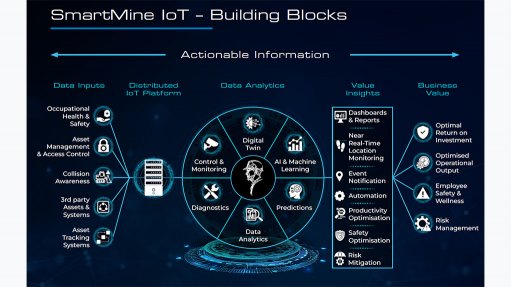
SmartMine IoT has been developed with the mining industry in mind, to provides our customers with powerful business intelligence and data modelling...
VISIT SHOWROOM
Rentech provides renewable energy products and services to the local and selected African markets. Supplying inverters, lithium and lead-acid...
VISIT SHOWROOM



Press Office
Announcements
What's On
Subscribe to improve your user experience...
Option 1 (equivalent of R125 a month):
Receive a weekly copy of Creamer Media's Engineering News & Mining Weekly magazine
(print copy for those in South Africa and e-magazine for those outside of South Africa)
Receive daily email newsletters
Access to full search results
Access archive of magazine back copies
Access to Projects in Progress
Access to ONE Research Report of your choice in PDF format
Option 2 (equivalent of R375 a month):
All benefits from Option 1
PLUS
Access to Creamer Media's Research Channel Africa for ALL Research Reports, in PDF format, on various industrial and mining sectors
including Electricity; Water; Energy Transition; Hydrogen; Roads, Rail and Ports; Coal; Gold; Platinum; Battery Metals; etc.
Already a subscriber?
Forgotten your password?
Receive weekly copy of Creamer Media's Engineering News & Mining Weekly magazine (print copy for those in South Africa and e-magazine for those outside of South Africa)
➕
Recieve daily email newsletters
➕
Access to full search results
➕
Access archive of magazine back copies
➕
Access to Projects in Progress
➕
Access to ONE Research Report of your choice in PDF format
RESEARCH CHANNEL AFRICA
R4500 (equivalent of R375 a month)
SUBSCRIBEAll benefits from Option 1
➕
Access to Creamer Media's Research Channel Africa for ALL Research Reports on various industrial and mining sectors, in PDF format, including on:
Electricity
➕
Water
➕
Energy Transition
➕
Hydrogen
➕
Roads, Rail and Ports
➕
Coal
➕
Gold
➕
Platinum
➕
Battery Metals
➕
etc.
Receive all benefits from Option 1 or Option 2 delivered to numerous people at your company
➕
Multiple User names and Passwords for simultaneous log-ins
➕
Intranet integration access to all in your organisation
