



MeerKAT again achieves an astronomical advance, imaging an ORC

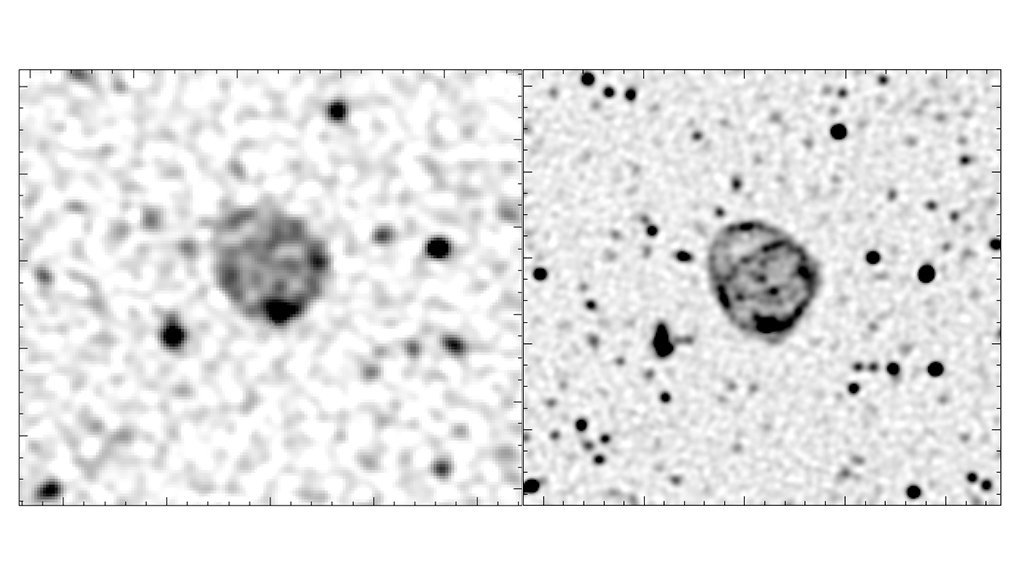
Left: the ASKAP image of ORC1; right: the much higher resolution MeerKAT image of ORC1.
Photo by SARAO & CSIRO


South Africa’s MeerKAT radio telescope array has achieved a major follow-up to a most significant discovery made by Australia’s ASKAP radio telescope array. MeerKAT has secured the highest resolution radio-wave image to date of an ‘odd radio circle’ (ORC), a still-unexplained phenomenon, originally discovered by ASKAP. The new image from MeerKAT has been published in the Monthly Notices of the Royal Astronomical Society.
“[T]he ORC project is a great example of the clever use of MeerKAT by its users, playing to its strengths: ASKAP observes large swathes of the sky and can discover relatively rare types of objects; MeerKAT can then follow up to study them in greater detail,” highlighted South African Radio Astronomy Observatory Chief Scientist Dr Fernando Camilo. Both MeerKAT and ASKAP are precursors of the international Square Kilometre Array (SKA) radio telescope (indeed, the name ASKAP comes from Australian SKA Precursor), which will be co-hosted by South Africa and Australia.
So far, only five ORCs have been discovered. (The new MeerKAT image is of ORC1.) They can only be detected on the radio wavelengths of the electromagnetic spectrum; astronomers searching for them on the visual light, infrared and X-ray wavelengths have not yet found any sign of them.
“We know ORCs are rings of faint radio emissions surrounding a galaxy with a highly active black hole at its centre, but we don’t yet know what causes them, or why they are so rare,” reported study co-author, (Australian) Commonwealth Scientific and Industrial Research Organisation and Western Sydney University scientist Professor Ray Norris. “No doubt the SKA telescopes, once built, will find many more ORCs and be able to tell us more about the lifecycle of galaxies.”
ORCs are enormous: they have a diameter of about a million light years, which is 16 times that of our own galaxy, the Milky Way. But because they are faint, they are hard to detect.
There are currently three main theories concerning the origin of ORCs. One is that they could be the aftereffect of a huge explosion at the centres of their galaxies (such as would happen if two supermassive black holes merged). The second theory is that they are created by powerful jets of energetic particles spewed out of their galactic centres. The third theory is that they are the result of a ‘starburst termination shock’, resulting from the intense production of stars in a galaxy. (A termination shock is a standing shock wave in space, where the solar wind of a star, or in this case, the combined solar winds of many stars, encounters the interstellar or intergalactic medium of dust and gas and is decelerated to subsonic speeds.)
Article Enquiry
Email Article
Save Article
Feedback
To advertise email advertising@creamermedia.co.za or click here
Research Reports

Projects

Latest Multimedia
Latest News

Showroom

As one of South Africa's leading manufacturers, Bell Equipment distributes and exports its wide range of heavy equipment globally to mining,...
VISIT SHOWROOM
We supply customers with practical affordable solutions for their testing needs. Our products include benchtop, portable, in-line process control...
VISIT SHOWROOM

Announcements
What's On
Subscribe to improve your user experience...
Option 1 (equivalent of R125 a month):
Receive a weekly copy of Creamer Media's Engineering News & Mining Weekly magazine
(print copy for those in South Africa and e-magazine for those outside of South Africa)
Receive daily email newsletters
Access to full search results
Access archive of magazine back copies
Access to Projects in Progress
Access to ONE Research Report of your choice in PDF format
Option 2 (equivalent of R375 a month):
All benefits from Option 1
PLUS
Access to Creamer Media's Research Channel Africa for ALL Research Reports, in PDF format, on various industrial and mining sectors
including Electricity; Water; Energy Transition; Hydrogen; Roads, Rail and Ports; Coal; Gold; Platinum; Battery Metals; etc.
Already a subscriber?
Forgotten your password?
Receive weekly copy of Creamer Media's Engineering News & Mining Weekly magazine (print copy for those in South Africa and e-magazine for those outside of South Africa)
➕
Recieve daily email newsletters
➕
Access to full search results
➕
Access archive of magazine back copies
➕
Access to Projects in Progress
➕
Access to ONE Research Report of your choice in PDF format
RESEARCH CHANNEL AFRICA
R4500 (equivalent of R375 a month)
SUBSCRIBEAll benefits from Option 1
➕
Access to Creamer Media's Research Channel Africa for ALL Research Reports on various industrial and mining sectors, in PDF format, including on:
Electricity
➕
Water
➕
Energy Transition
➕
Hydrogen
➕
Roads, Rail and Ports
➕
Coal
➕
Gold
➕
Platinum
➕
Battery Metals
➕
etc.
Receive all benefits from Option 1 or Option 2 delivered to numerous people at your company
➕
Multiple User names and Passwords for simultaneous log-ins
➕
Intranet integration access to all in your organisation
