



Khumani mine, South Africa

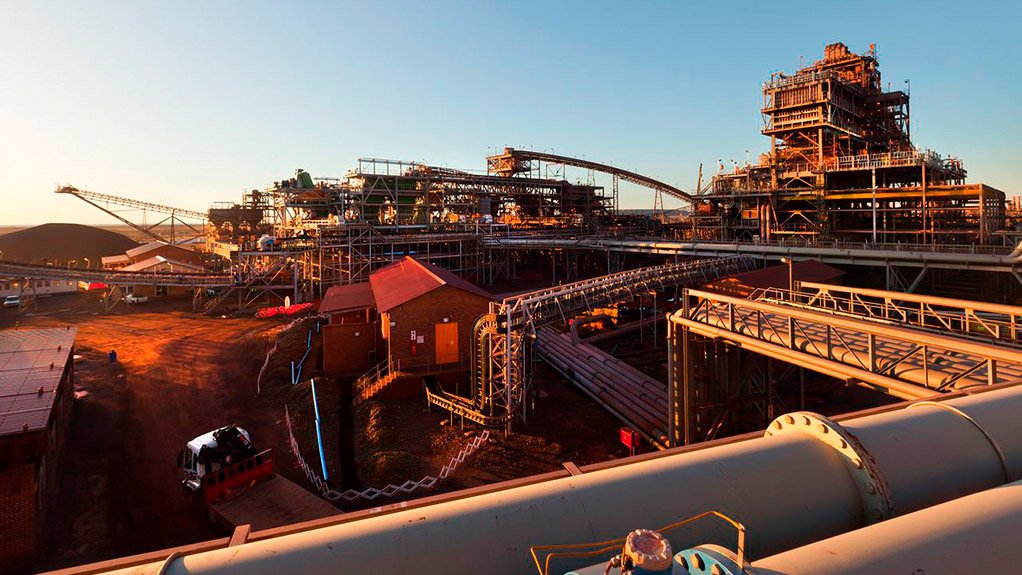


This article has been supplied.
Name: Khumani mine.
Location: Khumani mine is located 30 km south of Kathu, and about 65 km north of Assmang’s Beeshoek mine, in the Northern Cape, South Africa.
Holding and Controlling Company: Assmang, a joint venture between Assore and African Rainbow Minerals (ARM).
Brief Description: Khumani has quality ore and a mine life of up to 35 years, at 16-million tonnes per year.
The Khumani replaced the older Beeshoek mine as the main iron-ore producer for Assmang.
The ARM and Assore board of directors approved additional expenditure of R5.5- billion in August 2009 for the completion of the Khumani expansion project, which increased Khumani’s capacity from ten-million tonnes a year to 16-million tonnes a year.
Iron-ore mined at Khumani is exported through the Saldanha Bay iron-ore bulk terminal.
Brief History: Construction at the Khumani mine started on October 5, 2006.
The first blast took place in May 2007, which dislodged about 600 000 t of ore for collection and treatment. The infrastructure packages progressed well, and by October 2007, parts of the plant were ready for cold commissioning.
Hot commissioning, which is the last major primary testing phase, began at the end of 2007. The first consignment of ore was delivered to the Bruce primary crusher in December 2007.
The on- and off-grade screening plants were ready to treat ore by late 2007, while construction of the jigs and high-pressure grinding roll sections were still in progress.
The jig plants were the last element to be finalised and commissioning took place in July 2008. Assmang brought Khumani to the development and ramp-up stage in early 2008.
Products: Iron-ore.
Geology/Mineralisation: The Khumani iron-ore deposits are contained within a sequence of early Proterozoic sediments of the Transvaal Supergroup, deposited between 2.5-billion and 2.2-billion years ago.
Laminated hematite ore forms part of the Manganore iron formation and conglomerate ore forms part of the Doornfontein Conglomerate Member at the base of the Gamagara formation.
Erosion of the northern Khumani deposit is less than that of the southern Beeshoek area, which leads to Khumani being characterised by larger stratiform bodies and prominent hanging wall outcrops. The downward-dip portions are well preserved and developed, but in the outcrops, the deposits are thin and isolated.
Reserves: Total proven and probable reserves as at June 30, 2016, were estimated at 426.01-million tonnes grading at 64.39% iron-ore.
Stockpiles as at June 30, 2016, were estimated at 4.45-million tonnes grading at 60% iron-ore.
Resources: Total resources as at June 30, 2016, were estimated at 571.14-million tonnes grading at 64.3% iron-ore.
Mining Method: Openpit.
Major Infrastructure and Equipment: The iron-ore is mined from openpits using conventional drilling and blasting, and is then loaded onto trucks, followed by hauling to either of the Bruce and King primary and secondary crushing facilities.
Overland conveyors are used to transfer the ore and it is stockpiled onto blending beds that divides the material into on- and off-grade material, before reaching the Parsons beneficiation plant.
On-grade material is moved from the on-grade stockpile through to the washing and screening plant to produce final product that contains tertiary crushing of any oversize material from the screening plant.
Any oversized material is crushed in the tertiary crushers, and beneficiated through jigging to remove any contaminants. The final products are stockpiled on the lumpy or fines product stockpiles before loading them onto 342 wagon trains.
Prospects: Khumani is the major contributor to the economy of the Northern Cape, and have a strong demand for the next four years.
The design work for the ultra-fines recovery circuit is complete and the capital is approved. This project will allow for the recovery of additional iron-ore units from the tailings streams, which will see the production of an additional 250 000 t/y of iron-ore.
Contact: ARM Corporate office and Assore Finance manager Ross Davies
Contact Details:
ARM
Tel +27 11 779 1300
Email mailto:ir.admin@arm.co.za
Website http://www.arm.co.za/
Assore
Tel +27 11 770 6815
Email http://rossdavies@assore.com
Website http://www.assore.com/
Article Enquiry
Email Article
Save Article
Feedback
To advertise email advertising@creamermedia.co.za or click here
Research Reports

Projects


Latest Multimedia


Latest News

Showroom

The Steel Tube Export Association of South Africa was established to develop sustainable, internationally competitive carbon steel tube and pipe...
VISIT SHOWROOM
Rentech provides renewable energy products and services to the local and selected African markets. Supplying inverters, lithium and lead-acid...
VISIT SHOWROOM



Press Office
Announcements
What's On
Subscribe to improve your user experience...
Option 1 (equivalent of R125 a month):
Receive a weekly copy of Creamer Media's Engineering News & Mining Weekly magazine
(print copy for those in South Africa and e-magazine for those outside of South Africa)
Receive daily email newsletters
Access to full search results
Access archive of magazine back copies
Access to Projects in Progress
Access to ONE Research Report of your choice in PDF format
Option 2 (equivalent of R375 a month):
All benefits from Option 1
PLUS
Access to Creamer Media's Research Channel Africa for ALL Research Reports, in PDF format, on various industrial and mining sectors
including Electricity; Water; Energy Transition; Hydrogen; Roads, Rail and Ports; Coal; Gold; Platinum; Battery Metals; etc.
Already a subscriber?
Forgotten your password?
Receive weekly copy of Creamer Media's Engineering News & Mining Weekly magazine (print copy for those in South Africa and e-magazine for those outside of South Africa)
➕
Recieve daily email newsletters
➕
Access to full search results
➕
Access archive of magazine back copies
➕
Access to Projects in Progress
➕
Access to ONE Research Report of your choice in PDF format
RESEARCH CHANNEL AFRICA
R4500 (equivalent of R375 a month)
SUBSCRIBEAll benefits from Option 1
➕
Access to Creamer Media's Research Channel Africa for ALL Research Reports on various industrial and mining sectors, in PDF format, including on:
Electricity
➕
Water
➕
Energy Transition
➕
Hydrogen
➕
Roads, Rail and Ports
➕
Coal
➕
Gold
➕
Platinum
➕
Battery Metals
➕
etc.
Receive all benefits from Option 1 or Option 2 delivered to numerous people at your company
➕
Multiple User names and Passwords for simultaneous log-ins
➕
Intranet integration access to all in your organisation
